Introduction
Dog ear infections are painful, common, and often more complicated than they first appear. Many owners search for the “best antibiotic for dog ear infection” because they want a fast solution. That instinct makes sense, but the real answer is more precise. There is no single best Antibiotic for every dog ear infection. The right treatment depends on what is causing the problem. How deep does the infection go? Whether bacteria or yeast are involved, and whether the eardrum is intact. In many cases, the correct treatment is not even an antibiotic alone. Vets may use topical ear medicine. Antifungal therapy. anti-inflammatory medication. Oral drugs, when the infection is deeper or has spread beyond the outer ear canal.
For dog owners, the most useful mindset is not “What is the strongest antibiotic?. But “What is the correct diagnosis?. That distinction matters because otitis externa is the medical term for outer ear canal inflammation. Is one of the most common ear problems in dogs. And the signs can look similar, whether the trigger is bacteria. Yeast, parasites, allergies, or a foreign body. VCA and the MSD Veterinary Manual both stress that treatment depends on the specific diagnosis. And that the underlying cause must be addressed to stop the cycle from returning.
Introduction – Why Dog Ear Infections Are So Common
Otitis externa is common because the dog’s ear canal is warm. Narrow space that can trap moisture, wax, debris, and inflammatory material. Dogs with floppy, hairy, or poorly ventilated ears tend to be at higher risk. But any breed can develop an infection. VCA notes that breeds such as cocker spaniels. Miniature poodles and Old English sheepdogs are more prone, yet the condition is not limited to them. Ear pain, scratching, head shaking, redness, and discharge. And odor is a typical sign, and chronic cases may develop thickening or narrowing of the canal.
A dog’s ear health is often tied to a bigger medical picture. Allergies are a major contributor, and VCA reports that allergies are involved in as many as 43% of ear infection cases. Especially recurrent ones. Food allergies are also strongly associated with repeated ear trouble. Hormonal disorders such as hypothyroidism can contribute as well. which is why repeated infections. Should never be treated as isolated events. When the root cause is missed, the infection often comes back even after temporary improvement.
For many dogs, ear infections begin as irritation rather than a true deep infection. Moisture from swimming and bathing. Rainy weather or routine scratching can set off inflammation, and then bacteria or yeast take advantage of the damaged environment. That is why the best long-term strategy is not only to kill microbes. But also to reduce inflammation, clean the ear correctly, and manage the trigger that started the problem in the first place. BSAVA has also highlighted that antibacterial treatment can be followed by yeast overgrowth in some cases, which reinforces the need for diagnosis rather than guesswork.
What is the Best Antibiotic for a dog’s ear infection?
The most important truth is simple: there is no universal best antibiotic for dog ear infection. The best medication is the one that matches the cause of the infection, the depth of the disease, and the condition of the eardrum. In many dogs, treatment begins with a topical prescription ear preparation rather than an oral antibiotic, because medication placed directly in the ear canal can act where the problem is located. In other cases, especially when middle ear involvement is suspected, oral therapy becomes necessary.
Merck Veterinary Manual explains that systemic antimicrobials are not required for uncomplicated otitis externa, but they should be used when otitis media is suspected. It also notes that treatment must be chosen based on cytology or culture, because some gram-negative organisms do not respond well to standard first-line dermatologic antibiotics. That is why a drug that works well in one dog may fail completely in another.
In practical terms, the “best” treatment often means a combination approach. Vets frequently prescribe a product that targets bacteria, another ingredient that addresses yeast if present, and a steroid or similar anti-inflammatory agent to reduce swelling and discomfort. AVMA journal discussion of recurrent otitis externa similarly emphasizes cleaning, topical antimicrobial therapy, and topical or systemic glucocorticoids tailored to the individual patient.
Why There Is No Single “Best Antibiotic”
Dog ear infections are not one disease. They are a category of problems with different causes and different tissue depths. A dog may have a bacterial infection, a yeast overgrowth, mites, allergic inflammation, a foreign body, a ruptured eardrum, or even chronic structural changes in the ear canal. If the cause is wrong, the medication is wrong. And when the medicine is wrong, the dog may only improve temporarily, or not at all.
This is also why the same ear can need a different treatment plan at different times. A mild, superficial infection may respond well to topical therapy and cleaning, while a severe or chronic infection may need repeated checks, culture testing, and possibly oral medication. Merck notes that chronic cases can take months to resolve and sometimes require indefinite maintenance therapy. That long timeline is one reason many veterinarians are careful about starting treatment without a diagnosis.
There is another important reason to avoid random antibiotic use: resistance and secondary imbalance. BSAVA has reported that broad antibacterial monotherapy can promote Malassezia overgrowth in canine otitis externa/media. In plain language, using the wrong antibacterial strategy can create a new problem while trying to solve the first one. That is one more reason vets focus on cytology, not assumptions.
How Vets Diagnose Ear Infections
A proper diagnosis usually starts with a visual ear exam and an otoscopic inspection. If the canal is too swollen, full of debris, or too painful to examine, sedation or general anesthesia may be needed so the veterinarian can look deeply enough to assess the problem. VCA notes that microscopic examination of ear material is essential to choose the right medication, and that culture and susceptibility testing are often used in severe or chronic infections.
This step matters because the appearance of the ear does not reliably tell the full story. Redness, odor, discharge, and itching can be seen with bacterial infections, yeast infections, ear mites, foreign bodies, or mixed disease. VCA specifically warns that symptoms may resemble ear mites and that ear mites can create conditions that lead to secondary bacterial or fungal infection. A veterinarian must identify the exact cause before choosing therapy.
When the infection seems severe, recurrent, or unusually painful, the vet may broaden the workup. Merck notes that if otitis media is suspected, CT or MRI can help determine whether myringotomy and middle ear flushing are needed, and middle ear samples can be collected for cytology and culture. This is a deeper diagnostic step, but it is often necessary when the disease has moved beyond the outer canal.
Most Common Antibiotic and Medication Approaches for Dog Ear Infection
The most common first-line approach for outer ear infection is topical prescription therapy. This may contain an antibiotic, an antifungal, and a steroid in one product, which allows treatment of multiple processes at once. VCA explains that medications may be prescribed specifically for bacteria or fungi, and some products combine both with an anti-inflammatory agent. Merck adds that yeast otitis typically responds well to topical therapy that includes an antifungal and a steroid to reduce inflammation.
Topical treatment is often preferred because it delivers medication directly to where the disease lives. It is also useful when the infection is confined to the external ear canal, and the eardrum is intact. In those situations, local treatment may work better than oral medication alone, because it reaches the surface tissues more directly. When the canal is extremely swollen or obstructed, however, the medicine may not penetrate well enough, and the vet may need to adjust the plan.
For more advanced disease, oral medication may be needed. VCA notes that oral antibiotics such as amoxicillin-clavulanate, enrofloxacin, cefpodoxime, and marbofloxacin may be used in middle ear infections, along with antifungals such as ketoconazole or itraconazole in many cases. Oral corticosteroids may also be helpful when inflammation and pain are severe. These are not “better” than ear drops in every case; they are simply more appropriate in deeper or more complex disease.
Topical Antibiotic Ear Drops: Often the First Choice
Topical ear medications are frequently the most practical starting point for uncomplicated otitis externa. They work in the ear canal itself, where bacteria and yeast often multiply, and they can reduce local inflammation at the same time. In many dogs, this brings faster relief than an oral drug alone because the medicine is applied where the infection is active.
The important caution is that topical treatment should not be chosen blindly. VCA warns against treating ear symptoms with over-the-counter ear drops without a proper diagnosis. The problem may be bacteria, fungi, mites, a foreign body, a polyp, or a tumor, and some medications can be harmful if the eardrum is damaged. A correct diagnosis protects both treatment success and hearing safety.
Some dogs also need a medication specifically designed for longer-term control of severe inflammation or resistant organisms. Merck notes that chronic otitis externa with severely stenotic ears may require high-dose corticosteroid support to help preserve medical management, although this cannot be continued indefinitely because of adverse effects. That kind of decision belongs in a veterinarian’s hands, not in home treatment experiments.
Oral Antibiotics: For Deep, Severe, or Middle Ear Infections
Oral antibiotics are not the default answer for every dog with a sore ear. They are more appropriate when the disease is deeper, the ear canal is so inflamed that topical drug penetration is poor, or when otitis media is suspected. Merck is explicit that systemic antimicrobials are not required for otitis externa itself, but are indicated when the middle ear is involved.
When middle ear disease is present, the treatment often becomes longer and more intensive. VCA notes that middle ear infections may be treated with oral antibiotics or antifungal medications for four to six weeks, with close follow-up. A dog with a ruptured eardrum may also need flushing and specialist-level care, because the canal and middle ear need to be cleared safely.
Oral therapy has a role, but it is not a shortcut. It can be the right choice when the infection has gone beyond the surface, but it still needs to be matched to the organism and the clinical picture. That is why culture, microscopy, and rechecks matter so much in recurrent or resistant disease.
Combination Medications: Often the Smartest Option
Combination prescription medications are common in modern ear care because many cases involve more than one problem at once. A dog may have bacteria, yeast, and inflammation all at the same time. In those situations, a product that combines antimicrobial and anti-inflammatory ingredients can be more efficient than using several separate treatments. VCA states that some medications combine antibiotics and antifungals with an anti-inflammatory agent.
This Approach is especially useful when the ear is red, painful, and full of discharge, because the treatment not only suppresses microbes. It also calms the inflamed lining of the ear canal, which can improve comfort and allow the medication to work more effectively. In other words, combination therapy often treats the infection and the inflammation together rather than chasing one symptom at a time.
Combination treatment is also part of good stewardship. If a veterinarian suspects yeast plus bacteria, treating only the bacteria can leave the yeast untreated or even allow it to expand. BSAVA’s reporting on fungal dysbiosis after antibacterial monotherapy supports the idea that mixed ear disease deserves mixed thinking.
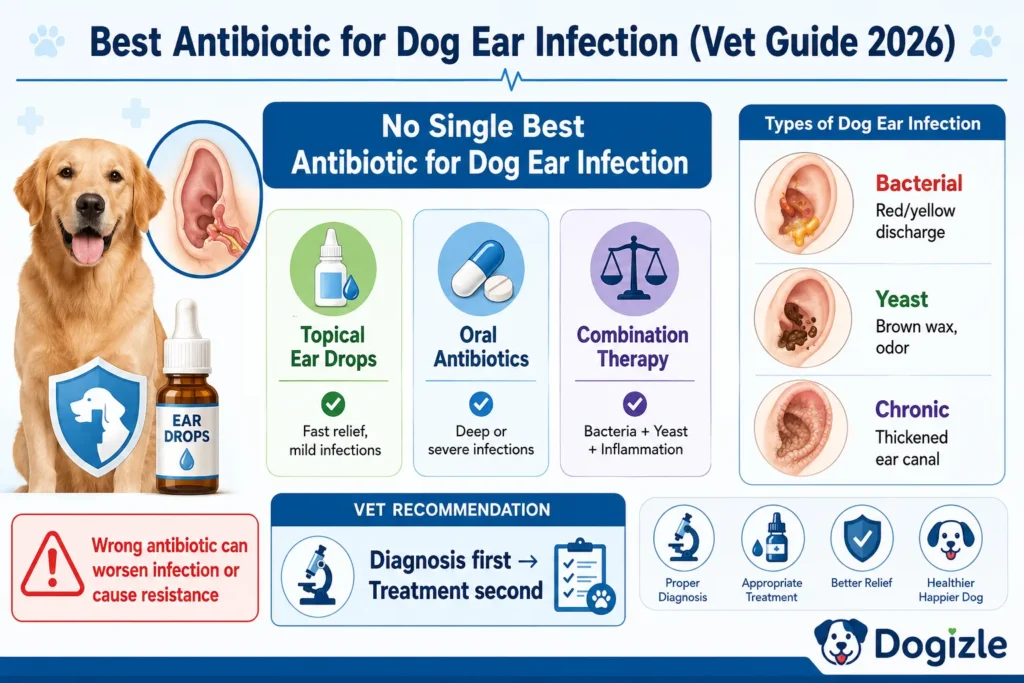
This vet-approved infographic explains why there is no single best antibiotic and shows the correct treatment options including ear drops, oral medication, and combination therapy. Learn symptoms, risks, and the importance of proper diagnosis before treatment.
Types of Dog Ear Infections: This Changes the Medicine
A bacterial ear infection usually causes redness, odor, discharge, pain, and head shaking. VCA describes black or yellowish discharge, a bad smell, and inflamed canals as common clinical signs. These cases often respond to antibacterial therapy chosen by a veterinarian after an exam and, when needed, cytology or culture.
A yeast ear infection can look similar, but it often needs antifungal treatment instead of antibiotics alone. Merck states that yeast otitis typically responds well to topical therapy that includes an antifungal and a steroid to help decrease inflammation. This is one of the biggest reasons guessing can backfire: if the discharge is yeast-driven, an antibiotic-only plan may miss the real cause.
Chronic ear infections are a separate challenge. They often involve tissue thickening, narrowing of the canal, persistent pain, and sometimes hearing problems. Merck notes that chronic cases may be associated with severe pain, edema, epithelial ulceration, and resistance problems, particularly when methicillin-resistant Staphylococcus pseudintermedius or Pseudomonas aeruginosa are involved. These cases can take months to settle and sometimes require ongoing maintenance.
Why Vets Often Swab the Ear
Ear swabs and cytology are not optional extras; they are often central to the diagnosis. They help show whether the problem is bacteria, yeast, inflammatory debris, or a mixture. VCA says microscopic examination is essential to choose the correct medication, and that culture and susceptibility testing are often used in severe or chronic cases. That is especially important when the infection has not responded to prior treatment.
A swab also helps prevent unnecessary medication use. If a dog has a yeast infection, an antibiotic alone may not help and may make the microbial balance worse. If the dog has resistant bacteria, a standard drug may fail. So the issue is a foreign body or a ruptured eardrum; medication alone is not enough. Diagnosis narrows the possibilities so treatment becomes targeted rather than wasteful.
In a more serious disease, the sample may need to come from the middle ear rather than the external ear canal, because external debris can be contaminated. MSD and Merck both support the idea that otitis media may require imaging and deeper sampling. That is one reason repeated or stubborn infections deserve further workup instead of repeated guesswork.
How Long Do Dog Ear Infections Take to Heal?
The timeline depends on severity, the underlying cause, and whether the dog is treated early. Merck states that many acute cases resolve in about 2 to 4 weeks, while chronic cases can take months and may require ongoing maintenance. Middle ear infections may require four to six weeks or more of treatment, with rechecks to ensure the problem is actually resolving.
The ear canal heals best when the cause is handled early. If the infection is linked to allergies, moisture, parasites, or structural changes, those factors must be corrected, or the dog may relapse. VCA emphasizes that if an underlying disease remains unidentified and untreated, the outcome is less favorable, and several recheck exams may be needed.
This is why “how fast will it heal?” is not always a question with a simple answer. Some dogs improve quickly after the correct medication is started, while others need a staged approach, repeated cleaning, and follow-up microscopy before the ear is truly clear.
Risks of the Wrong Antibiotic
The first risk is treatment failure. If the cause is yeast, parasites, or a foreign body, the dog is exposed to medication without solving the real problem. That delays healing and keeps the ear inflamed. VCA warns that the exact cause must be diagnosed so the right treatment can be selected.
The second risk is resistance. Merck notes that resistant organisms such as methicillin-resistant Staphylococcus pseudintermedius and Pseudomonas aeruginosa are frustrating causes of otitis externa, often linked to chronic disease and severe canal damage. Misuse of antimicrobials makes these problems harder to solve.
The third risk is harm to the ear itself. VCA warns that if the eardrum is ruptured, certain medications can cause hearing loss. That is why veterinary examination matters before any medication is placed into the ear canal. A home attempt that seems harmless can become dangerous if the membrane is not intact.
Can You Treat a Dog Ear Infection at Home?
A dog with a mildly irritated ear may need supportive care, but home care should be limited to vet-approved steps. VCA advises that if the ears are red, inflamed, or painful, you should consult a veterinarian before cleaning because the dog may have an ear infection or a ruptured eardrum. That guidance is important because not every itchy ear is safe for home cleaning.
When a vet has already diagnosed the condition, home care usually means following the cleaning and medication plan exactly. VCA explains that the ears should be cleaned first, then medication applied, although some cleansers may weaken certain medicines, so timing should be confirmed with the veterinarian. The point is not to improvise; the point is to follow the prescribed sequence carefully.
What should not be done at home is equally important. Human ear drops, random antibiotic tablets, and DIY herbal mixtures are poor substitutes for veterinary diagnosis. They can mask symptoms, irritate the canal, or simply fail to treat the real infection. The safest home role is support, not substitution.
Safe Ear Cleaning Matters More Than Most Owners Realize
Correct ear cleaning can help treatment work better, but incorrect cleaning can make things worse. VCA recommends filling the canal with cleaning solution, massaging the base of the ear, allowing the dog to shake, and then wiping away loosened debris with gauze or cotton. The page also warns not to insert a cotton-tipped applicator deep into the ear canal because it can damage the canal or eardrum or push debris deeper.
Cleaning is especially important when medication must reach the canal lining. If debris blocks the pathway, treatment may not penetrate well. But cleaning should always be gentle and appropriate to the dog’s pain level. If the dog is uncomfortable or reacts strongly, the cleaning should stop, and the vet should be contacted.
For dogs with recurrent infections, regular ear care can be part of prevention, but over-cleaning is not helpful. A balanced routine, based on the dog’s breed, ear shape, allergy status, and vet guidance, is usually better than constant cleaning.
European Dog Care Factors
For dog owners in Europe, the same medical principles still apply: diagnose the cause, treat the right pathogen, protect the eardrum, and control the underlying trigger. Local veterinary prescription rules may differ by country, but the clinical logic does not change. Specialist dermatology and small animal veterinary groups such as ECVD and BSAVA exist specifically to support this level of care.
The reason this matters in a pillar article is simple: ear infections are not “just dirty ears.” They are a dermatologic and sometimes systemic problem. ECVD describes veterinary dermatology as a specialty that includes diseases affecting the ears, and BSAVA focuses on advancing small animal veterinary practice and providing clinical resources. Those two organizations are strong authority references for a resource footer.
Expert Vet Tips for Prevention and Recovery
Ear infections are easier to treat early than late. If your dog starts head shaking, scratching, or smelling unusual, early veterinary care can prevent a mild flare-up from becoming a chronic problem. VCA notes that nearly all ear infections that are diagnosed and treated can be successfully managed, although multiple rechecks may be needed.
Dogs prone to ear disease often benefit from consistent management of the underlying trigger. That may mean allergy control, better moisture control after swimming, regular but not excessive cleaning, or a tailored long-term plan from the veterinarian. Merck emphasizes that the inciting cause must be addressed to prevent recurrence.
Another helpful principle is completing treatment fully. Even if the ear looks and smells better after a few days, stopping early can allow the infection to rebound. Because treatment duration is based on reexamination and repeat cytology, the visible improvement should not be treated as the final checkpoint.
Common Mistakes Dog Owners Make
One of the biggest mistakes is assuming every ear infection needs the same medicine. That leads to self-treatment, delayed Diagnosis, and worse outcomes. Another mistake is using human products in a dog’s ear without knowing whether the eardrum is intact. VCA is clear that over-the-counter ear drops should not replace a veterinary exam.
A second major mistake is stopping treatment too early. Chronic ear disease often improves in stages, and a dog may seem better before the infection is truly gone. Merck’s recommendation for ongoing rechecks exists precisely because visual improvement can be misleading.
A third mistake is ignoring the underlying disease. If allergies, hormonal disease, or a structural narrowing is driving the problem, the ear may keep relapsing until that root cause is managed. VCA specifically points out that untreated underlying disease leads to a less favorable outcome.
Pros and Cons of Antibiotic Treatment
The biggest advantage of correct antibiotic Treatment is relief. When a dog truly has a bacterial ear infection, targeted therapy can reduce pain, odor, discharge, and inflammation quickly. This improves comfort and may prevent deeper complications. VCA and Merck both support timely treatment as the path to successful management.
The disadvantages are mainly about misuse, not the concept of treatment itself. Antibiotics may be ineffective if the infection is fungal, parasitic, or driven by another cause. They may also contribute to resistance or promote yeast overgrowth when used inappropriately. That is why the choice of medicine matters as much as the fact that medicine is being used.
In other words, antibiotics are powerful tools, but not magical ones. They work best when the diagnosis is right, the formulation is appropriate, the ear is cleaned properly, and the follow-up schedule is respected.
When to See a Vet Immediately
Some ear symptoms need prompt attention. Severe pain, obvious swelling, foul odor, repeated infections, balance problems, or a dog that will not allow the ear to be touched can all indicate a more serious disease. VCA notes that severe and chronic infections can cause narrowing of the canal, and Merck notes that resistant infections can be painful, ulcerative, and long-lasting.
A dog with a suspected ruptured eardrum or middle ear disease should be seen quickly, because treatment choices become more delicate and some medications may be unsafe. VCA’s middle ear guidance makes clear that this often requires flushing, careful medication selection, and follow-up rechecks.
If your dog is repeatedly scratching one ear, tilting the head, or showing signs of imbalance, it is wiser to treat the case as a medical issue rather than a grooming problem. Ear disease can move from uncomfortable to complicated faster than many owners expect.
People Also Ask
There is no single strongest antibiotic for every dog ear infection. Vets choose medication based on the cause of the infection, the depth of the problem, and whether the eardrum is intact. Some infections need topical therapy, others need oral drugs, and many need a combination approach.
Some mild irritation may improve only after the underlying trigger is removed, but true bacterial infections often need prescription treatment. Yeast infections usually need antifungal therapy rather than antibiotics, and chronic or severe cases need veterinary care rather than watchful waiting.
No. VCA warns against using over-the-counter ear drops without a veterinary diagnosis. The problem may not be what it seems, and if the eardrum is ruptured, certain medications can cause hearing loss.
Vets usually start with a physical exam and otoscopic inspection, then examine the ear material under a microscope. In severe or chronic cases, they may use culture and susceptibility testing. If the middle ear is suspected, imaging such as CT or MRI may be recommended.
Yes. VCA states that ear infections cause pain and discomfort, and dogs often shake their heads, scratch their ears, and show redness, odor, or discharge. Chronic infections can also narrow the ear canal and make the problem more difficult to treat.
Conclusion
The search for the best antibiotic for Dog Rar infection does not lead to one single drug. It leads to a diagnosis. That is the real answer. The right treatment depends on whether the infection is bacterial or yeast-based, whether the eardrum is intact, whether the disease is limited to the outer canal or has reached the middle ear, and whether allergies or another underlying condition are driving the problem.
In many cases, the best treatment is a prescription ear medication that may combine an antibiotic, antifungal, and anti-inflammatory ingredient. So, in deeper or more severe cases, oral antibiotics or antifungals may be needed. In chronic disease, repeated checks, cleaning, and management of the underlying trigger are essential. The most reliable path is early veterinary care, not trial-and-error treatment at home.