Introduction
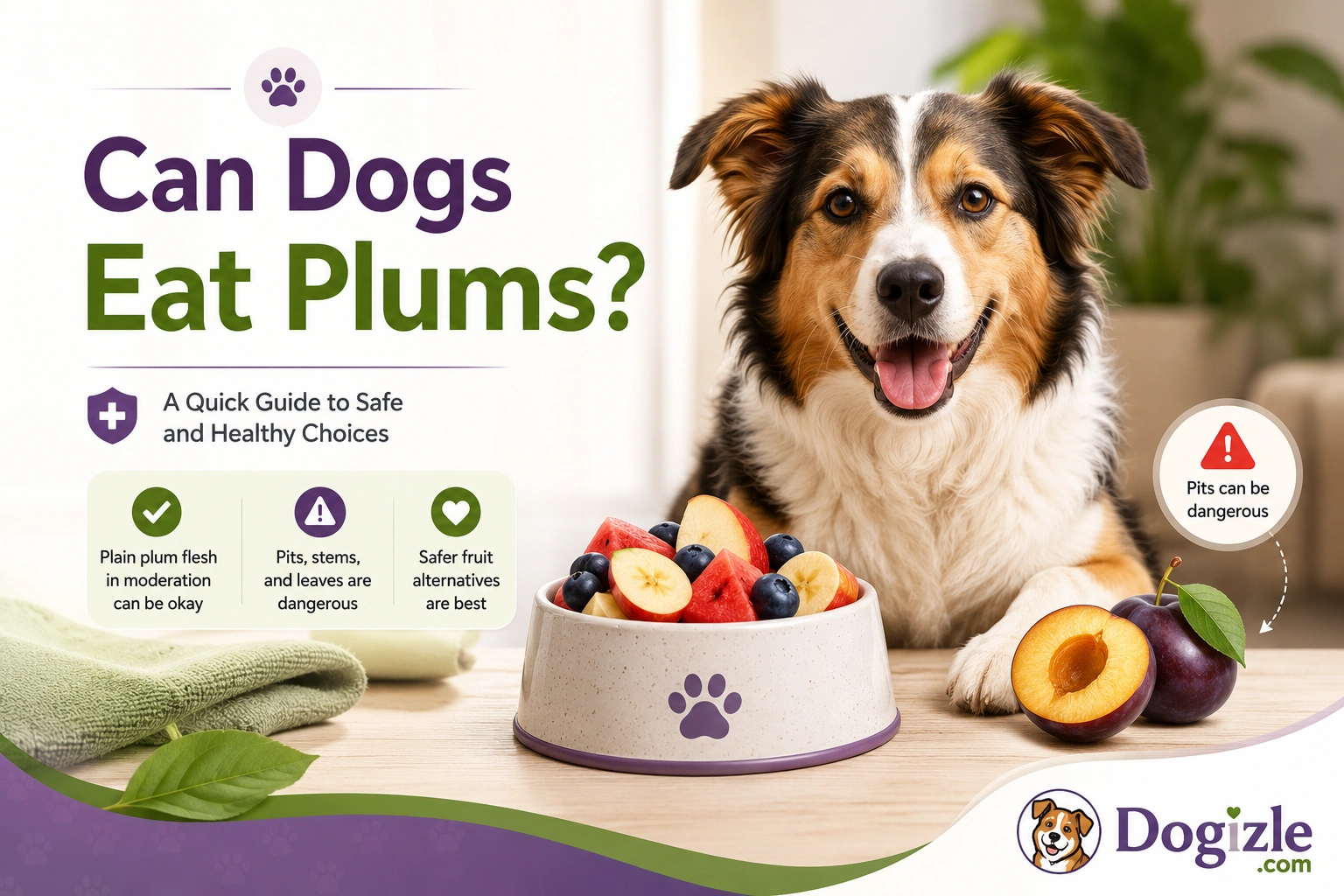
Some healthy adult dogs may tolerate a few tiny pieces of plain, fully pitted plum flesh, but the safest answer is to Skip Plums Altogether. The real danger is the pit, plus the stems and leaves, which contain cyanide-related compounds and can also cause choking or intestinal blockage. Veterinary and poison-control sources agree on that risk, even though some pet-care pages allow the flesh in moderation.
If you have ever stood in the kitchen with a plum in your hand and a dog staring at you as you owe them a share, this guide is for you. Plums look harmless, but stone fruits are exactly the kind of snack that creates confusion for dog owners: one source says “moderation,” another says “toxic,” and a third says “just don’t.” The truth sits in the middle. A little plain flesh may not be a crisis, but the pit and plant parts are where the real danger lives. If your dog has already eaten a plum pit, the right response is not guesswork; it is quick, practical action.
Bottom line: plum flesh is a “maybe” treat for some dogs, but plums are not a smart everyday snack, and they are absolutely not a casual food to leave within reach.
Can Dogs Eat Plums?
Yes, some sources say a dog can eat small amounts of pitted plum flesh as an occasional treat, especially in healthy adult dogs. PetMD is fairly permissive on the flesh itself, but it still warns that plum pits are toxic and can cause choking or blockage, and that too much plum can trigger vomiting, diarrhea, and weight gain.
But there is a catch: the broader veterinary and poison-control picture is much more cautious. ASPCA lists plum as toxic to dogs and points to the stems, leaves, and seeds as cyanide sources. Pet Poison Helpline also notes that Prunus species can contain cyanogenic glycosides in the bark, leaves, and seeds, and that large ingestions may also create a foreign-body obstruction.
So the honest answer is this: a tiny amount of flesh may be tolerated, but plums are not a “good dog fruit” in the same way apples or blueberries are. PetMD’s own general fruit guidance says fruit is not necessary for a complete diet and should stay at no more than about 10% of treats, while PDSA and Blue Cross both emphasize small quantities and removing pits, seeds, and stones from fruit.
Mini summary: If you want the safest owner-level rule, choose another fruit. If a dog has already had a tiny bite of plain flesh, that is not the same thing as eating a pit.
Why Plums Are Tricky for Dogs
Plums are tricky because the fruit has two different risk layers.
First, there is the plant toxicity layer. ASPCA says plum stems, leaves, and seeds contain cyanide, and that the risk can be especially concerning in wilting plant material. Pet Poison Helpline similarly highlights cyanogenic glycosides in Prunus species.
Second, there is the mechanical injury layer. Even when a pit is swallowed whole and cyanide is not released, the pit itself can still cause choking or a blockage in the gut. PetMD and Pet Poison Helpline both point to obstruction as a real problem, especially when a dog swallows large pieces or multiple pits.
That is why plums are not just a “sugar issue.” They are a toxicity + choking + blockage issue. For dog owners, that combination is usually enough to make the fruit a poor choice in everyday life.
Pros and Cons at a Glance
| Potential upside | Real Downside |
| A few dogs can tolerate tiny pieces of plain flesh | The pit, stems, and leaves are the main danger |
| Plum flesh may be offered as an occasional novelty treat | Too much can cause vomiting, diarrhea, and weight gain |
| It looks like a simple fruit snack | Choking and intestinal blockage are real risks |
| Some owners like fruit-based enrichment | Safer fruits exist, so the risk is rarely worth it |
The “pro” column is short for a reason: plums do not bring enough value to justify much risk. PetMD also notes that fruit is optional, not essential, in a complete dog diet.
Mini summary: The real issue is not whether plums are “fruit.” It is that plums are a stone fruit with a dangerous pit and plant parts that should not be treated casually.
Are Plum Flesh, Skin, Pit, Stems, and Leaves Safe?
Plum flesh
Plain plum flesh is the least risky part, and PetMD says healthy adult dogs can have it in moderation if it is prepared properly. Even then, it should stay small because plums are still a sugary fruit and can upset sensitive stomachs.
Plum skin
The skin is not the main danger. The bigger issue is still the pit, stem, and leaves. In practice, many owners focus on whether the fruit is fully pitted and cut small enough to be swallowed safely.
Plum pit
This is the part to treat as unsafe. PetMD says plum pits are toxic and can cause choking or intestinal blockage, and ASPCA identifies the seed as part of the toxic plant structure.
Stems and leaves
Do not feed these. ASPCA says stems and leaves contain cyanide, and Pet Poison Helpline includes bark, leaves, and seeds among the dangerous parts of Prunus plants.
Wilted plant material
This matters more than many owners realize. ASPCA notes that the plant parts are particularly toxic in the process of wilting. That means fallen yard debris, pruned branches, or half-wilted fruit tree leaves should be treated carefully.
Bottom line: if the fruit is not fully pitted, it does not belong in your dog’s bowl.
How Much Plum Can a Dog Eat?
There is no official universal plum serving size for dogs, and that is already a clue that plums are not a standard dog treat. PetMD’s general fruit guidance says treats, including fruit, should make up no more than 10% of a dog’s diet, and PDSA recommends fruit only in very small quantities as an occasional treat.
For a dog owner, the safest practical approach is:
- Only use fully pitted plum flesh.
- Cut it into tiny bite-sized pieces.
- Start with a very small amount.
- Stop immediately if your dog has a sensitive stomach or any medical condition that makes fruit a bad idea. PetMD specifically says dogs with obesity, diabetes, bladder stones, allergies, or gastrointestinal disease should be discussed with a veterinarian before being fed fruit.
A simple decision table
| Situation | Best choice |
| Healthy adult dog, plum fully pitted, flesh only | A tiny taste is less risky, but still optional |
| Puppy or small-breed dog | Better to skip it because the margin for error is small |
| A dog with diabetes, obesity, GI sensitivity, or a history of diet issues | Avoid plums |
| Plum pit is missing, chewed, or possibly swallowed | Treat as urgent and call a vet or poison service |
| Plum tree leaves, stems, or wilted plant debris were eaten | Contact a vet or poison service right away |
This is the kind of table that helps AI Overviews and real owners at the same time: it gives a fast decision path instead of a vague “maybe.” The sources agree on the key principles: small amounts only for some dogs, pit and plant parts avoided, and medical caution for dogs with special health needs.
Mini summary: If you cannot guarantee the fruit is fully pitted and cut safely, do not offer it at all.
Who Should Avoid Plums Completely?
Plums are a poor choice for dogs that already have digestive or metabolic concerns. PetMD says fruit should be approached carefully in dogs with obesity, diabetes, bladder stones, allergies, and gastrointestinal disease, and it also notes that too much fruit can lead to stomach upset, vomiting, diarrhea, and weight gain.
In real-world dog ownership, that means plums are best avoided for:
- Puppies, whose digestion is still developing.
- Toy breeds and small dogs are more prone to pit fragments and large bites because they are more vulnerable.
- Dogs with diabetes or weight issues, because the fruit is sugary.
- Dogs with sensitive stomachs, because fruit can trigger diarrhea.
- Dogs that gulp food because the choking risk is higher. The risk of choking and blockage is specifically highlighted by PetMD and Pet Poison Helpline.
Mini summary: The more fragile the dog’s digestive system, the less sense plum snacks make.
What If My Dog Ate a Plum Pit?
This is the section where speed matters.
If your dog chewed, cracked, or possibly swallowed a plum pit, contact your veterinarian or a poison service immediately. ASPCA says plum toxicity can involve difficulty breathing, dilated pupils, panting, shock, and brick-red mucous membranes. PetMD also says to contact a vet right away if a pit is ingested because of choking and blockage risk.
Pet Poison Helpline adds an important nuance: dogs that swallow seeds whole may be less likely to show cyanide toxicity because the cyanide is not released, but large ingestions can still cause obstruction. So “swallowed whole” does not mean “safe.” It only means the problem may be more mechanical than toxic.
What to do right now
- Remove the remaining fruit so no more is eaten.
- Check whether the pit is missing or chewed.
- Do not give home remedies or induce vomiting unless a vet tells you to. Pet Poison Helpline specifically advises not to induce emesis or give treatments until instructed.
- Call your veterinarian or local poison control service.
- Go to an emergency clinic immediately if your dog shows any concerning signs. ASPCA advises contacting a local veterinarian as soon as possible if a pet may have ingested a toxic substance.
Warning signs to watch for
| Possible sign | What it may suggest |
| Difficulty breathing | Possible cyanide-related toxicity or airway concern |
| Panting, weakness, shock | Urgent systemic illness |
| Dilated pupils | Possible toxic exposure |
| Vomiting or diarrhea | GI irritation or toxicity |
| Drooling, distress, reduced appetite | Something is wrong and needs assessment |
These signs align with ASPCA’s plum toxicity listing and PetMD’s warning that pits can also create digestive blockage.
Mini summary: If the pit is missing, do not “watch and wait” casually. Treat it as a vet question now, not later.
Can Dogs Eat Prunes, Dried Plums, or Sweet Plum Products?
Prunes are dried plums, and PetMD says they are not a great option for dogs because they are even higher in sugar and may also cause gas or digestive discomfort. In other words, drying does not make plums safer; it usually makes them more concentrated.
That means prunes are not a smart “workaround” for dogs. If the fruit is already a question mark in fresh form, drying it does not turn it into a dog treat. PetMD’s general fruit guidance also reminds owners that fruit is optional, and PDSA says fruit should be only a small, occasional part of a dog’s intake.
Bottom line: Skip prunes and choose a safer fruit instead.
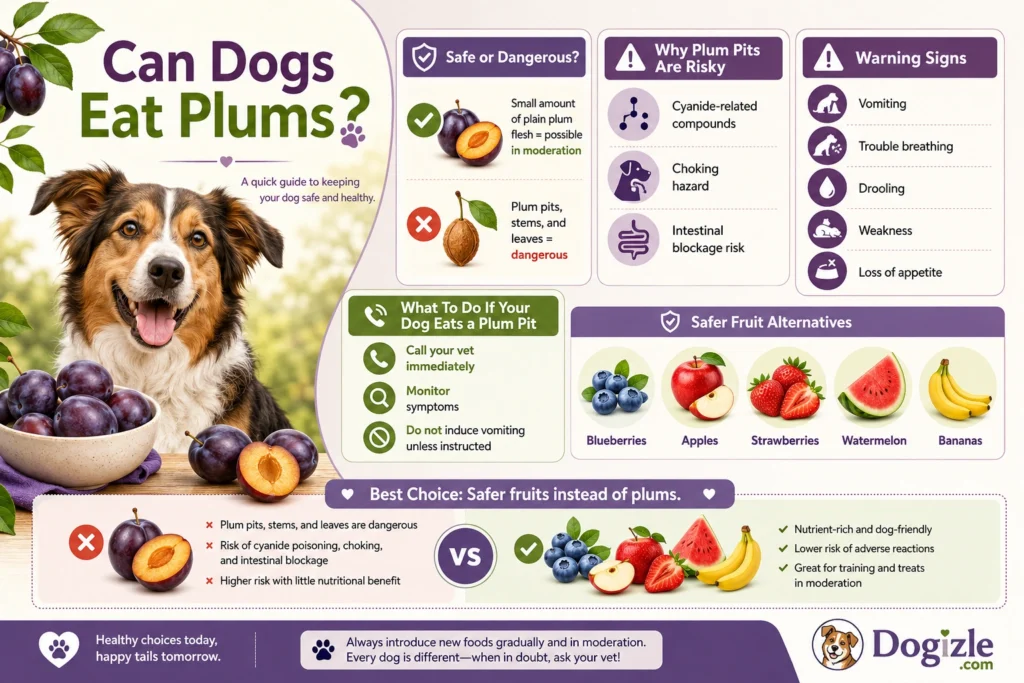
Best Dog-Safe Fruit Alternatives Instead of Plums
If you want a treat that is easier to serve safely, use fruits that PDSA, Blue Cross, and AKC consistently place in the “occasional treat” category. They still need to be served correctly, but they do not carry the same plum-pit problem.
| Safer fruit | Why is it easier to use |
| Apples | Must be cored and de-seeded, but widely accepted as a dog treat |
| Blueberries | Small, low-mess, and easy for training treats |
| Strawberries | Popular, simple, and easy to portion |
| Bananas | Soft and easy to mash, though still sugary |
| Melon/watermelon | Good summer option when rind and seeds are removed |
| Pears | Safe when seeds, core, and pit are removed |
| Pineapple | Use only the flesh after removing the skin and core |
PDSA explicitly recommends apples, bananas, blueberries, cranberries, strawberries, mango, nectarine, orange, pear, pineapple, and melon when prepared correctly. Blue Cross and AKC also highlight fruit as an occasional treat and stress-removing cores, seeds, and other inedible parts.
Best alternative for most dogs
For the average healthy dog, blueberries or apple pieces are usually the simplest switch because they are easy to portion, easy to store, and far less risky than stone fruit. That is an inference from the safety guidance above, and it is the kind of swap that keeps the treat habit while lowering the risk.
Mini summary: If your goal is a safe treat, plums are not the best fruit to build around. Use a simpler alternative.
Common Mistakes Dog Owners Make
The biggest plum mistakes are predictable, which is why this topic deserves a full pillar page.
- Assuming “fruit” automatically means “dog-safe.” It does not. PetMD says some fruits are safe, while others should be avoided or limited.
- Forgetting the pit. This is the most serious mistake. ASPCA and PetMD both flag the pit as dangerous.
- Leaving fruit bowls or pit waste within reach. A dropped pit, a picnic plate, or a compost bowl can become a problem fast. Pet Poison Helpline warns that large ingestions can cause obstruction.
- Giving plums to a dog with diabetes or a sensitive stomach. PetMD says to be cautious with fruit in dogs with these issues.
- Treating prunes as a “healthier” version. They are not. PetMD says prunes are even higher in sugar than fresh plums.
Expert tip: If a food needs three warnings before you serve it, it probably does not belong in the regular treat rotation.
Practical Plum-Safety Tips for Europe, Urban Homes, and Apartments
This topic has a stronger real-world angle in Europe than many people realize. In many cities and suburbs, dogs encounter stone fruit through shared gardens, market baskets, orchard walks, picnic leftovers, and neighborhood trees. That makes prevention more important than theory.
For apartment dogs and city dogs, keep fruit in closed containers, clean counters quickly, and teach a strong “leave it” cue. For dogs that walk in parks or shared green spaces, assume there may be dropped pits on the ground during the summer fruit season. In the UK and across Europe, a simple habit of checking what your dog picked up can prevent a midnight vet visit. This is practical owner guidance built around the known risks of pits, choking, and obstruction.
Cold-weather and travel note
In colder months, dried fruit often appears in baked goods, snack mixes, and holiday food boards. That matters because prunes are dried plums, and dried fruit is easy to overlook. During travel, especially in rentals or pet-friendly accommodations, keep fruit bowls and picnic leftovers out of reach. PetMD and PDSA both support the general “treats only, small amounts, properly prepared” rule.
Mini summary: Prevention beats emergency care. In real homes, the safest plum is the one your dog never gets access to.
Expert Tips for Safer Treatment
- Use fruit as a treat, not a snack habit. PetMD says fruit is optional, not required.
- Keep fruit pieces tiny. PDSA advises bite-sized pieces to reduce choking risk.
- Remove every pit, seed, core, and stem. Blue Cross and AKC both emphasize removing the unsafe parts from fruit.
- Watch the first serving. Any new food can upset the stomach, even if it is generally considered safe. PetMD notes digestive upset is possible with too much fruit.
- When in doubt, choose berries. Berries are usually easier to portion and less likely to create a pit-related emergency. That recommendation is an inference from the safer-fruit guidance.
People Also Ask
The skin is not the main hazard. The bigger concerns are the pit, stems, and leaves, plus the sugar load in the fruit itself. If you are going to offer plums at all, they should be fully pitted and given only in tiny amounts.
No. Plum pits are unsafe because they can contain cyanide-related compounds and can also cause choking or intestinal blockage.
ASPCA lists plum as toxic to dogs and identifies the stems, leaves, and seeds as cyanide sources. Some pet-care guidance allows the flesh in moderation, but the toxic parts and obstruction risk are real.
Call your veterinarian or a poison service immediately, especially if the pit was chewed, cracked, or cannot be found. Do not give home remedies unless a professional tells you to. Watch for breathing trouble, vomiting, lethargy, drooling, or shock.
It is better to avoid prunes. PetMD says prunes are dried plums and are even higher in sugar, which makes them a poor treat choice for dogs.
Apples, blueberries, strawberries, bananas, melon, pears, and pineapple are all commonly listed as safer options when prepared correctly. They still need seeds, cores, rinds, and skins removed where relevant.
Yes. ASPCA says plum stems, leaves, and seeds contain cyanide-related compounds, and Pet Poison Helpline includes leaves, bark, and seeds among the hazardous parts of Prunus species.
Conclusion
So, can dogs eat plums? The safest answer is that plums are not a good dog treat. A tiny bit of plain, fully pitted flesh may be tolerated by some Healthy adult dogs, but the pit, stems, and leaves are the real danger, and they bring choking, blockage, and cyanide-related concerns into the picture. That is too much risk for a food that dogs do not need in the first place.
For most dog owners, the smarter move is simple: skip plums, use a safer fruit such as blueberries or apple pieces, and keep stone fruit pits away from curious mouths. If your dog has already eaten a pit or plant part, do not wait for symptoms to become serious before acting. Call your veterinarian or a poison service quickly and follow professional guidance.
Bookmark this guide, share it with another dog owner, and keep exploring Dogizle for safer feeding advice, practical dog care tips, and vet-aware guidance you can trust.