Introduction
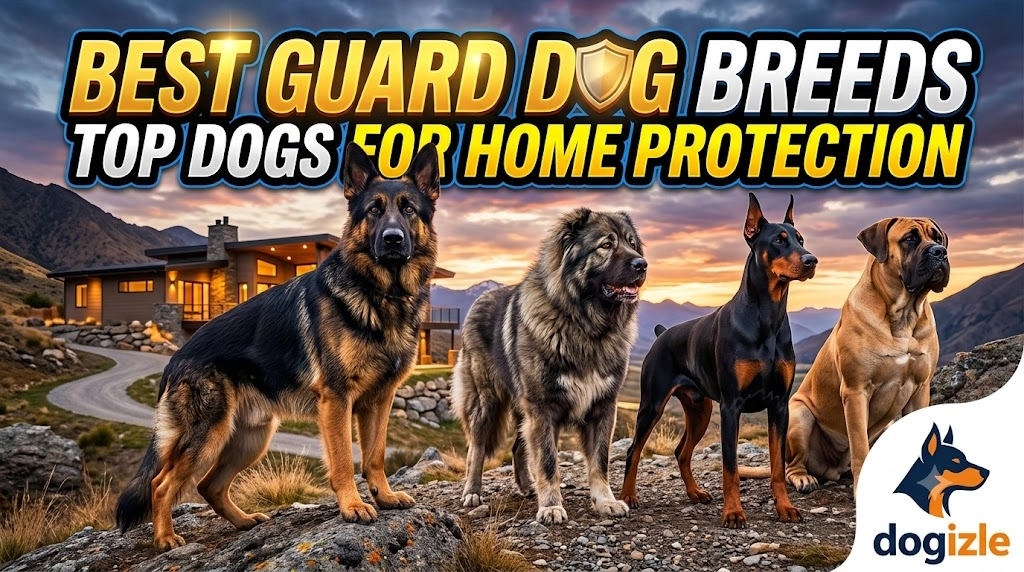
If you are searching for the Best Guard Dog Breeds, the right answer is not just “the biggest dog” or “the toughest-looking dog.” The best guard dogs are alert, loyal, watchful, and trainable enough to protect a home without becoming reckless or difficult to manage. That balance is exactly what the strongest current sources emphasize: guardian breeds should be dependable, but they also need proper training and socialization.
That matters because a good guard dog is more than a symbol of security. Families want a dog that can fit into daily life, tolerate visitors, live safely in the home, and still provide confidence. In Europe and other Western markets, that usually means thinking about apartment size, leash laws, neighbor noise, weather, and access to training classes, not just breed reputation. Responsible pet charities also stress positive training, gradual socialization, and reward-based learning rather than harsh correction.
This guide breaks the topic into simple, practical decisions so you can choose a protective breed that truly fits your household, your experience level, and your lifestyle.
What Makes a Great Guard Dog?
A great guard dog is typically loyal, alert, observant, confident, and responsive to training. AKC describes guardian breeds as loyal, fearless, strong, and watchful, while its Working Group overview says these dogs are intelligent, strong, watchful, and alert, and should be properly trained and socialized because many are naturally protective.
In practice, that means the ideal guard dog should:
- notice unusual activity,
- stay calm enough to think before reacting,
- learn household rules,
- accept family routines,
- and distinguish normal visitors from real threats.
That last point is important. A useful guard dog is not a chaos machine; it is a stable, well-managed dog with strong instincts and good manners.
Mini summary
The best guard dogs are not the most aggressive dogs. They are the dogs that combine protective instinct + trainability + control.
Guard Dog vs Watchdog vs Protection Dog
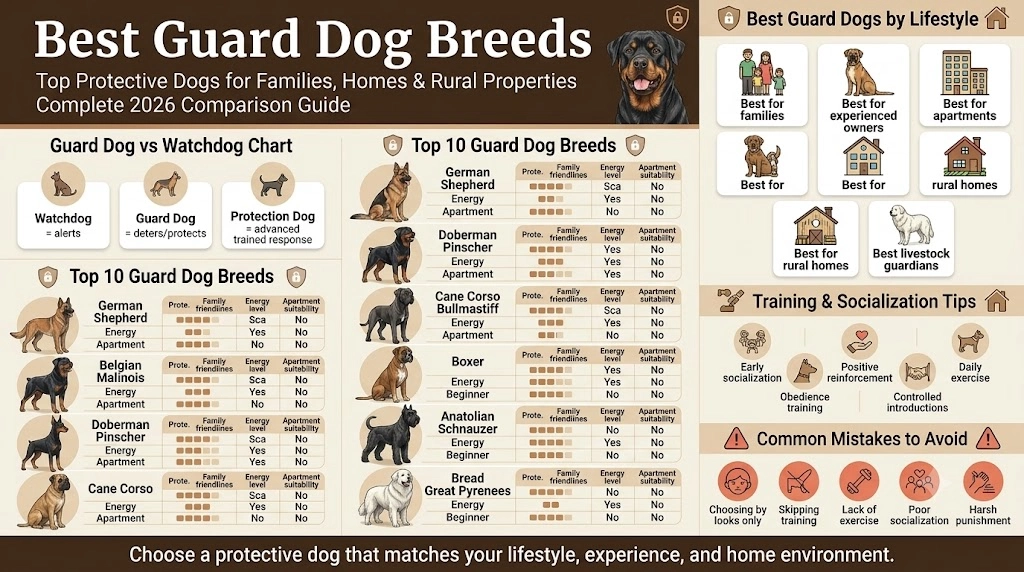
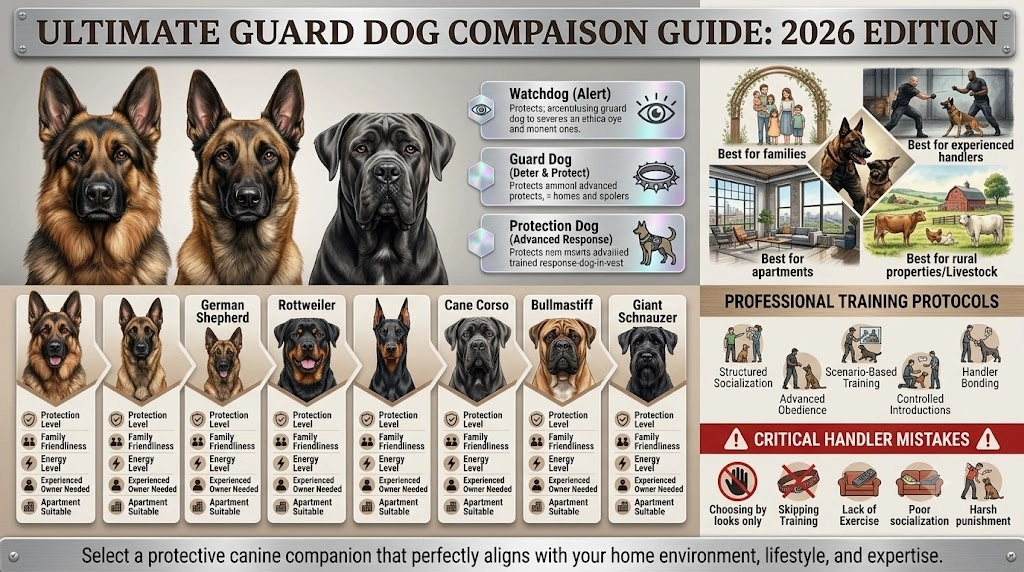
| Type | Main job | Typical behavior | Best for | Important note |
| Watchdog | Alerts you to activity | Barks, watches, signals | Apartments, smaller homes, and families who want awareness | Usually less confrontational than a true guard dog |
| Guard dog | Helps deter or confront a threat | Alert, protective, territorial | Homes, yards, rural properties | Needs training so protection stays controlled |
| Protection dog | Advanced protection work | Highly trained response behavior | Experienced handlers, working in roles | Not the same as a casual family pet and should be managed responsibly |
Rover defines a guard dog as a dog trained to protect a place, while AKC’s guardian-breed guidance stresses that these dogs need training and socialization because of their strength and size. That is why the terms are often blended online, but they are not identical in real life.
Mini summary
If you only want barking and awareness, a watchdog may be enough. If you want a stronger territorial instinct and presence, look at guard breeds. It you want formal bite/protection work, that enters specialized training territory.
Best Guard Dog Breeds at a Glance
| Breed | Best For | Energy | Training Need | Apartment Fit | Notes |
| German Shepherd | Families, active homes | High | Moderate to high | Possible with work | Loyal, protective, widely trusted family guardian |
| Belgian Malinois | Experienced owners | Very high | Very high | Usually poor | World-class worker, intense drive, needs a job |
| Rottweiler | Confident handlers, active families | Moderate to high | High | Often challenging | Strong, loyal, self-assured family protector |
| Doberman Pinscher | Active households | High | High | Limited | Fearless, vigilant, compact, and powerful |
| Cane Corso | Experienced owners, property protection | Moderate to high | High | Usually poor | Assertive, confident, “bodyguard dog” heritage |
| Bullmastiff | Calm homes, property deterrence | Low to moderate | Moderate | Limited | Fearless at work, docile at home |
| Boxer | Families who want alertness + playfulness | High | Moderate to high | Possible with work | Courageous, energetic, needs exercise |
| Giant Schnauzer | Experienced, active owners | High | High | Poor | Strong-willed and protective, needs obedience |
| Anatolian Shepherd | Rural properties, livestock guarding | Moderate to high | High | Poor | Territorial flock guardian, independent thinker |
| Great Pyrenees | Farms, cooler climates, livestock | Moderate | Moderate to high | Limited | Thick-coated guardian bred for snowy mountains and flock defense |
The Best Guard Dog Breeds, Explained Breed by Breed
1) German Shepherd
The German Shepherd remains one of the strongest all-around choices for families and active homes because it combines intelligence, loyalty, and a strong protective instinct. Rover notes that with good training and socialization, German Shepherds can be loyal, friendly, and good with kids. That mix is one reason they appear so often in guard-dog discussions.
Best for: families, experienced beginners, active households
Why it works: trainable, watchful, adaptable
Watch out for: high exercise needs and the need for early socialization
Mini summary
A German Shepherd is often the most balanced answer when someone wants a serious guard dog that can still live as a family companion.
2) Belgian Malinois
The Belgian Malinois is a world-class working dog with intense drive. AKC describes the breed as smart, confident, versatile, and strongly bonded to its human partner. Rover says it needs an active family and a job to stay happy, which is exactly why it is usually not a casual-pet choice.
Best for: experienced owners, sport homes, handlers who love training
Why it works: speed, focus, work ethic, seriousness
Watch out for: too much energy for low-activity families or lazy routines
Mini summary
The Malinois is a “professional-level” guard breed. It is brilliant, but it needs structure, work, and time.
3) Rottweiler
The Rottweiler is one of the classic protective breeds. AKC calls it a robust working breed of great strength, and Rover describes it as loyal, adaptable, and a good family pet when managed well. This makes it a strong choice for owners who want a serious guardian with a stable home personality.
Best for: active families, owners with structure, confident handlers
Why it works: calm self-assurance, family loyalty, real guarding instinct
Watch out for: exercise demands and the need for firm but fair training
Mini summary
A well-raised Rottweiler can be a loyal family protector, but it should never be chosen casually.
4) Doberman Pinscher
AKC describes the Doberman Pinscher as sleek, powerful, intelligent, fearless, and vigilant, and its breed standard highlights energy, alertness, obedience, and loyalty. That is exactly the kind of profile that fits owners seeking a fast, responsive guard dog with strong presence.
Best for: active homes, handlers who enjoy obedience work
Why it works: speed, vigilance, elegance, close bond with family
Watch out for: under-stimulation, boredom, and limited space without enough activity
Mini summary
Dobermans are among the most iconic protection dogs because they combine physical presence with sharp intelligence.
5) Cane Corso
AKC calls the Cane Corso smart, trainable, assertive, and a peerless protector, with a name that roughly translates to “bodyguard dog.” Its breed standard also describes a powerful, athletic dog with a history as a property watchdog. That makes it one of the most serious home-protection breeds on the list.
Best for: experienced handlers, property guarding, confident owners
Why it works: imposing presence, protective instinct, trainability
Watch out for: owner inexperience and weak boundaries
Mini summary
A Cane Corso is not a beginner’s casual companion. It is a powerful, purpose-built guardian that needs mature handling.
6) Bullmastiff
The Bullmastiff was developed in England to guard estates against poachers, and AKC describes it as fearless at work and docile at home. That is a rare combination and one reason it remains attractive for homeowners who want a calm indoor companion with real deterrence value.
Best for: households wanting a calmer guardian, property deterrence
Why it works: size, confidence, low-to-moderate activity, serious presence
Watch out for: health management, space needs, and proper manners
Mini summary
Bullmastiffs are one of the best “quiet but formidable” guard breeds.
7) Boxer
Boxers are playful, energetic, courageous, and alert. AKC notes they need ample daily exercise and should not be left to run freely in unsafe settings. Rover also places them among the family guard breeds that need training and activity. That makes Boxers a good fit for families who want a dog that is both lively and watchful.
Best for: active families, playful homes, people who want a cheerful guardian
Why it works: alertness, loyalty, athleticism, family friendliness
Watch out for: enough exercise and consistency every day
Mini summary
A Boxer can be a smart choice when you want a dog that protects but still feels joyful and approachable.
8) Giant Schnauzer
HowStuffWorks describes Giant Schnauzers as energetic, strong-willed, and among the best guard dog breeds for experienced owners. It also says obedience training is essential to manage the breed’s protective nature. That combination makes it an excellent choice for experienced handlers who want a serious watchdog and family guardian.
Best for: experienced owners, active homes, structured training households
Why it works: strong bark, confidence, work ethic
Watch out for: willfulness and the need for clear leadership
Mini summary
The Giant Schnauzer is highly capable, but it rewards disciplined owners more than casual ones.
9) Anatolian Shepherd
AKC describes the Anatolian Shepherd as a rugged, imposing flock guardian that is protective, territorial, intelligent, patient, and profoundly loyal. Its history is deeply rooted in livestock guarding, and AKC notes it has been bred for millennia to guard flocks rather than herd them.
Best for: farms, acreage, livestock protection, experienced rural owners
Why it works: independence, territorial awareness, endurance
Watch out for: urban life, limited space, and weak social management
Mini summary
This breed is a livestock guardian first and a house pet second. That distinction matters.
10) Great Pyrenees
AKC describes the Great Pyrenees as a large, thickly coated, powerful working dog bred to deter predators on snowy mountaintops, and notes that it is now a vigilant guardian of home and family. AKC also points out that the breed was developed to watch over flocks, and that socialization and puppy classes can help with manners.
Best for: cooler climates, farms, rural homes, families who appreciate a calmer guardian
Why it works: size, coat, guardian instinct, steady nature
Watch out for: barking, independence, and the need for consistent boundaries
Mini summary
Great Pyrenees can be excellent guardians, but they are not “plug and play” dogs. They need guidance, especially in urban settings.
Best Guard Dog Breeds for Different Owner Types
| Owner Type | Better Breed Choices | Why These Fit |
| Families with children | German Shepherd, Boxer, Bullmastiff | Protective but still companion-oriented when trained well |
| First-time owners | Best to stay cautious; consider calmer breeds with professional support | AKC notes some working breeds may not suit first-time owners |
| Experienced handlers | Belgian Malinois, Cane Corso, Giant Schnauzer | High drive, strong protection instincts, advanced training needs |
| Rural/property owners | Anatolian Shepherd, Great Pyrenees, Bullmastiff | Strong territorial instinct and property guarding history |
| Active sports homes | Doberman, Malinois, Boxer, German Shepherd | High energy and strong work ethic |
Best Guard Dog Breeds for Families
Families usually need a guard dog that can be protective without being unstable or too intense. Rover’s family-friendly guard-dog guide repeatedly emphasizes fit, lifestyle, and training. AKC also highlights that guardian breeds need proper socialization, and that socialization should start early for the best results.
The strongest family-oriented guard breeds usually include:
- German Shepherd
- Boxer
- Bullmastiff
- Some Rottweilers from responsible lines with excellent socialization
These dogs can be deeply loyal and protective, but they still need household rules, supervised introductions, and consistent training.
Mini summary
For families, the sweet spot is a dog that is protective but people-oriented, trainable, and stable in everyday life.
Best Guard Dog Breeds for Experienced Owners
Experienced handlers can successfully manage higher-drive breeds that are not ideal for beginners. The Belgian Malinois is the clearest example because AKC describes it as a world-class worker, while Rover says it needs a job to stay happy. Giant Schnauzers and Cane Corsos also fit this category because they are strong, protective, and more demanding than the average pet breed.
These dogs are best when the owner can provide:
- daily exercise,
- obedience structure,
- mental work,
- early socialization,
- and a calm, confident handling style.
Mini summary
The more intense the breed, the more important the owner’s skill becomes.
Best Large Guard Dogs for Homes and Rural Properties
If the goal is visible deterrence, estate presence, or larger-property security, the strongest candidates are usually the Bullmastiff, Cane Corso, Giant Schnauzer, Anatolian Shepherd, and Great Pyrenees. AKC and Rover’s current guidance shows that large working breeds often bring strong guarding instincts, but they also need room, structure, and enough activity to stay balanced.
For rural homes, size is only part of the story. A true property dog must be able to settle, observe, and react appropriately, not just look intimidating. That is why socialization and training remain non-negotiable.
Mini summary
Large guard dogs work best when their size is matched by training, routine, and a realistic household plan.
Best Livestock Guardian Breeds
Livestock guardian breeds are a separate category from household guard dogs. They are bred to protect animals, not to do flashy obedience work. AKC identifies breeds like the Anatolian Shepherd and Great Pyrenees as flock guardians, and Rover’s broader guard-dog roundup also includes breeds such as the Great Pyrenees and Schnauzers in protective roles.
These breeds are often excellent in:
- farms,
- acreage,
- mixed rural properties,
- and homes where a calm but watchful presence is valued.
They are usually not the best fit for busy apartment life or low-experience owners who want a quick, easy guard dog.
Mini summary
A livestock guardian is a specialist. That specialization is powerful, but it also limits where the breed fits best.
How to Choose the Right Guard Dog for Your Lifestyle
Use the breed’s reputation as a starting point, not the final answer. Rover explicitly says the dog should fit your lifestyle and needs, and AKC says working breeds can be naturally protective but require proper training and socialization.
A simple decision framework
- Be honest about your experience.
If you are new to dogs, avoid jumping straight to the most intense breed. AKC notes some working breeds may not be for first-time owners. - Match the energy level to your daily life.
A Belgian Malinois or Boxer will struggle in a low-activity home. A Bullmastiff may be calmer, but it still needs structure and health-aware care. - Think about your space.
Large, protective breeds can live in homes, but apartments make everything harder: noise, stairs, hallway traffic, and daily exercise all matter. For urban owners, a calm temperament and strong training routine are essential. This follows directly from the training and socialization expectations stressed by AKC, PDSA, Blue Cross, and RSPCA. - Decide whether you need family protection or livestock protection.
Anatolian Shepherds and Great Pyrenees are better understood as livestock guardians; German Shepherds and Boxers are more versatile home-and-family options. - Plan for training before the puppy comes home.
Good socialization starts early and should be gradual, positive, and varied.
Mini summary
The best breed is the one your household can actually manage well for years, not the breed that sounds most impressive on paper.
Training and Socialization: The Part That Decides Everything
Training is not optional for guard dogs. It is the difference between a reliable protector and a hard-to-control liability. AKC, PDSA, Blue Cross, and RSPCA all emphasize reward-based training, gradual exposure, and consistency.
Training priorities for guard breeds
| Training Goal | Why It Matters | Best Practice |
| Recall | Helps prevent accidents and improves control | Practice in secure, low-distraction places first |
| Sit / stay / wait | Builds impulse control | Use short, reward-based sessions |
| Loose-lead walking | Essential in cities and neighborhoods | Stop when pulling starts; reward calm walking |
| Socialization | Prevents fear and overreactivity | Expose the puppy gradually to safe people, places, sounds, and surfaces |
| Calm greetings | Reduces over-guarding | Reward quiet behavior and avoid shouting |
PDSA explains that puppies should be introduced to new experiences gradually, not overwhelmed, while Blue Cross advises exposing them to different sounds, smells, textures, and sights in a positive way. AKC also stresses that early socialization can permanently shape adult temperament.
Mini summary
A guard dog without socialization is not “more protective.” It is simply more likely to become unpredictable.
Apartment Living: Which Guard Dogs Can Work?
Apartment life is possible for some guard breeds, but only when the owner is realistic. The issue is not just size. It is also barking, exercise, hallway triggers, lift rides, and how well the dog handles strangers in shared spaces. The training advice Best Guard Dog Breeds from PDSA and Blue Cross makes this especially clear: these dogs need repetition, calm exposure, and consistent handling to thrive in busy environments.
More workable in apartments, with effort:
German Shepherd, Boxer, some Rottweilers, and some Dobermans.
Usually, poor apartment choices:
Belgian Malinois, Cane Corso, Anatolian Shepherd, Great Pyrenees, and Giant Schnauzer, unless the owner has exceptional time, training skills, and exercise access.
Apartment survival checklist
- daily structured walks,
- short training sessions,
- quiet crate or settle training,
- controlled visitor introductions,
- and a plan for barking before it becomes a habit.
Mini summary
An apartment is not automatically a deal-breaker, but it raises the difficulty level for every guard breed.
Europe-Specific Practical Advice
For European and UK households, the best guard dog choice is often the one that fits housing density, public-space rules, and local lifestyle. Blue Cross and PDSA emphasize building confidence through controlled exposure, while RSPCA’s guidance on outside living shows that welfare, shelter, and extreme-weather protection matter Best Guard Dog Breeds if a dog spends time outdoors.
That matters because many European owners live with:
- smaller homes,
- shared buildings,
- tighter leash expectations,
- and more daily foot traffic than rural North American properties.
So a strong guard breed should also have:
- manageable barking,
- good leash manners,
- stable temperament,
- and the ability to relax indoors.
In colder European climates, thick-coated guardian breeds such as the Great Pyrenees may feel more natural, but the RSPCA still cautions that any dog kept Best Guard Dog Breeds outdoors needs suitable shelter and protection from extreme weather. In warmer regions, large heavy breeds can be harder to manage comfortably, so exercise timing and heat awareness become more important.
Mini summary
In Europe, a good guard dog must be a good neighbor, a good indoor companion, and a good outdoor citizen.
Cold Weather and Seasonal Care Tips
Some guardian breeds were built for colder work, but no breed should be treated like an outdoor machine. AKC notes the Great Pyrenees Best Guard Dog Breeds was bred for snowy mountain work, and RSPCA says dogs kept outside need shelter, water, and protection from extreme weather.
In colder months
- keep paw care in mind,
- dry thick coats well after wet walks,
- Watch for joint stiffness in large breeds,
- and avoid assuming a heavy coat means a dog needs no comfort.
In warmer months
- walk early or late,
- shorten high-intensity exercise,
- and watch closely for overheating, especially in large, heavy, or dark-coated breeds. AKC’s breed pages for large dogs such as the Neapolitan Mastiff and Great Pyrenees show why heat management matters in big, powerful breeds.
Mini summary
Seasonal care is not optional with guard breeds. Their size and coat can make weather management more important, not less.
Diet and Body Condition: Why It Matters for Guard Dogs
Guard breeds often look imposing, but the healthiest ones are not overfed and sluggish. Large working dogs need appropriate nutrition, steady body condition, and joint-aware care. Rover’s breed pages repeatedly link active breeds with exercise needs and health risks like hip dysplasia or heart issues. That is a reminder that a guard dog’s body is part of its performance.
Practical feeding and condition notes
- Keep treats controlled during training.
- Watch weight closely in Bullmastiffs, Rottweilers, and other large breeds.
- Use slow, steady exercise instead of endless rough play for giant dogs.
- Ask a veterinarian for breed-appropriate feeding guidance, especially for puppies and large-breed growth.
That advice is especially important because many guard breeds are also prone to orthopedic or cardiac concerns in current breed profiles.
Mini summary
A fit guard dog is a healthier guard dog. Weight control and joint care matter more than many owners expect.
Pros and Cons of Guard Dog Breeds
Pros
- Strong deterrent presence
- Loyal to the family
- Often highly trainable
- Good for confident households
- Can improve peace of mind when matched correctly
Cons
- Training demands are high
- Some breeds are too intense for beginners
- Poor socialization can create behavior problems
- Large breeds may be costly to feed and manage
- Not every “protective” dog is suitable for family life
Mini summary
Guard dogs bring real benefits, but only when the household is ready for the responsibility.
Common Mistakes Dog Owners Make
- Choosing by appearance only.
A big, intimidating dog is not automatically the right guard dog. - Skipping socialization.
PDSA, Blue Cross, and AKC all stress that positive early exposure matters. - Using punishment instead of reward-based training.
RSPCA warns against shouting or punishing dogs because it can worsen their behavior. - Underestimating exercise needs.
Malinois, Boxers, and German Shepherds need far more activity than many owners expect. - Ignoring the dog’s job.
Working breeds often need a purpose, not just a backyard. Rover explicitly says some breeds need a job to stay happy.
Mini summary
Most guard-dog problems come from mismatched expectations, not from the breed itself.
Safety and Health Notes Every Owner Should Know
A guard dog should never be left unmanaged just because it is protective. AKC and RSPCA both stress safe, well-structured ownership, and RSPCA notes that dogs kept outdoors need suitable shelter and extreme-weather protection.
Contact a vet or qualified behavior professional if you notice:
- sudden aggression,
- fear-based snapping,
- resource guarding that worsens,
- inability to settle,
- Repeated anxiety in public,
- or pain-related irritability.
Behavior problems can be linked to fear, stress, or illness, and RSPCA notes dogs are more likely to behave badly if they’re scared or suffering.
Dangerous myths to avoid
- “A guard dog should be aggressive.”
- “Big breeds do not need socialization.”
- “If a dog protects the house, it will automatically be good with children.”
- “Outdoor living is always fine if the breed is large.”
Those ideas conflict with the training and welfare guidance from AKC, PDSA, Blue Cross, and RSPCA.
Mini summary
The safest guard dog is the one that is trained, monitored, and managed like a real family member.
Expert Tips for Choosing the Right Breed
- Start with your lifestyle, not the breed label. Rover makes this point directly.
- Choose a breed whose energy level matches your routine.
- Plan for socialization before the puppy comes home.
- Use reward-based training from day one.
- Think ahead about who will walk, train, groom, and supervise the dog.
- For first-time owners, get help from an accredited trainer early rather than after problems appear.
Mini summary
The best guard-dog owners are not the toughest people. They are the most consistent people.
People Also Ask
There is no single perfect answer, but the German Shepherd is often the most balanced choice because it is protective, trainable, and adaptable for many households. Rover and AKC both support that broad family-guardian profile.
The Belgian Malinois is one of the strongest choices for experienced handlers because it is a world-class worker with very high energy and drive.
They can be, but only with the right breed, the right breeder or rescue background, and excellent socialization. Rover notes that several protective breeds can be loving companions with proper training and care.
No. The best guard dogs are protective, not reckless. AKC and RSPCA both emphasize training, socialization, and calm management rather than fear-based behavior.
Sometimes, yes, but only with serious commitment. Smaller or calmer protective breeds may adapt better, while high-drive breeds usually struggle without enough activity and training.
Conclusion
The Best Guard Dog Breeds are not just strong-looking dogs. They are stable, loyal, watchful, and trainable companions that fit the home they live in. For many families, that means a German Shepherd, Boxer, Bullmastiff, or well-managed Rottweiler. This experienced owners, breeds like the Belgian Malinois, Cane Corso, and Giant Schnauzer bring serious protective ability. For farms and rural properties, Anatolian Shepherds and Great Pyrenees stand out as specialist guardians.
The real key is not just breed choice. It is training, socialization, exercise, and honest self-assessment. The safest and most effective guard dog is the one you can raise responsibly for the long term. Bookmark this guide, share it with another dog owner, and build your next article around practical matching, not just breed lists.
This content is for educational and informational purposes only and does not replace professional veterinary advice. Always consult a licensed veterinarian for medical concerns regarding your dog.