Before You Give Your Dog a Date, Read This First
If you are wondering, can Dogs Eat Dates? The good news is that plain dates are not considered toxic to dogs, but that does not mean they are a free-for-all snack. The real issues are the high natural sugar content, the chance of digestive upset if your dog eats too much, and the danger of the date pit, which can cause choking or a blockage. Chewy, Daily Paws, AKC, and The Dodo all agree on the same basic idea: dates can be shared, but only in moderation and only when they are plain and pitted.
For dog owners, that creates a very practical question: not just “is this safe?” but “how do I feed it safely, how much is too much, and when should I call the vet?” This guide answers those questions clearly, so you can make a smart choice whether you live in a city apartment, a family home, or anywhere across Europe, the UK, the US, Canada, or Australia. The goal is simple: keep the treat safe, keep the portions tiny, and keep your dog out of trouble.
Quick Answer: Are Dates Safe for Dogs?
Yes, dogs can eat dates in moderation if the dates are plain, pitted, and served in tiny amounts. They are not in the same danger category as grapes or raisins, but they are still a sugary treat that should stay occasional rather than routine.
The safest rule is this: dates are a rare treat, not a health food for dogs. They can be given once in a while, but there are better everyday fruit choices for most dogs, especially lower-sugar options like blueberries. Chewy specifically calls out blueberries as a better choice, and AKC also treats blueberries as a safe fruit option for dogs when fed in moderation.
Snippet-ready answer
Can dogs eat dates? Yes, plain pitted dates are generally safe in small amounts, but they should only be an occasional treat because they are high in sugar, and the pit can be dangerous.
What Makes Dates Good or Bad for Dogs?
Dates have some nutrients, including fiber, potassium, magnesium, and B vitamins, which is why they sometimes get described as a wholesome human snack. AKC, Daily Paws, Chewy, and The Dodo all note that dates contain helpful nutrients, but they also emphasize that dogs do not need dates to stay healthy.
The problem is balance. Dogs already get complete nutrition from a well-formulated diet, so the small nutritional upside of dates is usually outweighed by the sugar load and the risk of overfeeding. Chewy notes that dates are very high in natural sugar and calories, while Rover says they are relatively high in sugar and should be shared sparingly. Daily Paws also points out that dates are high in fructose and that dogs do not need them in their diet.
In plain English
Dates are not “bad” in a poisonous sense, but they are not a smart everyday snack either. For most dogs, they are a nice-to-have treat, not a need-to-have food.
Can Dogs Eat Date Pits?
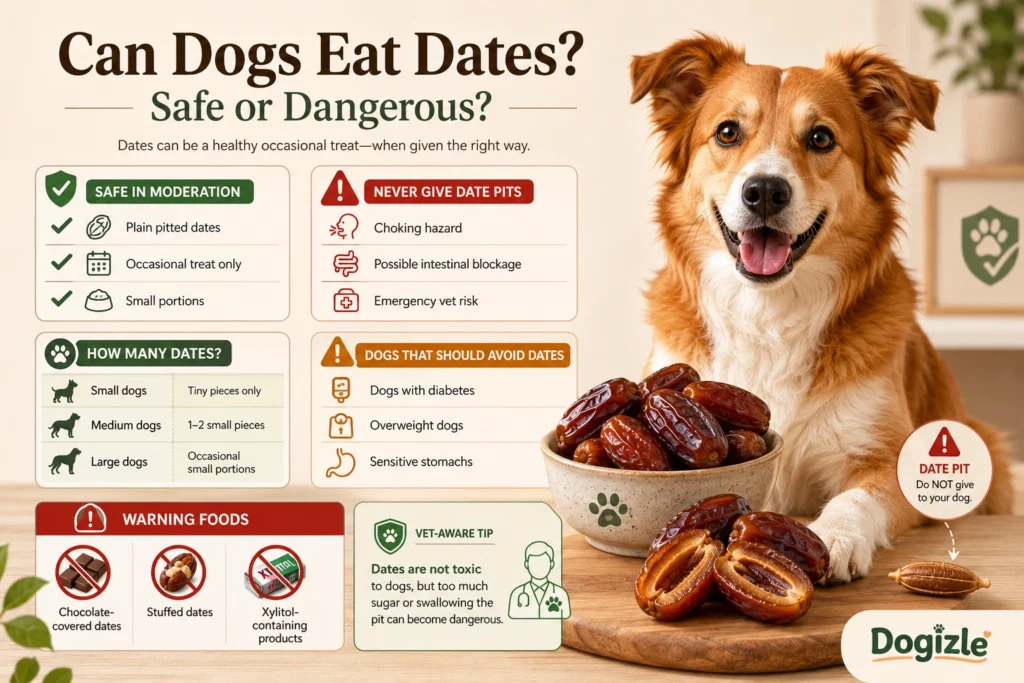
No. Dogs should never eat date pits. The pit is the main danger here. Chewy explains that pits are not digestible and can create a choking hazard or intestinal blockage. The Dodo also warns that the pit can be dangerous, especially for smaller dogs. Veterinary references from VCA and Merck explain that swallowed foreign objects can cause vomiting, abdominal pain, reduced appetite, lethargy, and sometimes surgery if a blockage develops.
The practical takeaway is simple: never hand over a whole date. Always remove the pit first, and then cut the fruit into small pieces if you decide to share any at all. That small extra step is what turns a risky snack into a much safer one.
What to watch for if a pit is swallowed
| Possible sign | Why it Matters |
| Vomiting | Can happen with a blockage or irritation. |
| Abdominal pain or tenderness | May suggest the pit is stuck or causing distress. |
| Loss of appetite | Common with foreign-body problems. |
| Lethargy | A red flag in obstruction cases. |
| Straining to defecate | Can happen when something is blocking the gut. |
Can Dogs Eat Dried Dates or Fresh Dates?
Both fresh and dried dates are discussed as safe in small amounts when they are plain and pitted. Daily Paws says fresh dates are generally easier to digest, while dried dates can still be okay as long as they are not coated with sugar or chocolate. PetLab also notes that dried dates are very high in sugar and calories, which is why they should be treated as an occasional snack only.
In real-life feeding, fresh dates are usually the easier choice because portion control is simpler. Dried dates tend to be denser, stickier, and easier to overfeed, especially with small dogs. That is not because dried dates are inherently toxic; it is because it is easier to give too much too fast.
How Many Dates Can a Dog Eat?
The best answer is: very few. Chewy says dates should be offered in tiny portions and no more than twice a week, and The Dodo says one or two may be plenty as a special-occasion treat. Rover also says they should be shared sparingly, maybe one or two at a time, periodically.
Here is a conservative editorial guide you can publish:
| Dog size | Safer starting point | Notes |
| Toy / very small dogs | 1 tiny piece | Keep it minimal because sugar and calories add up fast. |
| Small dogs | 1 small piece | Watch closely for stomach upset. |
| Medium dogs | 1–2 small pieces | Keep it occasional, not daily. |
| Large dogs | Up to 2 small pieces | Still a treat, not a meal addition. |
This table is intentionally conservative. It reflects the “small amount, occasional treat” guidance repeated across Chewy, Daily Paws, Rover, and The Dodo, rather than turning dates into a regular training or daily snack.
Best rule of thumb
If you are asking whether your dog can have more, the answer is probably no. Treats should stay a small part of a dog’s total calories, and dates are not the best way to spend that treat budget.
Which Dogs Should Avoid Dates?
Some dogs should skip dates completely, or only have them after a vet says it is okay. Dogs with diabetes are the biggest concern because dates are high in sugar. PetLab explicitly says dogs with diabetes should not be offered dates, and Chewy warns that too many dates may contribute to blood sugar issues over time. Dogs that need weight control should also avoid regular date treats because of the calorie density.
Dogs with sensitive stomachs may also react badly if they are given too much too soon. The Dodo advises starting with very small amounts and speaking to a veterinarian if vomiting, diarrhea, or constipation appear. That makes sense because a sudden change in treat type can upset digestion even when the food is not toxic.
Skip dates if your dog is:
- Diabetic or insulin-dependent.
- Overweight or on a calorie-restricted plan.
- Prone to diarrhea, gas, or stomach sensitivity.
- A very small dog, where even tiny treats can add up fast.
How To Feed Dates Safely to Dogs
If you decide to give your dog a date, keep it simple. Chewy, Daily Paws, and The Dodo all stress the same core steps: plain fruit only, remove the pit, and keep the portion small. Chewy also warns against chocolate-covered dates, stuffed dates, added sugars, nuts, and artificial sweeteners such as xylitol. ASPCA warns that xylitol can cause low blood sugar and liver injury in dogs.
Safe-feeding checklist
- Choose a plain date with no coating or filling.
- Remove the pit completely.
- Cut the flesh into tiny pieces, especially for small dogs.
- Offer only a very small amount the first time.
- Watch for vomiting, diarrhea, constipation, or unusual discomfort.
Avoid these date products
- Chocolate-covered dates.
- Stuffed dates with unknown ingredients.
- Sugar-free dates or sugar-free fillings that may contain xylitol.
- Large, sticky pieces that are hard to chew safely.
What To Do If Your Dog Eats a Date Pit
Do not panic, but do not ignore it either. A date pit is a foreign body risk, and foreign body obstructions can become serious. VCA lists vomiting, diarrhea, abdominal pain, decreased appetite, lethargy, and straining to defecate as common signs, while Merck notes that swallowed foreign objects may require surgical removal if they do not pass.
Call your vet urgently if you see:
| Symptom | Why is it urgent |
| Repeated vomiting | Possible blockage or irritation. |
| Bloated or painful belly | Can signal obstruction or severe discomfort. |
| Refusing food | A common obstruction sign. |
| Trouble passing stool | The pit may be stuck. |
| Weakness or severe lethargy | Can mean the problem is becoming more serious. |
If you suspect a toxic ingredient such as xylitol, contact your veterinarian or poison control immediately. ASPCA’s Poison Control page says to call their emergency line at (888) 426-4435 if you think your pet has ingested a potentially poisonous substance.
Are Dates Toxic to Dogs?
No, dates are generally not toxic to dogs in the way that grapes and raisins are. AKC, Chewy, Daily Paws, and The Dodo all state that dates are not highly toxic or poisonous, but they are still not a food to give freely because of sugar and potential risks.
That distinction matters. “Not toxic” does not mean “great for dogs.” It only means the fruit flesh is not a known poison. The real-life decision still depends on the dog’s size, health status, and how the date is prepared.
Are Dates Good for Dogs?
Dates can offer a little fiber and some micronutrients, but the Benefit is limited because dogs should only eat them in tiny amounts. Chewy says the amount is too small to provide meaningful nutritional benefits, while Daily Paws and AKC both note that dogs do not need dates in their diet.
What this means for dog owners
If your goal is everyday nutrition, dates are not the best tool. If your goal is a tiny occasional treat, plain pitted dates can fit into a balanced routine. For most dogs, lower-sugar fruit choices are simply more practical.
Best Safer Fruit Alternatives to Dates
If you want fruit treats that are easier to justify more often, blueberries are the strongest alternative in the current source set. Chewy, AKC, and Daily Paws all treat blueberries as safe for dogs when given in moderation, and Chewy specifically recommends lower-sugar fruits like blueberries as a better option than dates.
Better everyday treat options
- Blueberries.
- Other dog-safe fruits in moderation, such as apples or bananas, with seeds, cores, and pits removed.
Common Mistakes Dog Owners Make
The most common mistake is giving a dog a whole date with the pit still inside. The second mistake is assuming that because dates are “natural,” they must be healthy enough for frequent use. The third mistake is forgetting that stuffed or chocolate-covered dates can contain dangerous ingredients such as xylitol. Chewy and ASPCA both make those warnings very clear.
Other mistakes to avoid
- Turning dates into a daily snack.
- Using them for dogs with diabetes or weight issues.
- Offering sticky, oversized pieces to small dogs.
- Ignoring mild vomiting or diarrhea after a new treat.
Expert Tips for Feeding Dates Responsibly
Use dates the same way you would use any rich treat: occasionally, intentionally, and in tiny amounts. For apartment dogs, senior dogs, and small breeds common in city homes across Europe and North America, a few extra calories matter more than people think. A “little bite” can become a habit, and habits are what create weight gain over time. That is why moderation is the real safety rule, not just pit removal. The current top pages all point toward this same conclusion.
Practical expert tips
- Keep dates out of reach on counters and tables.
- Use a tiny piece as a rare reward, not a regular training treat.
- For frequent training, choose a lower-sugar dog-safe treat instead.
- If your dog has any medical condition, ask your veterinarian first. Chewy and Daily Paws both recommend vet guidance before introducing new foods.
Apartment Living, Urban Dogs, and European Homes: Why Portion Control Matters
For dogs living in apartments or city homes, treat calories can add up quickly because these dogs often get fewer random movement bursts than very active rural or working dogs. Dates are especially easy to overfeed because they are small, sticky, sweet, and calorie-dense. That makes them a poor “casual snack” in a household where tiny extra treats are already part of the daily routine. This is particularly relevant for families in dense urban areas across the UK, Germany, France, Italy, Spain, the Netherlands, Sweden, Switzerland, Australia, Canada, and the US.
A smart routine is to keep dates as a special-occasion treat only. For everyday rewards, use lower-sugar options so you do not accidentally build a high-calorie habit. The best pages on the topic already lean in this direction, and your article should do it even more clearly.
Cold Weather and Seasonal Care Note
In colder months, dogs may be less active on some days, so treat calories can stack up even faster. That matters because dates are energy-dense and easy to overgive during holiday cooking, baking, and sharing. Holiday foods also raise the risk of unsafe ingredients like chocolate and sugar-free fillings, so this is one of the best times to keep dates out of easy reach. Chewy’s warning about chocolate-covered dates and xylitol is especially important here.
People Also Ask
Yes, as long as they are plain, pitted, and given only in very small amounts. The exact date variety matters less than the sugar level, the pit, and the portion size. Daily Paws notes there are many date varieties, and the same basic feeding caution applies.
Yes. Fresh dates are generally easier to digest than heavily processed versions, but they still need to be plain, pitted, and limited to tiny amounts.
Yes, but they should be treated carefully because dried dates are very high in sugar and calories. That makes it easier to overfeed them, especially small dogs.
Usually no. Dates are high in sugar, and pet guidance specifically warns against giving them to dogs with diabetes.
Most likely, you will see stomach upset such as diarrhea, gas, vomiting, or discomfort. If a pit was swallowed, the concern becomes choking or intestinal blockage, which needs prompt veterinary attention.
Usually not. Stuffed dates can contain nuts, chocolate, added sugar, or artificial sweeteners such as xylitol, which can be dangerous to dogs.
No. Raisins are a known toxic food for dogs, while dates are generally non-toxic in moderation. That does not make dates a healthy daily snack; it only means they are a safer fruit than raisins when used carefully.
Conclusion
So, can dogs eat dates? Yes, but only as a small, Occasional, plain, pitted treat. The fruit itself is generally not toxic, but the sugar content, the chance of overfeeding, and the risk from the pit mean dates should never become a regular snack. Chewy, Daily Paws, The Dodo, Rover, and AKC all point to the same practical answer: keep it modest, keep it plain, and keep the pit out.
For most dogs, blueberries or another lower-sugar fruit are easier to recommend as an everyday treat. If your dog swallowed a pit and develops vomiting, abdominal pain, constipation, or refuses food, do not wait and hope it passes quietly. Call your veterinarian promptly. Responsible feeding is what keeps a treat safe.