Which Fruits Are Actually Safe for Your Dog to Eat Daily?”
Dogs can eat Some Fruits, but fruit should stay a treat, not a meal. The safest approach is simple: choose plain fruit, wash it well, remove seeds, pits, cores, stems, peels, and rinds when needed, and keep the portion small. Treats, including fruit, should stay under 10% of your dog’s daily calories. Grapes and raisins are especially dangerous, while avocado, cherry pits, and stone-fruit pits also deserve serious caution.
For most healthy dogs, fruit is optional. That matters because a lot of owners think fruit is automatically “healthy,” when in reality, the wrong fruit, the wrong form, or the wrong portion can cause stomach upset or a true poisoning emergency. The page below is designed to give dog owners a clear yes/no path instead of a vague list.
Quick answer: Can dogs eat fruit?
Yes, many dogs can eat fruit in small amounts. Common dog-safe options include apples, bananas, blueberries, strawberries, watermelon, pineapple, cantaloupe, mango, pears, kiwi, raspberries, blackberries, and oranges, but each one should be served in a dog-safe form and in moderation. Several trusted pet-health sources also remind owners that fruit should only be an occasional treat.
The shortest possible answer
If the fruit is plain, fresh, seedless, pit-free, and served in a small portion, it may be okay. If it is grapes, raisins, sultanas, currants, avocado, or a stone-fruit pit, do not treat it casually. Those are the fruits that turn a simple snack question into a veterinary issue.
Quick Fruit Safety Chart for Dogs
| Fruit | Status | Best practice | Why it matters |
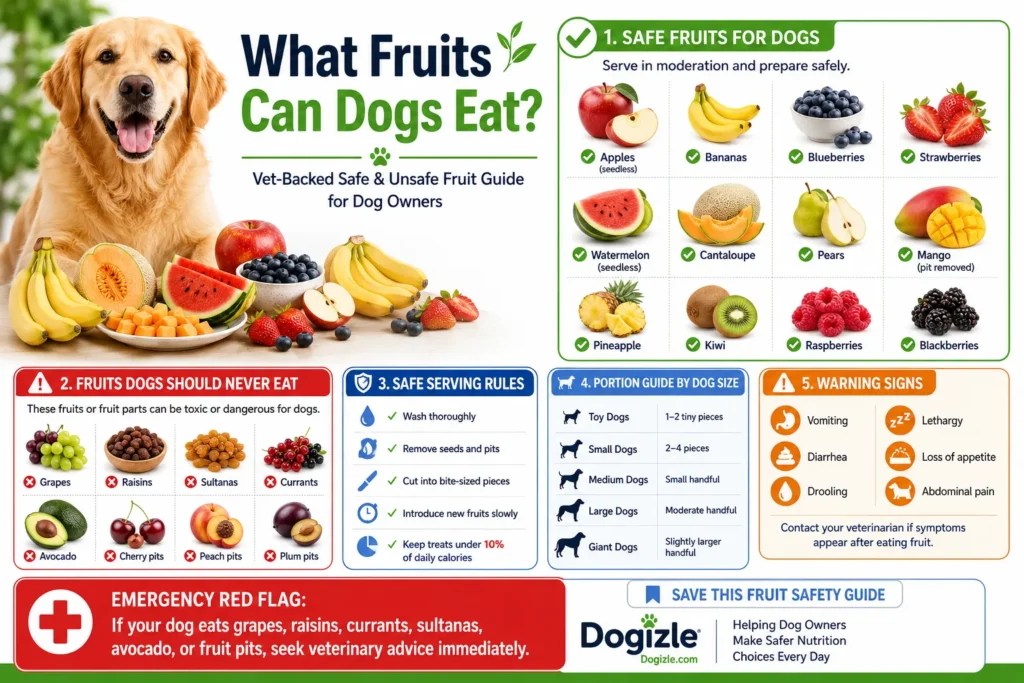
| Apples | Safe in moderation | Remove the core and seeds | Seeds and core can create risk; apple slices are easier to serve safely. |
| Bananas | Safe in moderation | Offer a few small pieces | Sweet and calorie-dense, so portion control matters. |
| Blueberries | Safe in moderation | Serve plain, a small handful at most | Small, easy treat; commonly listed as dog-safe. |
| Strawberries | Safe in moderation | Remove stems; slice for small dogs | Safe in moderation, but sugar still matters. |
| Watermelon | Safe in moderation | Remove rind and seeds | Very hydrating, but the rind and seeds are the main issue. |
| Cantaloupe | Safe in moderation | Remove rind and seeds | Good summer treat, but still treat-sized only. |
| Pineapple | Safe in moderation | Serve fresh, plain, bite-sized | Sweet fruit should be limited to avoid stomach upset and excess sugar. |
| Mango | Safe in moderation | Remove pit and peel | The pit is the major danger, and the flesh is sugary. |
| Pears | Safe in moderation | Remove the core and seeds | Seeds are not the part to share. |
| Kiwi | Safe in moderation | Slice into small pieces | Small size helps reduce choking risk. |
| Oranges | Safe in moderation | Remove peel; feed only small amounts | High sugar and peel can upset the stomach. |
| Raspberries / Blackberries | Safe in moderation | Small portions only | Good occasional treat, but not a daily fruit bowl. |
| Grapes / Raisins / Currants / Sultanas | Avoid completely | Do not feed | These can cause kidney failure and need urgent attention. |
| Avocado | Avoid completely | Keep away from dogs | Toxic risk plus high fat; not a good dog treat. |
| Cherries | Caution / often best avoided | Only fresh flesh, and only if all pits, stems, and leaves are removed | Pits, stems, and leaves can contain cyanide; pits also create a blockage risk. |
| Dried fruit | Avoid or keep out of reach | Not a smart dog treat | Concentrated sugar and the grape-family risk make it poor for dogs. |
The safest fruits for dogs in moderation
The best fruits for dogs are usually the ones that are easy to prepare, easy to portion, and low enough in risk that owners can serve them without guesswork. Apples, blueberries, strawberries, watermelon, cantaloupe, bananas, kiwi, pears, pineapple, oranges, raspberries, and blackberries all appear on reputable pet-care lists, but they still need proper preparation and moderation.
So Apples
Apples are a strong choice because they are easy to slice and widely accepted as dog-safe when the core and seeds are removed. Blue Cross and AKC both emphasize removing the core and seeds, and Dogs Trust also includes apples in the moderation-safe category.
Blueberries
Blueberries are one of the easiest “yes” fruits for dogs because they are small, simple to serve, and commonly listed as safe. They are still a treat, not a free-for-all, but they work well for training rewards and small snack portions.
Strawberries
Strawberries are regularly listed as safe when fed in moderation, and several sources note they should be plain and properly prepared. Remove the stems, avoid sugar-coated or processed versions, and slice them for tiny dogs.
Watermelon
Watermelon is a favorite summer treat because it is hydrating and dog-safe when the rind and seeds are removed. It is a good example of a fruit that is fine in the right form but unsafe in the wrong form.
Cantaloupe and honeydew
Cantaloupe is commonly recommended as a safe occasional treat, and PetMD notes that melon can be a hydrating option when served properly. The same logic applies to honeydew: plain flesh in small pieces is fine, but don’t treat it like a bowl of dog candy.
Pineapple
Pineapple is usually fine in small amounts, and Dogs Trust includes it in its “can usually feed in moderation” list. It is naturally sweet, so portion size matters more than the fruit’s reputation.
Mango
Mango flesh is commonly listed as safe in moderation, but the pit must be removed. The pit is the big risk, not the fruit bowl idea itself.
Pears
Pears are another good example of a fruit that can be safe in the right form. The flesh can be okay in small amounts, but the seeds and core should not be offered.
Oranges
Oranges can be okay in small amounts, but they are high in sugar, and the peel should not be fed. Blue Cross specifically warns that the peel can upset a dog’s stomach.
Kiwi, raspberries, and blackberries
Kiwi appears on the ASPCA’s safe-fruit list, while raspberries and blackberries are also commonly included among dog-safe berries. These are useful, but they should still be treated like occasional treats rather than a regular diet feature.
Mini summary: The safest dog fruits are plain, fresh, seedless or pit-free, and easy to portion. The best choices for most homes are apples, blueberries, strawberries, watermelon, cantaloupe, and bananas because they are easy to prep correctly.
Fruits dogs should avoid completely.
Some fruits are not “moderate foods.” They are do-not-feed foods. Grapes, raisins, sultanas, and currants are the clearest examples because they are linked with kidney failure in dogs, and several trusted sources warn that even small amounts can be dangerous. VCA, Merck, Blue Cross, Dogs Trust, ASPCA, and AVMA all treat grape-family foods as serious hazards.
Avocado is another fruit to keep away from dogs. Dogs Trust and ASPCA both list avocado among foods to avoid, with risks tied to persin and the high-fat content. The fruit may be trendy for humans, but it is not a safe dog snack.
Stone-fruit pits are also a major safety issue. Cherries, peaches, plums, and apricots all deserve caution because the pits can contain cyanide or create a choking or blockage risk, and the leaves or stems can also be hazardous. If you are building a trust-first article, this is where the “don’t be casual” message matters most.
Dried fruit is another trap. It often looks harmless, but it is concentrated, sugary, easy to overeat, and can be part of the grape-family danger zone, depending on the fruit. In UK and European households, this matters especially during holidays, when mince pies, fruitcake, sultanas, currants, and raisin-based bakes are common.
Foods to keep off the counter
- grapes
- raisins
- sultanas
- currants
- avocado
- cherry pits
- peach pits
- plum pits
- apricot pits
- fruitcake and raisin-containing baked goods
Mini summary: The “never feed” group is not large, but it is critical: grapes and raisins first, then avocado, then stone-fruit pits and dried fruit risks.
How much fruit can a dog eat?
Fruit should be treated as a treat, not a meal. A widely used guideline is the 10% rule: treats, including fruit, should make up no more than 10% of a dog’s daily calories. That recommendation appears across major pet-health guidance and is a useful anchor for both healthy dogs and dogs with weight concerns.
| Dog size | Practical fruit portion | Example |
| Toy / very small dog | 1–2 tiny pieces | A few blueberry-sized bites or a thin apple slice |
| Small dog | 2–4 small pieces | A few strawberry slices or diced watermelon |
| Medium dog | Small handful | Several blueberry or melon pieces |
| Large dog | Moderate handful | A little more, but still treat-sized |
| Giant dog | Slightly larger handful | Still not a bowlful; the 10% rule still applies |
This table is meant to be practical, not exact medicine. Dogs with diabetes, obesity, gastrointestinal disease, bladder issues, or special diets may need tighter limits, and any dog with a sensitive stomach should start with a very small amount. PetMD and Dogs Trust both emphasize moderation and advise speaking with a vet when a dog has special dietary needs.
Best rule for real-life dog owners
Start small, wait, and watch. A safe fruit can still cause loose stool, gas, or vomiting if the portion is too large or if your dog is not used to it. That is especially true when fruit is frozen, blended, or offered after a rich meal.
What to do if your dog eats too much fruit
Too much fruit often causes simple stomach upset first. Common signs include vomiting, diarrhea, drooling, reduced appetite, lethargy, restlessness, and gas. If the fruit was just “too much of a safe fruit,” the issue is often digestive upset. If the fruit was grapes, raisins, avocado, or a stone-fruit pit, treat it as urgent.
What to do next
- Stop feeding any more fruit.
- Check exactly what fruit was eaten and how much.
- Keep the packaging if it came from a prepared food.
- Call your vet if your dog seems unwell.
- Call poison control or an emergency vet immediately if the fruit was dangerous.
In the UK and Europe, owners are often advised to contact their local vet promptly and use national poison support or emergency veterinary services where available. In the US, ASPCA Poison Control is a standard emergency reference. The key point is not the phone number alone; it is the speed of action.
Signs your dog may have eaten a bad fruit
This is the section that can save a dog’s life if a reader lands on the page in panic. Some signs are digestive, while others point to toxin exposure or kidney stress. Blue Cross, Dogs Trust, VCA, and Merck all emphasize rapid veterinary attention for grape-family ingestions, and AKC and PetMD describe symptoms tied to cherry-pit or stone-fruit exposure.
| Warning sign | Why it matters |
| Vomiting | Common after toxin exposure or stomach upset. |
| Diarrhea | Can happen with overfeeding or poison exposure. |
| Lethargy | A common red flag in grape-family poisoning. |
| Loss of appetite | Can appear before more severe signs. |
| Abdominal pain | Seen in toxic or blocked-gut cases. |
| Excess thirst/urination | Can signal kidney stress. |
| Difficulty breathing | A concern with cyanide-related or severe toxic events. |
| Constipation / reduced stool | Can happen after a pit or blockage. |
Emergency rule: if your dog ate grapes, raisins, sultanas, currants, a cherry pit, or a stone-fruit pit, do not wait to “see what happens.” Contact a veterinarian promptly.
Best ways to serve fruit to dogs safely
The safest serving method is boring in the best way: wash it, cut it, and remove the risky parts. Dogs Trust, Blue Cross, ASPCA, Purina, and AKC all stress proper preparation rather than assuming the fruit is safe in any form.
Safe-serving checklist
- wash the fruit
- remove cores, seeds, pits, stems, peels, and rinds where needed
- cut into bite-sized pieces. Keep portions small
- avoid sugar-coated, canned, syrup-packed, or flavored versions
- introduce a new fruit slowly
Frozen fruit can be useful in warm weather, but it should still be plain and easy to chew. AKC notes that frozen fruit can work as a cool treat, and PetMD and Rover both point out that whole pieces may be too much for some dogs, especially fast eaters or small breeds.
What to avoid
- canned fruit in syrup
- fruit snacks
- flavored fruit cups
- fruit cake
- raisin bread
- sugar-free fruit products that may contain xylitol
- mixed human desserts with hidden fruit ingredients
Pros and cons of feeding fruit to dogs
Pros
- easy, fresh treat option
- useful for training in tiny portions
- can add variety without using ultra-processed snacks
- Several fruits are low in calories and high in moisture when served correctly
Cons
- Too much sugar can trigger stomach upset
- Some fruits are toxic
- Pits, seeds, and peels can create a choking or blockage risk
- Fruit is not nutritionally necessary for dogs
Common mistakes dog owners make
1. Treating “healthy” fruit like unlimited food
Fruit can still be too much. Dogs Trust and PetMD both remind owners that even safe treats should stay modest.
2. Forgetting the dangerous part of the fruit
The flesh may be okay, but the pit, core, stem, seed, or peel may not be. Apples, pears, peaches, cherries, and mangoes are common examples.
3. Giving fruit snacks or canned fruit
Processed fruit products often contain sugar, syrup, flavoring, or additives that are not appropriate for dogs.
4. Assuming dried fruit is harmless
Dried fruit is easy to overeat, concentrated in sugar, and especially dangerous if it is grape-family fruit.
5. Ignoring special health conditions
Overweight dogs, diabetic dogs, and dogs with sensitive digestion may need tighter treat rules or no extra fruit at all.
Expert tips for better fruit safety
- Use fruit as a training reward, not a bowl filler.
- Keep the safe list short and repeatable so the whole household follows it.
- Pre-cut fruit into tiny portions and store it in the fridge for easy use.
- Stick to one new fruit at a time so you can spot stomach sensitivity.
- For tiny dogs, choose berries or thin slices instead of large chunks.
- During holidays, keep raisins, currants, and fruitcake completely out of reach.
Europe-specific practical advice
This topic matters in Europe because many households regularly keep fruitcake, mince pies, currants, sultanas, and dried fruit in the kitchen during seasonal periods. Dogs Trust and Blue Cross specifically warn about grape-family ingredients in baked goods and holiday foods, which makes the winter and festive periods a high-risk time.
For UK and European dog owners, the safest rule is to treat all grape-family fruit as off-limits and keep holiday bakes, snack bowls, and counter food well away from dogs. Blue Cross and Dogs Trust both emphasize quick vet contact when a dog eats toxic food, and that is exactly the kind of practical line a high-trust dog article should reinforce.
European dog owners also tend to walk more in shared urban spaces, visit cafes, and spend time around families who may not know the rules. That means the article should encourage owners to teach guests not to share fruit bowl leftovers, dried fruit, or dessert scraps. This is a practical behavior-prevention angle that makes the page feel more useful than a generic food list.
Apartment living and urban dog ownership tips
Apartment dogs often get treats more frequently because owners are using food for training, enrichment, or recall practice indoors. That makes portion control even more important. A small dog in a city apartment does not need a large fruit snack just because it is convenient.
A smart apartment routine is:
- Keep fruit pre-cut into tiny portions
- Use fruit only for short training sessions
- Avoid sticky, smelly, or messy fruit indoors
- Choose low-mess options like blueberries or tiny apple pieces
- Store dried fruit and holiday baking ingredients well out of reach
This is especially useful for families, senior owners, and first-time dog owners, because the easier the system is, the more likely everyone will follow it consistently.
Cold weather and seasonal considerations
Cold weather changes the conversation because fruit often shows up in holiday desserts, baking, and snack trays. That is exactly when raisins, currants, sultanas, fruitcake, and mixed baked goods become more common in the home. Dogs Trust, Blue Cross, and RSPCA all highlight these seasonal hazards.
At the same time, frozen fruit can be a useful warm-weather or enrichment treat when it is plain and portioned correctly. AKC specifically notes frozen fruit can be a good icy option when served carefully.
People also ask
Usually not as a regular habit. Fruit should be occasional and limited to a small share of daily calories, with most of the diet coming from balanced dog food.
Yes, some fruits can be offered to puppies in tiny amounts, but puppies have more sensitive stomachs and need stricter portion control. PetMD notes that fruit for puppies still needs moderation.
Yes, if it is plain and safe for dogs. Frozen pieces can be a helpful summer treat, but size matters for choking safety.
It is best to avoid it. Dried fruit is concentrated, easy to overfeed on, and especially dangerous when it involves grapes, raisins, sultanas, or currants.
Yes. Multiple veterinary and pet-safety sources treat grapes, raisins, sultanas, and currants as toxic and linked to kidney failure.
For most dogs, blueberries, apple slices without core or seeds, strawberries, and plain watermelon pieces are among the easiest and safest options to start with.
Yes, in small amounts, but they are high in sugar, and the peel should be avoided.
The best answer to what fruits can dogs eat is not just a list of “yes” foods. It is a safety framework: choose plain fruit, keep portions small, remove seeds and pits, and treat grapes, raisins, avocado, and stone-fruit pits as serious hazards. That approach is more useful to dog owners, more trustworthy for searchers, and stronger for SEO because it answers the real decision behind the query.
Final Takeaway
The best answer to what fruits can dogs eat is not just a list of “yes” foods. It is a safety framework: choose plain fruit, keep portions small, remove seeds and pits, and treat grapes, raisins, avocado, and stone-fruit pits as serious hazards. That approach is more useful to dog owners, more trustworthy for searchers, and stronger for SEO because it answers the real decision behind the query.
For Dogizle.com, this page should function as a pillar article: a quick answer up top, a clear safe-vs-unsafe framework, practical serving rules, urgent warning signs, and a short emergency path. That structure is much more complete than the current list-style SERP and gives readers a reason to trust the site and keep exploring.