👀 Meaning in Text: What the Eyes Emoji Really Means
You’re mid-conversation, you send something juicy, dramatic, or a little bold — and back comes a single 👀. No words. Just two wide eyes staring at you. So what does 👀 mean in text?
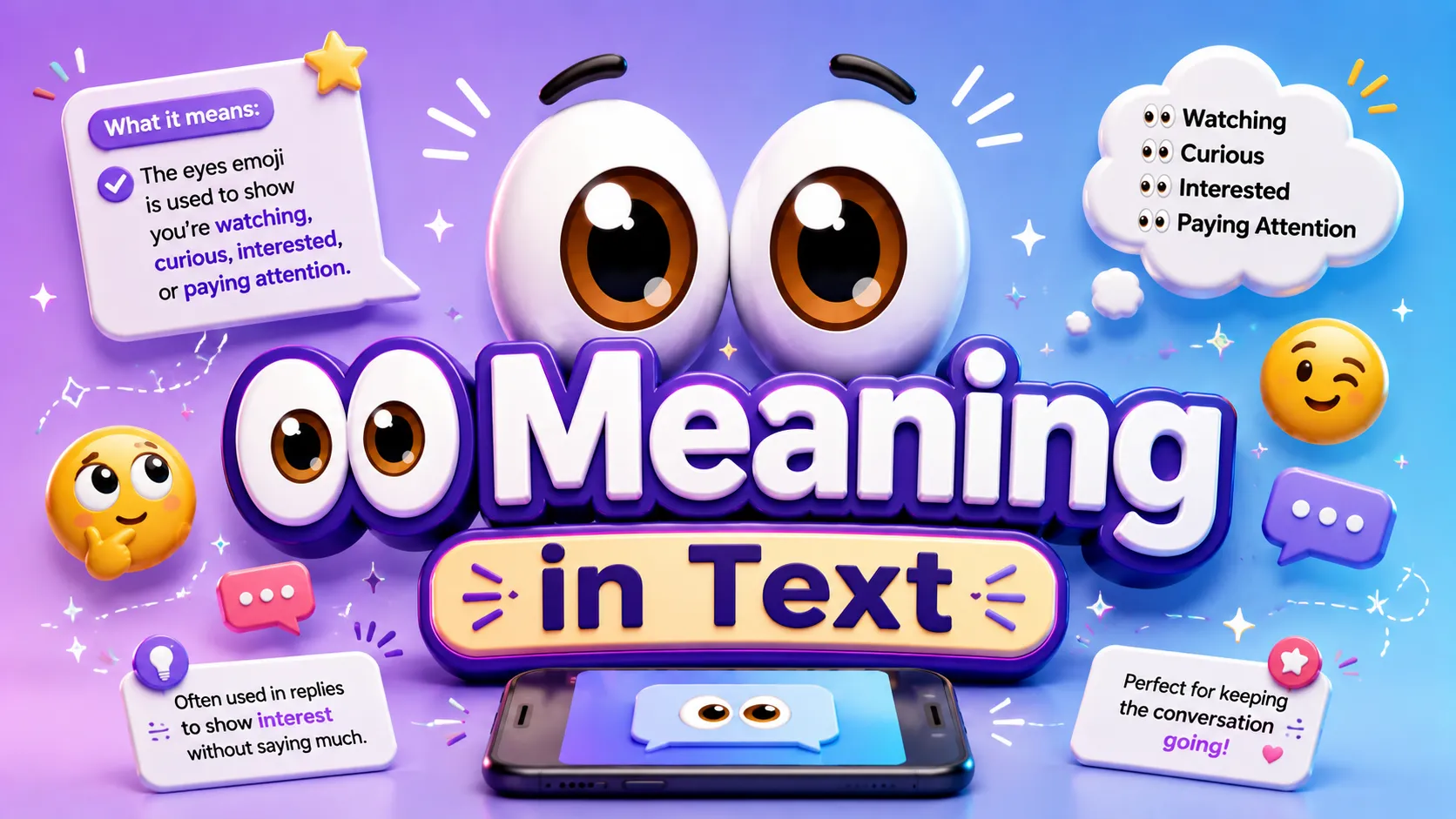
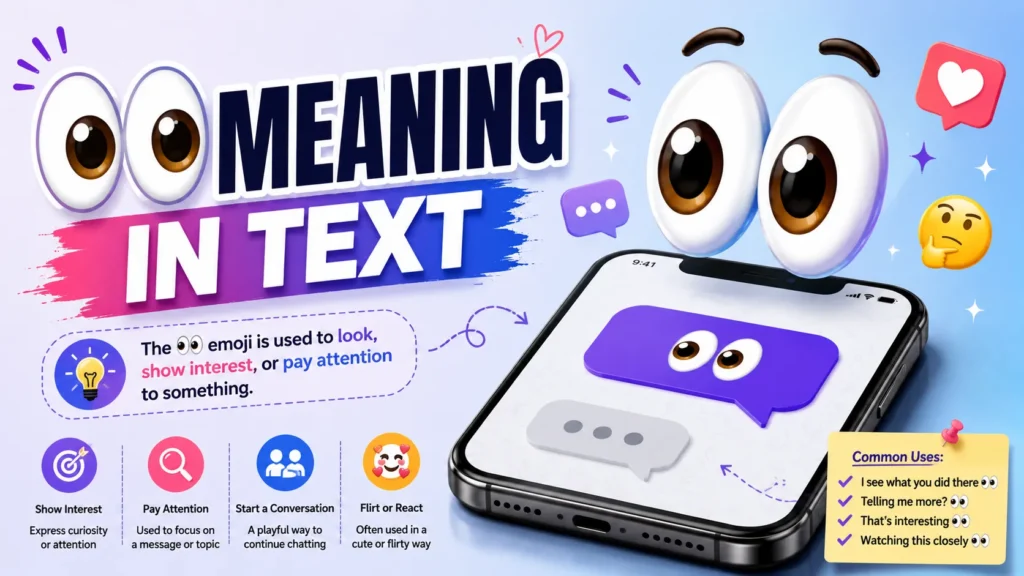
Quick answer: 👀 means the sender is paying close attention to what you said. Depending on context, it can signal Curiosity, Surprise, Suspicion, Flirtation, or “I’m watching this play out.” It works as a stand-in for a full reaction — and its exact meaning shifts based on who sent it, which platform it’s on, and what was said right before it.
People search for this meaning constantly because 👀 is one of the most ambiguous, context-dependent emojis in regular use. It carries no built-in facial expression — no smile, no frown — so it borrows its tone entirely from the conversation around it. This guide breaks that down completely: by sender, by platform, and by relationship context, with real examples throughout.
Quick Meaning Summary
| Sender / Context | Most Likely Meaning |
| From a guy, after a photo | Attraction, flirtation |
| From a girl, after a compliment | Coy interest, playful teasing |
| In a group chat, after gossip | Curiosity, “tell me everything” |
| On Snapchat, next to a Snap | Someone replayed or is watching your Story |
| On Instagram/TikTok comments | Public reaction — surprise, admiration, or “everyone’s watching this” |
| Sent with no text at all | Low-commitment reaction, prompting you to explain more |
| In a work chat | Flagging something worth noticing, understated tone |
What Is the 👀 Emoji, Exactly?
The 👀 emoji — officially named Eyes — depicts two wide, side-glancing eyeballs. It was approved as part of Unicode 6.0 in 2010 and added to Emoji 1.0 in 2015, making it one of the older, more universally recognized emojis still in heavy daily use.
It’s distinct from the single Eye emoji (👁️), which reads as more literal, clinical, or unsettling — often used for surveillance jokes or deadpan reactions. The plural Eyes (👀), by contrast, feels social and reactive. It was built for group chats, comment sections, and casual texting, not literal descriptions of eyesight.
Because it carries no attached expression, 👀 is one of the most flexible reaction emoji available — the reader fills in the tone (flirty, shady, excited, nosy) based entirely on context. That blankness is exactly why the meaning is so often searched: the symbol is doing emotional work while giving almost nothing away on its own.
Why Is 👀 So Popular in Texting?
Its popularity comes down to efficiency. A single 👀 can replace an entire sentence — “wait, tell me more,” “I saw that,” “I’m intrigued,” or “that’s suspicious” — without the sender having to commit to a specific tone. In group chats especially, it’s become shorthand for collective attention: when drama unfolds, someone drops 👀 to signal “we’re all watching this unfold” without derailing the conversation with a full comment.
The 6 Core Meanings of 👀 in Text
| Meaning | What It Signals | Example |
| Curiosity / interest | “Tell me more” | “I have news but I can’t say yet” → “👀” |
| Drawing attention | “Look at this” / highlighting something | “New menu just dropped 👀” |
| Surprise or shock | Reaction to unexpected news | “He just quit his job” → “👀” |
| Suspicion / shade (“sus”) | Something feels off or gossip-worthy | “She said she was ‘busy’ 👀” |
| Flirtation/attraction | Liking what they see, playful interest | Reply to a selfie: “👀🔥” |
| Watching / monitoring | Confirming presence or intent to follow along | “Anyone watching the game tonight?” → “👀 I’m in” |
Most confusion happens because people expect 👀 to mean one fixed thing. In reality, it’s a contextual amplifier — it intensifies whatever emotional charge already exists in the conversation rather than introducing a brand-new one.
👀 Meaning in Text From a Guy
When a guy sends 👀, it usually falls into one of three buckets: he’s intrigued, he’s flirting, or he’s reacting to something bold you said or posted.
- After a photo or selfie: Usually flirty — he likes what he sees but doesn’t want to say it outright.
- After you drop a hint or tease (“I have a secret”): He wants details — curiosity, not necessarily romantic.
- In a group chat after drama: He’s calling out the tension without directly commenting.
- Right after a compliment or bold statement you made: Often playful, similar to a text version of raised eyebrows.
The tone of the conversation before the emoji is the best predictor available. If things were already flirty, 👀 confirms it. If the conversation was neutral, it’s more likely plain curiosity or amusement.
👀 Meaning in Text From a Girl
From a girl, 👀 tends to skew slightly more toward playful teasing or subtle interest — “I see what’s happening here” — though it absolutely can be flirty too.
- Responding to a compliment: Often a coy “I noticed that,” without committing to a fuller reaction.
- In response to gossip: Signals she wants the full story, or already suspects something.
- On a dating app: A low-risk way to show interest without seeming too eager.
- After you say something bold or forward: Can mean she’s intrigued — or calling you out.
In both directions — guy or girl — 👀 functions as a low-commitment signal. It lets the sender express interest, amusement, or suspicion while keeping plausible deniability, which is the entire appeal of the emoji: it implies something without stating anything directly.
What 👀 Means on Each Platform
On Snapchat
👀 next to a Snap typically means someone replayed it or is closely watching your Story. Snapchat’s own eye iconography for viewed content reinforces this — seeing 👀 in chat often implies someone is actively keeping tabs on your activity.
On Instagram
Commonly dropped as a comment on posts or Stories to show admiration, surprise, or “I see you” without writing out a full comment. On an attractive photo it leans flirty; on a big announcement it leans excited or shocked.
On TikTok
Used in comments to mean “Everyone Is Watching This” — typically on controversial, funny, or surprising videos. It’s less personal than a DM use and more about a collective public reaction.
On WhatsApp / iMessage / SMS
The most literal use case — a direct reaction to something you just said, with no platform-specific meaning layered on top. This is where reading the surrounding context matters most.
In Work or Professional Chats
Less common, but used to flag something worth noticing — a typo, a surprising update, or a subtle “look at this” without derailing the professional tone of the conversation.
Is the 👀 Emoji Flirty?
Yes — 👀 can be flirty, but it isn’t flirty by default. It leans flirty when:
- It follows a compliment, selfie, or suggestive comment
- It’s sent alone, with no accompanying text (the silence itself implies something)
- The existing relationship already carries flirtatious undertones
- It’s paired with emojis like 🔥, 😏, or 😳
It’s not inherently flirty when it follows plain gossip, shocking news, or a joke with no romantic subtext. Rule of thumb: 👀 amplifies whatever energy already exists in the conversation — it rarely creates flirtation out of nowhere.
Real Example Conversations
| Message Sent | 👀 Reply Likely Means |
| “I might have a crush on someone in this group chat” | Curiosity — “who is it?!” |
| [Posts a new haircut or outfit photo] | Admiration or attraction |
| “Guess who got fired today” | Shock, wants the full story |
| “I saw your ex at the party” | Suspicion, wants details |
| “Movie night Friday?” | Confirming interest — “count me in” |
| “I did something I probably shouldn’t have” | Nosy curiosity, no judgment implied |
How to Reply to 👀 (By Intent)
If someone sends you a lone 👀, here’s how to respond depending on what you’re going for:
- Keep it playful: “👀 what does that mean” or “why the side-eye”
- Match the energy: Send 👀 back to keep the mystery going
- Push for clarity: “Ok what did you mean by that”
- If it feels flirty and you’re into it: “Stop looking at me like that 😏”
- If you’d rather move on: Simply answer the implied question directly — 👀 doesn’t require an emoji-for-emoji reply.
There’s no wrong way to respond, since 👀 is intentionally open-ended — any reply that keeps the conversation moving works fine.
👀 Combinations and What They Mean
| Combo | Meaning |
| 👀🍿 | “I’m watching this drama unfold” |
| 👀🔥 | Attraction / “that’s hot” |
| 👀😳 | Shock, slightly scandalized |
| 👀👀 | Emphasized attention — “everyone’s watching” or heightened curiosity |
| 👀💀 | Something is funny and shocking |
| 👁️👄👁️ | A related but distinct combo meaning stunned silence or “I have no words” |
Common Misunderstandings About 👀
- “It always means flirting.” It doesn’t — context and what preceded it matter more than the emoji itself.
- “It’s rude or shady by default.” Only in gossip-specific contexts; in most cases it’s neutral curiosity.
- “No reply is needed.” While it’s low-pressure, ignoring it entirely can read as dismissive in an active conversation — a short reply keeps things natural.
- “👀 and 👁️ mean the same thing.” They don’t — the single eye leans literal or unsettling, while the double eyes lean social and reactive.
Similar Emojis to 👀
- 👁️ (Eye) — More literal, often used for “seeing,” surveillance jokes, or unsettling/deadpan reactions rather than social curiosity.
- 👁️👄👁️ (Eye Mouth Eye) — Conveys speechlessness or secondhand embarrassment, distinct from the curiosity of 👀.
- 🍿 (Popcorn) — Often paired with 👀 to mean “grabbing snacks to watch this drama.”
- 😏 (Smirk) — Adds a clearer flirtatious or knowing tone that 👀 alone doesn’t guarantee.
People Also Ask
It Generally means the sender is paying close attention, is curious, surprised, or subtly flirting — the exact meaning depends on the conversation’s context.
Usually curiosity, amusement, or flirtation. If it follows a photo or compliment, it likely signals attraction
A similar range — curiosity, playful teasing, or subtle interest — often used as a low-commitment way to react without stating feelings directly.
It can be, especially when sent alone after a compliment or photo. It’s not automatically flirty in every context.
It typically signals that someone replayed or is actively watching your Snap or Story.
Doubling the emoji intensifies the reaction — it usually signals heightened curiosity, drama, or “everyone is watching this.”
Because it’s a low-effort, low-commitment way to react — it prompts the other person to explain more without the sender having to ask directly or reveal how they feel.
👀 (plural, wide eyes) feels playful and social, used for curiosity and reactions. 👁️ (single eye) feels more literal, used for surveillance or deadpan humor.
Conclusion
The 👀 emoji is less a fixed word and more a Social Cue — it tells the reader “pay attention here” and lets them decide whether that attention is romantic, nosy, shocked, or amused. Read it against the message that came before it, who sent it, and which platform it showed up on, and you’ll rarely be confused by it again.