QQ Meaning in Text: The Complete Guide to Every Way It’s Used (2026)
You’re scrolling through a group chat, a Discord server, or maybe a work email, and there it is: “QQ.” No context. No emoji. Just two letters that could mean someone is crying, mocking you, asking a favor, or referencing an app with a billion users.
Here’s the short version, then we’ll go deep on every single context you might actually be searching for.
Quick Answer: What Does QQ Mean?
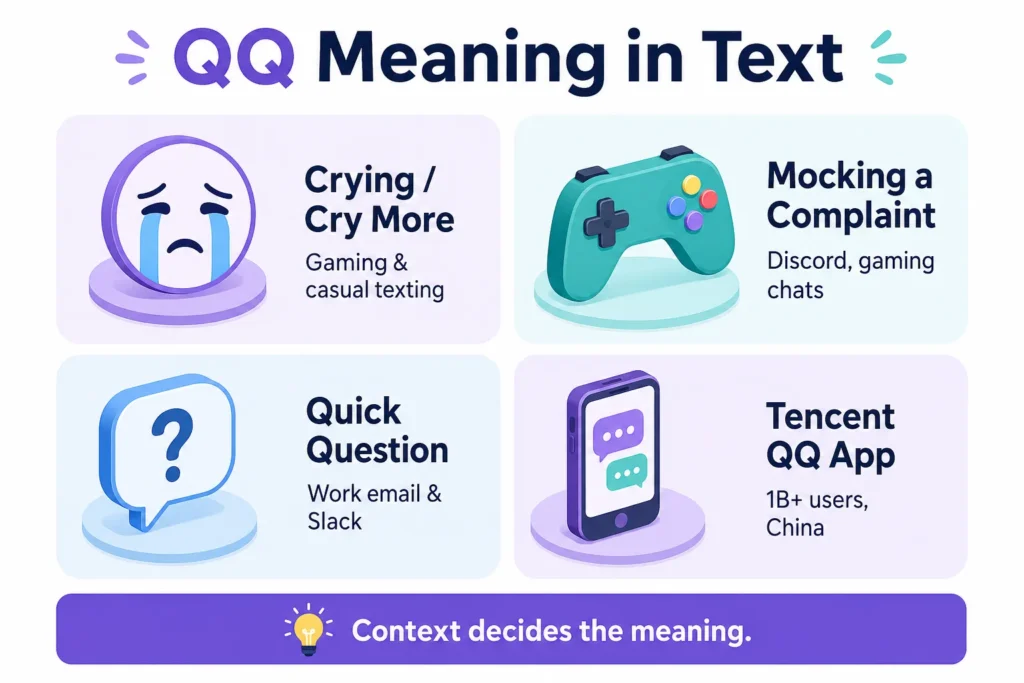
QQ most commonly means “crying” or “cry more.” It started as internet slang built to visually resemble two teary eyes, and it’s used — often sarcastically — to describe someone complaining, whining, or being upset over something small. In business or professional messages, QQ instead means “Quick Question.” And separately, QQ is also the name of a major Chinese instant-messaging app made by Tencent.
Which meaning applies depends entirely on where you saw it. Here’s how to tell the difference in under ten seconds:
| Where you saw it | Most likely meaning |
| Gaming chat, Discord, Reddit | “Cry more” / mocking a complaint |
| Group chat, Instagram/TikTok comment | Playful sadness or fake crying |
| Work email or Slack, usually at the start of a sentence | “Quick Question” |
| Referring to an app, account, or “add my QQ” | Tencent QQ (Chinese messaging platform) |
Now let’s unpack where this actually came from — because most articles online get the origin story wrong (or at least, incomplete).
Where Does QQ Actually Come From?
There are two competing origin theories for QQ, and rather than picking one, it’s worth knowing both — because the evidence supports a blend of them.
Theory 1: The visual “crying eyes” theory. The capital letters “QQ” resemble a pair of eyes with tears streaming down, similar to emoticons like T_T or :'(. Under this theory, QQ was never an acronym at all — it’s a small piece of typographic art that spread because it looked like crying.
Theory 2: The Warcraft II ragequit theory. This theory traces QQ to Warcraft II: Tides of Darkness (1995–96), where players on Battle.net could quit a match using the keyboard shortcut Ctrl+Q, Q (hit twice). Frustrated or losing players would “QQ” out of a match in anger, and better players began taunting weaker ones by telling them to go “QQ” — i.e., quit and stop complaining.
The honest answer: nobody can prove a single origin with certainty, and Urban Dictionary’s own community is split on it. What’s verifiable is that documented usage of “qq” as slang shows up on gaming forums and Urban Dictionary around 2006 — nearly a decade after Warcraft II — and that Blizzard Entertainment leaned into the joke itself, handing out “QQ n00b” branded tissues at BlizzCon 2008. Whichever theory started it, gaming culture is where it was popularized and normalized.
From there, QQ spread out of MMORPGs and competitive gaming into broader internet culture — forums, MSN and Yahoo Messenger in the 2000s, and eventually into texting and social media as we use it today.
QQ Meaning in Gaming (Where It All Started)
In gaming communities — Discord servers, League of Legends chat, World of Warcraft guilds, competitive lobbies — QQ is shorthand for “cry more” or “stop whining.” It’s almost always aimed at someone who’s:
- Complaining about losing a match
- Blaming teammates or game balance for a loss
- Rage-quitting or threatening to
- Being a sore loser in chat
Example:
Player 1: “This new patch is so unbalanced, I keep losing because of it.” Player 2: “qq bro, just get better.”
It’s usually said with a smirk, not real hostility — though like any slang, tone and relationship matter. Between friends, it’s banter. From a stranger after a loss, it can come across as an insult.
You’ll also see the intentional-misspelling combo “qq moar” (“moar” = “more”), which doubles down on the mocking tone.
QQ Meaning in Everyday Texting and Social Media
Outside gaming, QQ has softened into something closer to a crying emoji substitute — used for mild, often exaggerated sadness rather than genuine distress.
On Instagram or TikTok comments:
“I didn’t get the internship qq”
In a group chat:
“You went to the concert without me?? QQ”
As a caption or hashtag:
Used self-deprecatingly, almost like a meme reaction to a minor letdown — a bad grade, a missed event, a rainy day.
The key difference from the gaming usage: here, QQ is usually self-directed (“I’m sad”) rather than aimed at someone else as an insult. Context — who’s saying it, and about what — tells you which register you’re in.
Is QQ Rude?
Not inherently. It depends on direction and tone:
- Self-directed (“I failed my exam, qq”) → harmless, casual venting.
- Aimed at someone else (“qq about it”) → can range from playful teasing to a genuine dismissive jab, depending on your relationship with that person and the situation. Using it toward someone going through something serious can land as insensitive, since it trivializes real emotion.
QQ Meaning From a Girl (In Texting or Dating Apps)
When a girl texts “QQ,” she’s almost always using the crying/sad meaning, not the “quick question” one — the professional usage rarely shows up in casual or flirty texting. It typically signals mock sadness, playful disappointment, or a bid for a bit of sympathy, without being dead serious.
Example:
“You didn’t text me back all day qq”
This usually reads as light teasing rather than an actual complaint. It can also show up as a soft, low-stakes way to express that she missed you or felt a little ignored, without making it a big deal. As always, tone and the surrounding conversation matter more than the two letters themselves — the same “QQ” can be flirty in one context and genuinely a little hurt in another.
QQ Meaning in Business and Professional Messages
Flip the context to a work email, Slack message, or LinkedIn DM, and QQ almost always means “Quick Question.” It typically appears at the very start of a message as a heads-up that what follows should be fast and low-effort to answer.
Example:
“QQ — are we still on for the 3pm sync, or did that move?”
A few etiquette notes worth knowing:
- It signals the sender’s intent to be brief — it doesn’t guarantee the question is actually quick to answer.
- It’s common in North American workplace culture (especially tech and startups) but can read as unfamiliar jargon in more traditional or international business settings.
- It has zero overlap with the “crying” meaning in this context — nobody reading a work email will think you’re upset.
QQ as an App: Tencent QQ
Separately from all the slang meanings, QQ is also the name of a major instant messaging platform developed by Tencent, launched in China in 1999 (originally called OICQ before a legal dispute over similarity to ICQ led to the name change). It combines messaging, social networking, gaming, and more, and has amassed well over a billion registered accounts over its lifetime, making it one of the most significant messaging platforms in Chinese-language internet history — alongside its sibling app, WeChat.
If someone asks for “your QQ” or “your QQ number,” they’re asking for your Tencent QQ account ID, not making an emotional statement. This usage is common among Chinese gamers, students, and businesses, and increasingly shows up in international gaming and esports communities that have cross-cultural overlap with Chinese platforms.
Other, Less Common Meanings of QQ
A few niche and technical uses worth a quick mention, since they occasionally show up in searches:
- Aviation: “QQ” can appear as part of certain airline or flight-code identifiers, depending on the specific system in use.
- Physics/technical discussions: occasionally used informally as shorthand in advanced or niche technical contexts — not a standardized term, and rare enough that you’re unlikely to encounter it outside specialist forums.
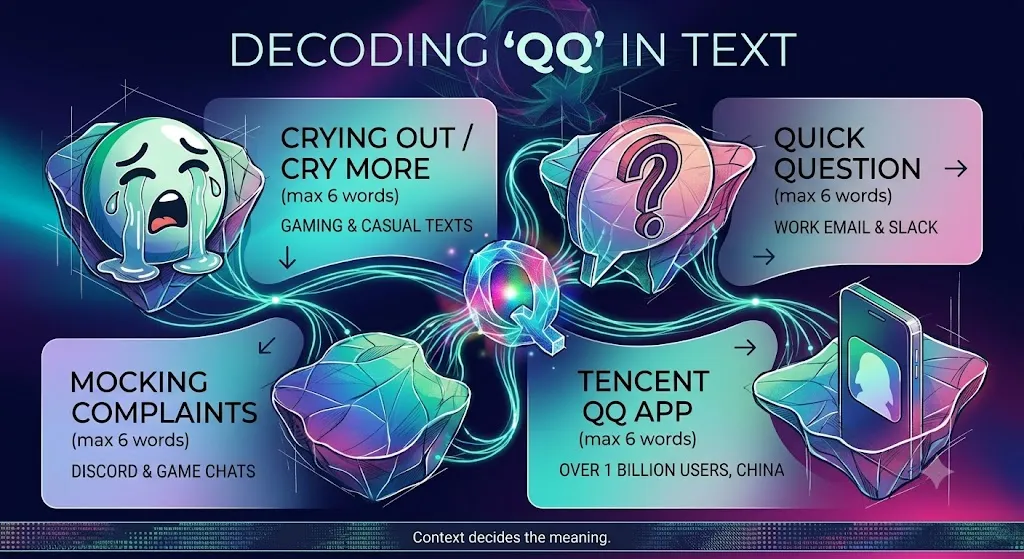
These are edge cases. For 99% of real-world texts, DMs, and chats, QQ means one of the four core meanings above: crying/mocking, quick question, the Tencent app, or playful self-directed sadness.
QQ Meaning on Each Platform
The core meaning doesn’t change platform to platform, but the typical usage pattern does. Here’s what to expect where:
Discord. Almost entirely the gaming meaning — “cry more” or mocking a complaint after a lost match. Extremely common in gaming servers, less so in non-gaming Discords.
Reddit. Shows up in gaming subreddits the same way it does on Discord, plus occasionally in comment sections as a quick, dry reaction to someone else’s complaint in the thread.
TikTok and Instagram. Mostly the softer, self-directed meaning — captions or comments expressing mild, often humorous disappointment (“missed the sale QQ”). Rarely used to mock someone else here.
Snapchat and group texts. Similar to Instagram — casual, self-directed, low-stakes sadness or teasing between friends, closer in spirit to a crying emoji than an insult.
X (Twitter) and Facebook. Least common of the major platforms; when it does appear, it usually follows the same self-directed, meme-adjacent pattern as Instagram/TikTok rather than the gaming-taunt version.
LinkedIn and workplace tools (Slack, email). Exclusively the “Quick Question” meaning — the crying interpretation essentially never applies here.
QQ vs. Similar Slang: How It Compares
| Term | Meaning | Tone | Common Setting |
| Crying / cry more | Mocking or playfully sad | Gaming, texting | |
| T-T or T_T | Crying face emoticon | Genuinely sad or exaggerated | Texting, anime/manga culture |
| SMH | “Shaking my head” | Disapproval, disbelief | General texting |
| “Cry about it” | Dismissive taunt | Blunt, sometimes harsh | Gaming, social media, memes |
| LOL | Laughing | Amused, light | General texting |
| IDC | “I don’t care” | Detached, dismissive | General texting |
The main distinction: QQ implies emotional engagement (someone is upset, or being mocked for being upset), while something like IDC signals the opposite — detachment. LOL is about amusement, not sadness or complaint, which is a common mix-up.
How to Respond to “QQ”
| If someone sends… | You could reply… |
| “QQ” after a real setback | “Aw, that sucks. You okay?” (treat it sincerely) |
| “QQ” as gaming banter aimed at you | “lol whatever, gg” or tease back |
| “QQ — [question]” in a work chat | Just answer the actual question |
| “QQ” as a caption/meme | A laughing emoji or playful comment usually fits |
If you’re ever unsure, the safest move is to look at the sentence around it. QQ rarely carries meaning entirely on its own — it’s a tone modifier, not a full statement.
Common Misconceptions About QQ
- “QQ always means crying eyes.” Not true — in professional contexts it means “Quick Question,” a completely different register.
- “QQ is an acronym.” Not necessarily — the crying-eyes theory suggests it’s visual shorthand, not letters standing for words, unlike “Quick Question,” which genuinely is an initialism.
- “QQ is always mean-spirited.” It can be, but plenty of usage — especially self-directed, on social media — is lighthearted or self-deprecating rather than an attack.
- “QQ is outdated.” It’s less dominant than it was during peak MMORPG culture, but it’s still active in gaming communities, meme culture, and workplace shorthand — it hasn’t disappeared, it’s just niche-shifted.
People Also Ask
Most often, “crying” or mock sadness/complaining. In a work message, it usually means “Quick Question” instead.
It’s slang for “cry more” — typically aimed at a player who’s complaining about losing or blaming the game for a loss.
It depends on tone and direction. Self-directed, it’s harmless. Aimed at someone during a genuinely upsetting moment, it can come across as dismissive.
Almost always the crying/sad meaning — usually playful or mock-sad rather than a serious complaint, though context always matters.
Yes, but only in professional or business contexts — usually placed at the start of a message. It’s unrelated to the crying meaning.
It’s a separate meaning entirely. Tencent QQ is a real instant-messaging platform launched in 1999, unrelated to the internet-slang usage.
Two theories: the letters visually resembling crying eyes, or a callback to a Warcraft II keyboard shortcut (Ctrl+Q, Q) used to quit a game. Documented slang usage dates to around 2006, and gaming culture is where it was popularized regardless of which theory is “true.
Conclusion
QQ is one of those rare slang terms that means genuinely different things depending entirely on where you encounter it. In gaming and casual texting, it’s about crying, whining, or mock sadness — sincere or sarcastic depending on tone. In a work email, it’s a “Quick Question” heads-up. And as a proper noun, it’s the name of one of the world’s largest messaging platforms. The two letters never change — the context around them does all the work.