
Can Dogs Eat Almonds? — The Hidden Danger Most Owners Miss
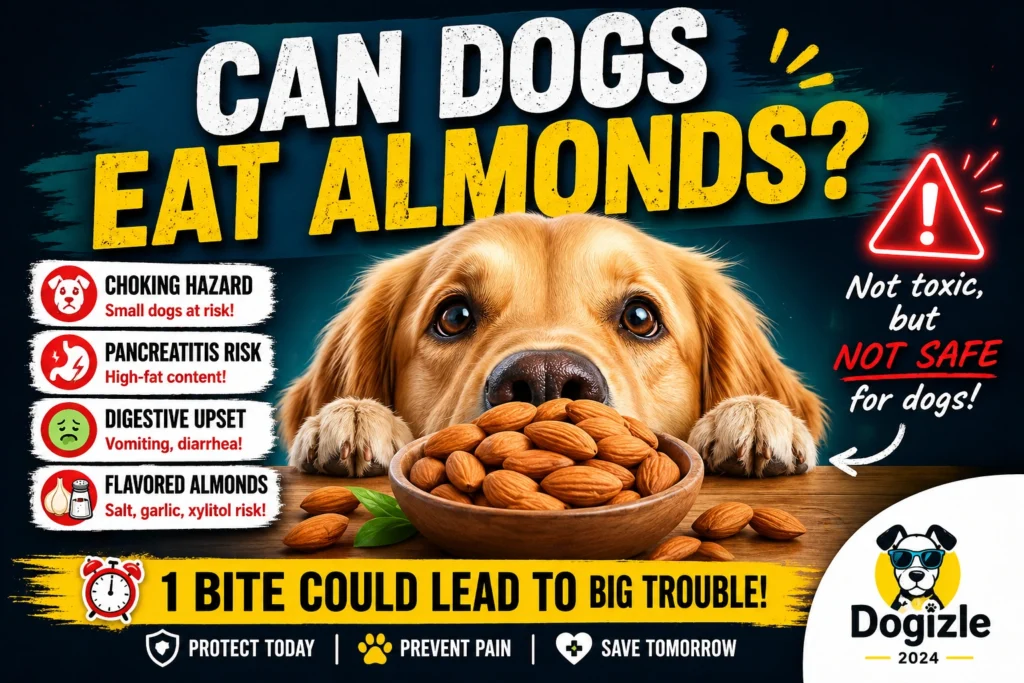
No, dogs should not eat almonds. They can cause choking, stomach upset, and problems from salty or flavored varieties. In this quick guide, you will learn why almonds are unsafe and which dogs are most at risk. And the best vet-approved snacks to choose instead—so you can protect your dog with confidence. And skip dangerous mistakes from the start today. Almonds are often marketed as a nutritious, heart-friendly snack for people. But that does not make them a good choice for dogs. In veterinary guidance, almonds are generally treated as a food to avoid because they are hard to chew. Hard to digest, and capable of causing stomach upset, choking, and, in larger amounts. More serious problems such as pancreatitis.
So the answer to the big question is simple:
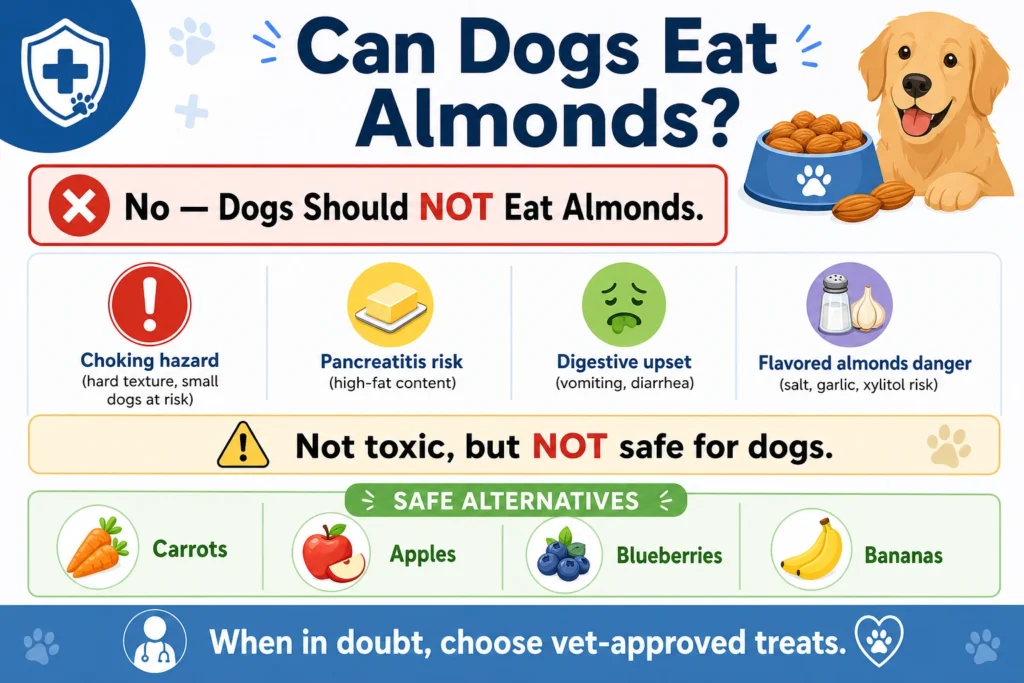
No — dogs should not eat almonds. Even when almonds are not “poisonous” in the same way as grapes or chocolate, they can still be unsafe and unpleasant for dogs, especially if the pieces are whole, salted, flavored, or eaten in quantity.
This guide explains the topic in clear, everyday language so dog owners can quickly understand what is risky, what is merely inconvenient, and what should be treated as an emergency.
Why Are Almonds Bad for Dogs? (Real Risks Explained)
A lot of confusion comes from the fact that almonds are considered a “healthy food” for humans. They are packed with fat, protein, and calories, and they fit nicely into a human snack plan. But dogs do not process foods the same way people do, and the digestive system of a dog is not built to handle many human snack foods in the same way. Veterinarians and animal welfare groups consistently warn that many foods that are harmless for people can still cause harm to pets, especially when they are high in fat or hard to chew.
Another reason almonds create confusion is that some sources say they are “not toxic,” which is technically true for sweet almonds sold for eating in many places. At the same time, “not toxic” does not mean “safe.” The ASPCA notes that sweet almonds are not toxic, but they can still lead to digestive upset and pancreatitis, and bitter almonds contain a cyanide compound and are considered toxic. That distinction matters because people often assume all almonds are safe just because they are sold in grocery stores.
Then there is the practical reality of how dogs eat. Many dogs swallow food quickly, chew poorly, or gulp down treats before the owner can react. A hard almond can become a choking hazard or an esophagus problem even before it has time to affect the stomach. That is why many veterinarians recommend avoiding almonds entirely rather than trying to estimate a “safe” number.
Quick Answer: Can Dogs Eat Almonds?
No, dogs should not eat almonds. Almonds are not the kind of food you should offer intentionally as a treat. The main concerns are choking, vomiting, diarrhea, stomach pain, and the possibility of pancreatitis, especially if the dog eats multiple nuts or an almond product with added salt, sugar, garlic, onion, or xylitol.
If your dog steals one almond, that does not automatically mean disaster. However, it still deserves attention, especially for a small dog, a puppy, or a dog with a sensitive stomach. If the almond was salted, flavored, chocolate-coated, or mixed with other unsafe ingredients, the risk rises quickly.
Are Almonds Safe for Dogs? (Veterinary Perspective)
From a veterinary perspective, almonds fall into a frustrating middle category: they are not usually listed as one of the most toxic foods, yet they are still not a good food for dogs. In other words, they are not a smart snack choice because they create more risk than benefit. That is why major pet-health sources advise avoiding them rather than trying to feed them “carefully.”
The biggest reason is that dogs are not adapted to eat nuts as a regular part of their diet. Nuts are calorie-dense and rich in oils and fats, and that can trigger vomiting, diarrhea, and potentially pancreatitis. The ASPCA specifically groups almonds with other nuts that can cause gastrointestinal signs and pancreatitis in pets.
There is also a texture problem. Almonds are firm, oval-shaped, and hard to break down. If a dog swallows them whole, the nut may lodge in the throat or esophagus or irritate the stomach on the way through. The AKC warns that almonds can block the esophagus or even injure the windpipe if they are not chewed well.
4 Major Risks of Almonds for Dogs
1. Choking hazard
Choking is one of the most immediate concerns. A whole almond is small enough to be swallowed quickly, but it is also hard enough to become stuck. Dogs that bolt their food, puppies, and smaller dogs have very little margin for error if a hard nut gets lodged in the throat. The risk is not just discomfort; it can become a true emergency if breathing is affected.
2. Digestive upset
Even if an almond passes through the throat without issue, it can still irritate the digestive tract. Common signs include gagging, bloating, vomiting, diarrhea, gas, and obvious abdominal discomfort. PetMD and ASPCA both note that nuts can upset a pet’s stomach, especially when consumed in more than tiny amounts.
3. Pancreatitis
Almonds are high in fat, and that is a major issue for dogs. High-fat foods can contribute to pancreatitis, which is a painful inflammation of the pancreas and can become severe. Clinical signs commonly include vomiting, diarrhea, lethargy, decreased appetite, abdominal pain, fever, and a “prayer posture” in some dogs. AVMA-linked veterinary literature and VCA both describe these signs clearly.
4. Salted, roasted, flavored, or processed almonds
Plain almonds are already a poor choice, but flavored versions are worse. Salted nuts can raise sodium intake, and seasoning blends may include garlic, onion, spices, or sweet coatings that create additional danger. Some packaged nut products also include oils and additives that make the food even harder for dogs to tolerate. The AKC and ASPCA both caution against salted and seasoned human foods for pets.
What Happens If a Dog Eats Almonds?
What happens next depends on several factors: the dog’s size, the number of almonds eaten, whether the nuts were whole or chopped, whether the almonds were plain or flavored, and whether the dog already has a history of digestive sensitivity. A single plain almond may cause no obvious problem in one dog, while another dog may develop vomiting, nausea, or a choking episode after a similar exposure.
For a small dog, even one almond can be enough to create a choking concern. For a medium or large dog, one or two plain almonds may not always lead to a dramatic reaction, but it is still wise to monitor closely for vomiting, diarrhea, drooling, reluctance to eat, or behavior changes. Bigger quantities are more concerning because they increase the chance of stomach upset and pancreatitis.
If the almond product was mixed with chocolate, xylitol, raisins, garlic, onion, or heavy seasonings, the situation changes immediately and should be treated more seriously. In those cases, the issue is no longer just the nut itself; the added ingredients may be far more dangerous than the almond.
Warning Signs After Eating Almonds
Watch for changes in breathing, swallowing, energy, appetite, and bowel habits. Alarm signs can include choking sounds, repeated gagging, vomiting, diarrhea, bloating, drooling, weakness, or obvious abdominal pain. These are the kinds of symptoms pet-health sources tell owners to take seriously after a Dog gets into almonds or other risky human foods.
Signs that are especially important in relation to pancreatitis include vomiting, lethargy, fever, poor appetite, diarrhea, and a painful belly. If your dog appears hunched, stiff, unusually quiet, or unwilling to be touched around the stomach, that deserves veterinary attention.
A dog that is coughing, struggling to breathe, or unable to swallow normally should be treated as urgent right away. Choking is a time-sensitive problem, and waiting to see whether the dog “works it out” can make the situation worse.
My Dog Ate Almonds — What Should I Do?
First, stay calm. Panic makes it harder to think clearly, and many accidental pet-food incidents can be handled step by step. The next move is to figure out how many almonds were eaten, whether they were plain or seasoned, and whether your dog is showing any symptoms right now. That information helps you decide how urgent the situation is.
If your dog is choking, has trouble breathing, collapses, or cannot swallow, seek immediate veterinary help. If the dog seems normal but ate more than a tiny amount, call your vet or a pet poison resource for advice, especially if your dog is small, elderly, very young, or already has stomach or pancreas issues. Veterinary and poison-control guidance consistently recommends using the amount eaten and the dog’s symptoms to guide next steps.
If your dog is calm and symptom-free after eating one or two plain almonds, monitoring at home may be reasonable in some cases, but only with close observation for vomiting, diarrhea, discomfort, or breathing changes. PetMD notes that a small amount may pass without trouble for some dogs, while still emphasizing that almonds are not a food to give on purpose.
Can Dogs Eat Almond Butter?
Almond butter is a little different from whole almonds because it removes the choking shape, but it is still not an ideal dog treat. It can be high in fat, and some brands contain salt, sugar, or xylitol. Xylitol is a major red flag in many sugar-free foods, so ingredient checks matter a great deal.
Some veterinary sources say a tiny lick of plain almond butter is usually not a major issue, especially if it is used to give medicine, but that is not the same as recommending it as a regular snack. The safest rule is to keep it occasional, tiny, and only if the product is clearly free from harmful additives.
Can Dogs Drink Almond Milk?
A small accidental taste of almond milk is usually not the same risk level as a bowl of flavored nuts, but almond milk is still not a great choice as a pet beverage. PetMD says a small amount may be okay if a dog licks up a spill, yet it should not be treated as a regular dog treat because it can contribute to stomach upset, pancreatitis, or weight gain, depending on the formula.
Many Almond Milks also contain sugars, oils, thickeners, or other ingredients that are not especially dog-friendly. Since dogs do not need nut milk in their diet, there is little upside and enough downside to make it an unnecessary gamble.
Safe Alternatives to Almonds for Dogs
Instead of giving almonds, choose snacks that are simpler, softer, and better aligned with canine digestion. Dog-safe fruits and vegetables such as carrots, apples, blueberries, bananas, strawberries, and watermelon are commonly listed as reasonable treats when served plain and in moderation. Carrots are often highlighted as a crunchy, low-risk option, while blueberries and apples are frequently recommended in small portions.
Peanut butter can also be a better alternative than almond products, but only when it is plain and xylitol-free. Even then, it should be used sparingly because calories add up fast. The key idea is not to replace almonds with another human snack blindly, but to choose foods that are known to be safer for Can Dogs Eat Almonds and to keep portions modest.
Common Mistakes Dog Owners Make
One common mistake is assuming that “natural” automatically means “safe.” Almonds are natural, but so are many foods that can upset a dog’s stomach or create a choking hazard. Pet-health sources repeatedly remind owners that human foods need to be judged by canine safety, not by human marketing language.
Another mistake is overlooking seasoning. A plain almond is already a poor choice, but an almond that is salted, roasted in oil, sugar-coated, or mixed with garlic and onion flavors can become much more dangerous. Human snack mixes often contain ingredients that are normal for people but inappropriate for pets.
A third mistake is ignoring portion size. Dogs do not need a large amount of almond-related food to have a problem, and the risk rises when the dog is small, fast-eating, or prone to stomach sensitivity. In nutrition, a “small amount” is not the same as “no risk.”
Breed-Related and Size-Related Risk Factors
The biggest practical risk factor is usually size, not breed. Small dogs have less room to tolerate a hard, round, whole almond, so choking and swallowing problems can show up more quickly. Puppies are also vulnerable because they chew less carefully and are more likely to swallow things whole.
Dogs that eat quickly may also be at higher risk, because they are more likely to swallow almonds without chewing enough to break them down. Flat-faced dogs may have extra breathing concerns in any choking situation, which is another reason hard foods are not a good idea, although the main problem here is still the almond itself. That is a practical inference from the choking guidance rather than a breed-specific almond rule.
Large dogs are not “safe” just because they are bigger. A larger dog may tolerate a small accidental exposure better than a toy breed, but a handful of almonds can still trigger vomiting, diarrhea, or a pancreas flare. A bigger size does not eliminate digestive risk.
Real-Life Scenarios: What Owners Actually See
In a home setting, almonds often get dropped on the floor during snacks, mixed into trail mix, or left within reach in a bowl on the table. Dogs are opportunistic eaters, and they tend to investigate anything that falls where they can reach it. That is why accidental ingestion is common, especially in busy households.
During gatherings, people may offer a dog a “tiny bite” without realizing that the bite contains salted nuts, flavorings, or other hidden ingredients. This is one reason veterinarian and poison-control sources stress that human foods should not be shared casually with pets. Even well-meaning feeding can create a medical problem.
Outdoor situations matter too. Dogs may pick up dropped food on walks, in parks, or near picnic areas. Because almonds can look harmless at a glance, owners may miss the connection when stomach upset appears later. That is why any unexplained vomiting, bloating, or abdominal discomfort after a walk deserves a second look.
Veterinary Expert Opinion
The broad veterinary consensus is consistent: almonds are not a toxic food in the same category as the most dangerous pet poisons, but they are still not recommended for dogs because they are difficult to digest, can cause stomach upset, and may create serious complications in larger amounts. That position is echoed across the ASPCA, AKC, and PetMD.
The practical takeaway is simple. Almonds offer dogs no meaningful nutritional advantage that outweighs the risks. Since safer treat options exist, the smartest decision is to leave almonds for people and choose dog-friendly snacks instead.
Pros & Cons of Almonds for Dogs
There are very few meaningful pros for dogs. Almonds are not usually considered highly toxic when they are sweet almonds, and a dog may sometimes pass one without any obvious illness. That is about as positive as the story gets.
The cons are much more important: choking risk, stomach upset, pancreatitis concern, possible blockage, and the danger of added salt or flavoring. Because dogs get no real benefit from almond snacks, the risk-benefit balance is poor.
FAQS
It is not usually considered toxic in the way some other Foods are, but it is still risky enough that it is not a good idea to offer it on purpose. A single almond may still cause choking or stomach upset in a small dog, so the safest answer is to avoid it.
Sweet almonds are generally not classified as poisonous, but they are still unsafe because they can cause digestive upset, choking, and pancreatitis. Bitter almonds are different and are considered toxic because they contain a cyanide compound.
Possible outcomes include choking, gagging, vomiting, diarrhea, bloating, discomfort, or, in more serious cases, pancreatitis. The exact reaction depends on the amount eaten, the dog’s size, and whether the almonds were plain or flavored.
No. Puppies are poor candidates for hard, choking-prone human snacks, and their smaller size makes the risk more concerning. It is better to keep almonds away from puppies completely.
Roasting does not solve the main problems. Roasted almonds are still hard, still high in fat, and still capable of causing choking or digestive upset. If they are salted or seasoned, the risk can become even higher.
Not as a regular treat. A tiny amount of plain almond butter may sometimes be used as a medication helper, but it should be xylitol-free and given only sparingly because of the fat content and the possibility of additives.
Conclusion
So let’s make it clear: dogs should not eat Almonds. Sweet almonds are not usually considered highly toxic, but they are still a poor and risky snack because they can cause choking, vomiting, diarrhea, and pancreatitis, especially if the dog eats several nuts or if the almonds are salted or flavored.
The safest approach is simple: keep almonds away from dogs, watch closely if your pet eats any by accident, and choose dog-friendly treats that are easier to digest and less likely to cause problems. Safer snack choices are available, so there is no good reason to take the risk.