Japanese Dog Names: Smart Picks That Fit Your Dog
Japanese Dog Names — struggling to find a name that truly fits your dog’s personality? This guide helps you discover meaningful, cute, and unique Japanese dog names with clear meanings, so you can choose the perfect name fast and with confidence. Selecting the perfect Japanese Dog name should feel exciting, meaningful, and even a little emotional—not frustrating or overwhelming.
Yet for most dog owners, the experience turns into the opposite.
You open a website expecting inspiration…
And instead, you’re hit with hundreds of random names thrown together without structure.
No guidance.
So, no clarity.
No real help.
Just endless scrolling.
And that creates confusion instead of confidence.
This guide solves that problem completely.
Instead of giving you another generic list, you’re getting a clear, structured naming system designed to help you choose the right name quickly and confidently—without second-guessing.
By the time you finish reading, you won’t just like a name…
You’ll know it’s the right one.
Why Most Japanese Dog Name Lists Fail
Let’s be honest.
Most popular dog name articles follow the same formula:
- Massive lists (100–500+ names)
- Basic meanings
- Loose categories (cute, strong, anime, etc.)
At first glance, that seems helpful.
But in reality, it creates three major problems:
1. Decision Overload
Too many choices lead to hesitation and indecision.
2. Lack of Direction
There’s no system to help you choose what actually fits your dog.
3. No Real-Life Context
Most lists ignore how names perform in daily situations like training, recall, or public use.
What Actually Works: A System, Not a List
The truth is simple:
You don’t need more names.
You need a smarter way to choose one.
That’s exactly what this guide provides.
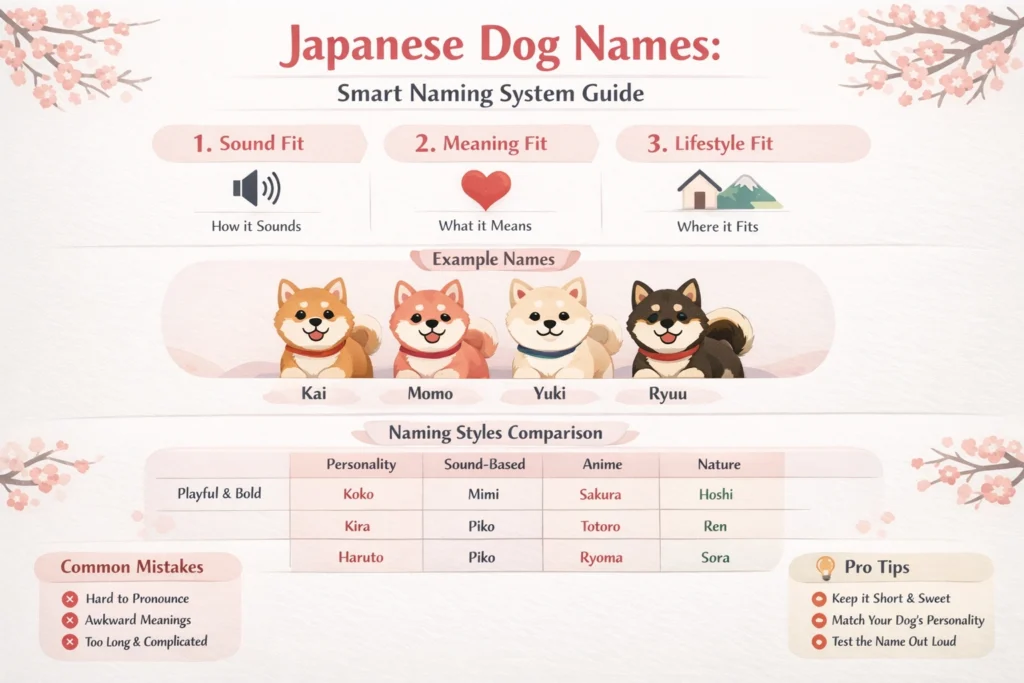
The 3-Part Naming System
Instead of scrolling endlessly, use this proven framework.
1. Sound Fit
This is where most people make mistakes.
A Name might look beautiful on paper—but if it doesn’t sound right, it won’t work in real life.
Ask yourself:
- Is it short?
- Is it clear?
- Is it easy to call out loudly?
Best Characteristics:
- 1–2 syllables
- Strong vowel ending
- Clean, sharp pronunciation
Examples:
- Kai
- Koko
- Momo
These names are easy to shout, easy to repeat, and easy for dogs to recognize.
2. Meaning Fit
A name should feel right—not just sound right.
This is where emotional bonding happens.
Consider:
- Appearance
- Personality
- Energy level
Examples:
- Hana (flower) → gentle, delicate dogs
- Ryuu (dragon) → powerful, dominant dogs
- Yuki (snow) → calm, white-coated dogs
A meaningful name strengthens your connection with your dog.
3. Lifestyle Fit
This is the most overlooked step.
A name might sound great at home—but fail in real-world situations.
Think about:
- Calling your dog in public
- Vet appointments
- Travel documentation
- Apartment vs outdoor environments
Pro Insight:
If a name feels awkward in public, it’s not the right choice.
Quick Comparison: Which Naming Style Fits Your Dog?
| Naming Style | Best For | Strength | Example Feel |
| Personality-based | Calm, bold, playful dogs | Very High | Yuki, Hana, Katsu |
| Sound-based | Training & recall | Very High | Kai, Koko, Momo |
| Meaning-based | Emotional connection | High | Sakura, Hoshi |
| Culture-based | Anime lovers | Medium-High | Goku, Nezuko |
| Nature-based | Elegant dogs | High | Sora, Umi, Kaede |
How to Choose the Right Japanese Dog Name
Step 1: Start With Your Dog’s Energy
Every dog has a natural vibe or temperament.
Gentle & Soft Dogs:
- Hana
- Momo
- Yuki
Strong & Confident Dogs:
- Ryuu
- Katsu
- Takeo
Always match the name to the dog—not trends or popularity.
Step 2: Keep Pronunciation Simple
Simple names perform better in real-life scenarios.
Why simplicity matters:
- Easier to repeat
- Faster recognition
- Better training response
Ideal Format:
- 1–2 syllables
- Ends in a vowel
Examples:
- Kai
- Sora
- Koko
Step 3: Match Your Lifestyle
Your environment directly impacts how effective a name is.
Apartment Living:
- Short, soft names
- Easy repetition
Active Outdoor Life:
- Clear, strong names
- Loud projection
European Travel Considerations:
Consistency is critical across:
- Vet records
- Microchip registration
- Pet passport
One name. One pronunciation. Always consistent.
Best Japanese Dog Names by Personality
Cute Japanese Dog Names
Perfect for affectionate, small, or fluffy dogs:
- Mochi
- Koko
- Momo
- Kiki
- Chibi
- Runa
- Nana
- Piko
- Yuki
- Tofu
These names feel warm, charming, and emotionally engaging.
Strong Japanese Dog Names
Ideal for confident, bold, or large dogs:
- Ryuu
- Takeo
- Katsu
- Akio
- Daiki
- Kenshin
- Tatsu
- Raiden
- Hiro
- Shiro
These names project strength, authority, and presence.
Nature-Inspired Japanese Dog Names
Elegant, timeless, and versatile:
- Sora (sky)
- Umi (ocean)
- Kaede (maple)
- Hoshi (star)
- Kumo (cloud)
- Taki (waterfall)
- Aki (autumn)
- Haru (spring)
- Natsu (summer)
- Yuki (snow)
Nature names are balanced and universally appealing.
Anime-Inspired Japanese Dog Names
Fun, expressive, and culturally rich:
- Totoro
- Goku
- Nezuko
- Sakura
- Kiki
- Luffy
- Hinata
- Asuna
- Naruto
- Chibi
Perfect for fans who want personality-driven names.
Japanese Dog Names for Male and Female Dogs
Male Japanese Dog Names
| Name | Meaning | Best Fit |
| Hiro | Generous | Friendly dogs |
| Kenji | Wise | Intelligent dogs |
| Taro | Big boy | Confident dogs |
| Akio | Bright | Cheerful dogs |
| Ryuu | Dragon | Strong dogs |
| Katsu | Victory | Determined dogs |
| Hiroki | Joy | Happy dogs |
| Kenta | Healthy | Active dogs |
Female Japanese Dog Names
| Name | Meaning | Best Fit |
| Hana | Flower | Gentle dogs |
| Sakura | Blossom | Elegant dogs |
| Yumi | Beauty | Calm dogs |
| Emi | Smile | Loving dogs |
| Aiko | Love child | Affectionate dogs |
| Yuri | Lily | Soft dogs |
| Rina | Jasmine | Graceful dogs |
| Miyu | Gentle | Sensitive dogs |
Choosing Based on Dog Size & Type
Small Dogs
Best-suited names:
- Mochi
- Kiki
- Momo
- Chibi
- Piko
Short names = better control and faster response.
Large Dogs
Recommended names:
- Ryuu
- Katsu
- Takeo
- Daiki
Strong sounds create authority and clarity.
Calm Dogs
- Yumi
- Sora
- Hana
- Kaede
Playful Dogs
- Koko
- Momo
- Kiki
- Yoshi
Pros and Cons of Japanese Dog Names
Advantages
- Unique and distinctive
- Deep meanings
- Strong emotional connection
- Training-friendly (short names)
- Culturally rich
Disadvantages
- Some names may be difficult to pronounce
- Meanings aren’t always used daily
- Trend-based names may age poorly
- Long names reduce recall efficiency
Common Mistakes Dog Owners Make
1. Choosing Long Names
Difficult to call and harder to train.
2. Names That Sound Like Commands
Example:
- “Kit” vs “Sit”
Confuses training.
3. Inconsistent Pronunciation
Different pronunciations = slower learning.
4. Trend-Based Naming
Trendy today… awkward tomorrow.
5. Skipping the Real-Life Test
Always say the name out loud in real situations.
Expert Tips for Choosing the Perfect Name
✔ Use the Call Test
Say it loudly:
“COME HERE ___!”
If it feels unnatural—skip it.
✔ Keep It Short
Short names = faster recognition.
✔ Think Long-Term
Your puppy will grow.
Choose a name that still fits years later.
✔ Consider Environment
- Apartment → soft names
- Outdoor → strong, clear names
Safety, Health & Real-Life Use
A dog’s name is not just identity—it’s a safety tool.
Fast response = safer dog.
Consistency is essential for:
- Veterinary records
- Microchip identification
- Travel documents (especially in Europe)
FAQs
Yes. They are unique, memorable, and work well if easy to pronounce.
Short names:
Kai
Koko
Momo
Yuki
Hana
Yes. It helps create a stronger connection.
Yes—but avoid overly trendy picks.
Popular choices:
Haru
Yuki
Katsu
Sora
Momo
Yes. Just keep pronunciation simple and respectful
Yes. Use the same name consistently across:
Vet records
Travel documents
Conclusion
The scientific name of a Dog is not just a memorization-based school answer—it represents a complete evolutionary and biological system.
The accepted modern classification, Canis lupus familiaris, clearly shows that:
- Dogs are domesticated animals
- They share ancestry with wolves
- They belong to a structured taxonomy
- They evolved through human interaction
Understanding this concept helps students move beyond rote learning and understand real biological science in a meaningful way.