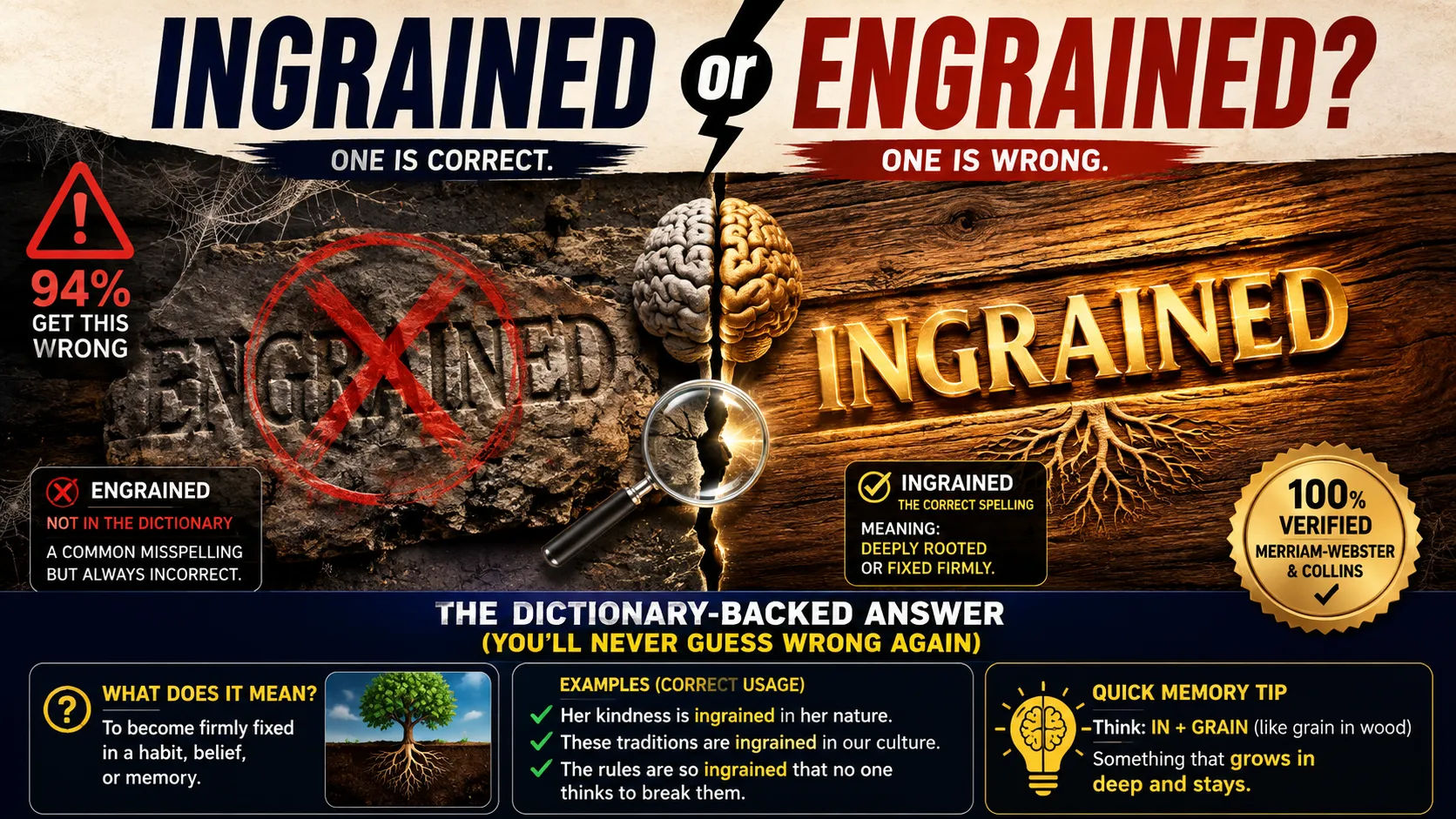
What Does “Ingrained” Mean?
Ingrained is an adjective that describes something so deeply embedded, established, or habitual that it’s difficult to change or remove. Merriam-Webster defines it as “forming a part of the essence or inmost being: deep-seated.”
It typically describes:
- Beliefs
- Habits
- Personality traits
- Cultural norms
- Biases or prejudices
- Physical residue (less common) — such as dirt worked into fabric
Quick Meaning Summary
| Term | Status | Meaning |
| Ingrained | Standard, modern spelling | Deeply embedded, firmly established, hard to change |
| Engrained | Valid but rare variant | Same meaning, older/less common spelling |
| Pronunciation | Identical for both | /ɪnˈɡreɪnd/ |
| Word class | Adjective (also past participle of the verb “ingrain”) | — |
Ingrained or Engrained: Which Spelling Is Correct?
“Ingrained” is the correct and standard spelling in modern English, in both American and British usage. “Engrained” is not a misspelling — dictionaries such as Merriam-Webster and Collins list it as a recognized variant — but it’s rare and reads as dated to most audiences today.
If you’re unsure which to use, default to ingrained.

Origin and History of Ingrained and Engrained
The word traces back to the verb ingrain: to work something into the “grain” — originally the grain or fiber of cloth dyed with fast colors, later extended metaphorically to a person’s character or a society’s habits.
Both ingrain and engrain appeared in English print by the 1500s. English spelling wasn’t standardized at the time, so neither form was considered “wrong.” Over the following centuries, usage gradually consolidated around ingrain/ingrained, which now dominates by a wide margin in both American and British English.
Why Do Two Spellings Exist?
Middle English inherited two prefixes that both roughly meant “into”:
- in-, from Latin, as in inscribe, infiltrate, incorporate
- en-, from Old English/Germanic roots, as in enable, encase, entangle
Both prefixes survived into modern English and attached to “grain” independently, producing two parallel spellings. No formal authority ever declared one correct and the other wrong — usage simply drifted toward “in-” over time.
Ingrained vs. Engrained: Key Differences
| Ingrained | Engrained | |
| Status | Standard, dominant spelling | Valid but rare variant |
| Region | Preferred in American and British English | Occasionally seen in British/older texts |
| Typical use | Beliefs, habits, traits, culture, bias | Same meanings; sometimes reserved for literal physical embedding |
| How it reads | Natural, current | Dated or overly formal |
| Dictionary listing | Primary entry | Listed as secondary variant, not flagged as an error |
Why Is “Ingrained” More Popular Today?
Usage-frequency data (tracked via published books since the 1800s) shows a long-term, consistent shift toward “ingrained” in both American and British English. Style guides, editors, and modern dictionaries have converged on it as the default, which reinforces its use in journalism, publishing, and education — a feedback loop that has made “engrained” increasingly uncommon outside older or literary texts.
American English vs. British English Usage
This isn’t a true US-vs-UK spelling split like color/colour:
- American English: ingrained — essentially no debate; engrained will read as an error to most American readers and editors.
- British English: ingrained is still dominant, though engrained survives slightly more often here than in the US, mainly in older or literary writing.
No dialect treats “engrained” as the preferred or expected spelling.
How to Use “Ingrained” in a Sentence
- Honesty was ingrained in her from childhood.
- Their skepticism toward authority is deeply ingrained.
- Good posture becomes ingrained with enough repetition.
- The company’s safety culture is ingrained at every level.
- His fear of public speaking was ingrained after one bad experience in school.
- Ingrained habits are the hardest ones to break.
- Respect for elders is ingrained in many cultures.
How to Use “Engrained” in a Sentence
- The grime was ingrained so deeply in the stone that no cleaning restored it.
- Their old customs remained ingrained in village life for generations.
- Years of dust had become ingrained in the wooden floorboards.
- Her formal, old-fashioned manner felt ingrained rather than practiced.
Common Mistakes to Avoid
- Assuming “engrained” is always a typo — it isn’t; it’s simply uncommon.
- Using “engrained” in formal or professional writing expecting it to sound more sophisticated — it usually reads as slightly off instead.
- Confusing either word with ingrown or engraved — both unrelated in origin and meaning.
- Correcting someone who uses “engrained” by calling it “wrong” — it’s outdated, not incorrect.
Ingrained vs. Ingrown vs. Engraved
| Word | Meaning | Example |
| Ingrained | Deeply embedded or established (belief, habit, trait) | An ingrained sense of duty |
| Ingrown | Grown inward into itself, usually physical | An ingrown toenail |
| Engraved | Cut or carved into a surface | Her name was engraved on the ring |
These three words are unrelated in origin despite looking similar — a common source of confusion.
Synonyms for Ingrained
- Deep-seated
- Inherent
- Intrinsic
- Deep-rooted
- Entrenched
- Innate
- Instilled
- Fixed
- Second nature
Mnemonic: How to Remember the Correct Spelling
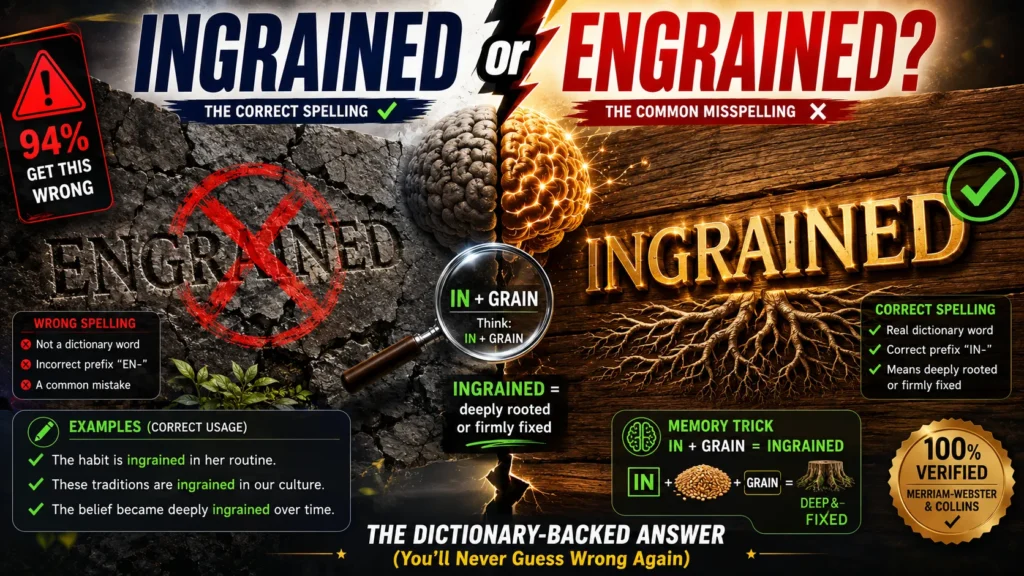
Think: “IN your nature, not engraved on a wall.”
- Ingrained = something inside you — belief, habit, character.
- If you catch yourself thinking of engrave, that’s the trap. Engrave and ingrained are unrelated words, but the visual similarity is exactly why writers slip into “engrained.” Notice the trap; default back to ingrained.
Explore More: https://dogizle.com/hyu-meaning-in-text/
Related Commonly Confused Words
- Ingrown vs. Ingrained
- Engrave vs. Engrained
- Imbed vs. Embed
- Benefited vs. Benefitted
- All Right vs. Alright
People Also Ask
Yes. It’s a recognized, dictionary-listed variant of “ingrained,” not a misspelling — but it’s rare in modern usage.
No. Ingrained is standard in both American and British English. Engrained appears slightly more often in older British writing, but it isn’t the preferred UK spelling.
Ingrained is the correct, standard, modern spelling in both American and British English. Engrained is valid but outdated.
It’s technically acceptable but not recommended — it can read as an error to readers and editors who expect the standard spelling. Use “ingrained” for anything formal.
There’s no meaningful difference — both describe something deeply established or hard to change. Some writers informally reserve “engrained” for literal physical embedding, like dirt in fabric, and “ingrained” for character, habits, and beliefs, but this isn’t an official rule.
From “ingrain,” originally describing dyeing cloth “in the grain” (fiber) with fast colors, later extended metaphorically to describe something worked permanently into a person’s character.
One word. It’s written as a single term — never “in grained” or hyphenated.
Conclusion
Ingrained is the spelling to use. It’s the Dictionary-preferred, dominant form in both American and British English, and it’s what modern readers, editors, and style guides expect. Engrained isn’t wrong — it’s a legitimate historical variant — but it’s rare enough today that using it will more likely read as a mistake than a stylistic choice. When in doubt, write ingrained, and save “engrained” for deliberately old-fashioned or literary contexts.