MF Meaning in Text: What It Really Means (And Where the “Facts” Everyone Else Is Copying Actually Came From)
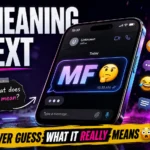
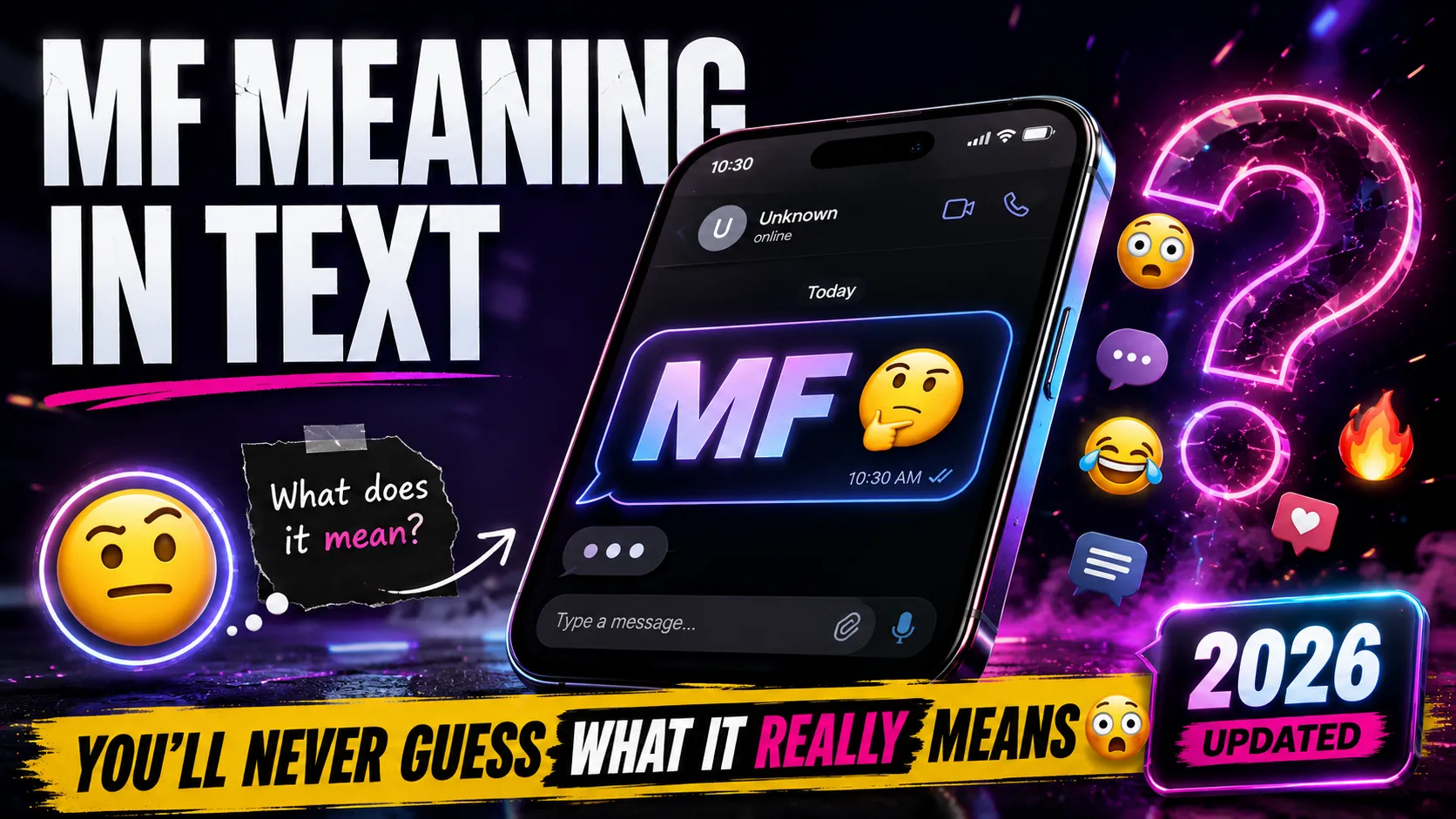
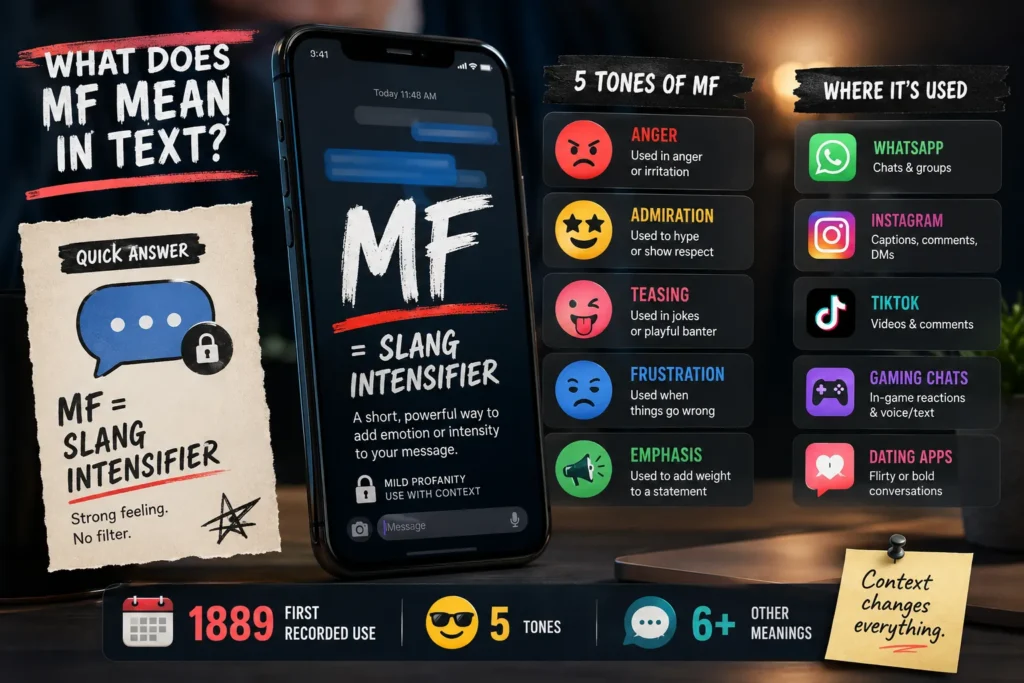
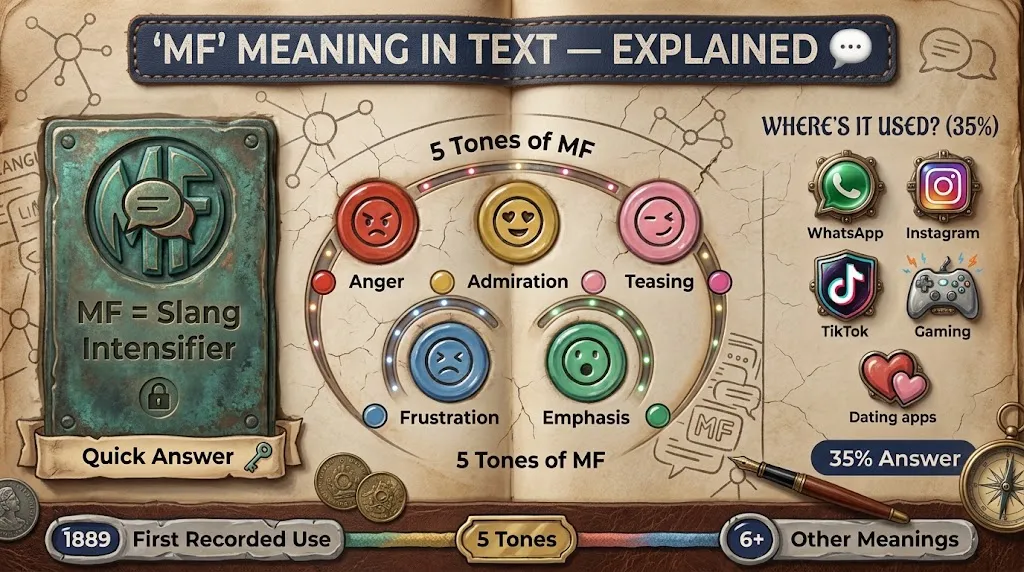
Quick answer: In texting and on social media, MF is short for “motherf**ker,” used as a slang intensifier rather than a literal insult. Depending on tone, it can express anger, shock, admiration, or playful teasing — “that MF stole my fries” and “you’re such a talented MF” mean very different things. Outside of texting, MF also stands for Mutual Fund (finance), Myelofibrosis (medicine), mezzo-forte (music), Medium Frequency (electronics), and Multi-Function (tech products).
If you scrolled past a comment, DM, or gaming chat and stopped on “mf,” this guide breaks down exactly what it means, how to tell the tone apart, where the abbreviation actually came from (with real sources — not guesses), and how to respond.
What MF Means in Texting
In the overwhelming majority of texts, comments, and captions, “mf” is a censored abbreviation of “motherf**ker.” People type the two letters instead of the full word for three practical reasons:
- Speed — two keystrokes beat eleven.
- Platform filters — many apps auto-flag or shadow-mute posts containing the unabbreviated word, and “mf” usually slides past those filters.
- Softened delivery — an abbreviation reads as less confrontational than the spelled-out slur, even though everyone knows what it means.
What trips people up is that the word itself has almost nothing to do with its literal construction anymore. Linguists classify it as a generalized intensifier — a word that amplifies whatever emotion surrounds it — closer in function to “damn” or “hell” than to an actual accusation. That’s why the same abbreviation can show up in an insult, a compliment, and a joke within the same conversation.
Where MF Actually Came From
Most articles on this topic guess wildly at the term’s history — you’ll see claims ranging from “the 15th century” to “the 1970s” with no source attached. Here’s what’s actually documented:
- 1889: The earliest confirmed print citation is in the Oxford English Dictionary, taken from a Texas Court of Criminal Appeals transcript of a murder trial (Levy v. State), where a witness quoted the phrase during testimony. Court reporters partially censored it even then.
- 1906–1918: Related forms (“motherfucking,” then “motherfucker” as a standalone noun) begin appearing more regularly in court records and soldiers’ slang, with Merriam-Webster listing 1918 as the first known dictionary-recorded use of the noun form.
- 1948: The clipped abbreviation “m.f.” shows up in print for the first time in Ezra Pound’s Pisan Cantos, rendering World War II soldier dialogue.
- Mid-20th century: The word moves through jazz and blues culture, where it’s flipped from a pure insult into a term of grudging respect — “a bad motherfucker” meant someone impressively skilled or tough.
- 1960s–70s onward: Hip-hop, funk, and film (blaxploitation cinema, then mainstream action movies) push the word into wider pop-culture use.
- 2000s–today: Early internet forums and SMS texting revive the two-letter clip “mf” as a filter-dodging shorthand, and social media (Twitter, Instagram, TikTok) cements it as everyday slang.
One persistent myth worth addressing directly: some sources claim the word originated specifically as a reference to slavery-era abuse. Lexicographers — including Jesse Sheidlower, former editor at large of the OED — have stated there’s no documented evidence for that specific origin story. The word’s actual paper trail starts with the 1889 Texas court record above; broader claims about its precise origin should be treated as folklore, not fact.
The 5 Tones of MF (With Examples)
Tone is everything with this word. Here’s how the same two letters shift meaning:
| Tone | What It Signals | Example |
| Anger/insult | Genuine frustration or contempt | “That MF cut me off in traffic.” |
| Admiration / respect | Impressed by skill, toughness, or boldness | “You’re a talented MF, not gonna lie.” |
| Playful teasing | Affectionate jab between close friends | “You’re such an MF for eating my leftovers 😂” |
| Self-directed frustration | Annoyance at your own mistake | “MF, I forgot my charger again.” |
| Pure emphasis / intensifier | Adds punch with no real insult intended | “This coffee is MF delicious.” |
The giveaway is almost always what surrounds the word — punctuation, emoji, capitalization, and who’s saying it. “lol you’re an mf 😂” and “you’re an MF.” read as completely different messages.
MF on Different Platforms
The word’s core meaning doesn’t change by app, but the social risk of using it does:
- WhatsApp / iMessage / SMS: Lowest risk — these are private, one-on-one or small-group chats, so MF here is almost always casual and between people who already know each other’s humor.
- Instagram: Common in captions and comments, usually for emphasis or humor. Public visibility means tone can be misread by strangers scrolling past.
- TikTok: Frequently used in captions, voiceovers, and comment sections for comedic or dramatic effect — TikTok culture leans toward exaggeration, so MF there skews playful more often than hostile.
- X (Twitter): Higher risk of being read as genuinely aggressive, since replies and quote-tweets are public and often between strangers, not friends.
- Snapchat: Mostly private, short-form, and playful — similar risk profile to WhatsApp.
- Gaming chat (Discord, Xbox/PlayStation party chat, Twitch): Extremely common as a reflexive reaction to a clutch play or a frustrating loss — usually not personal.
- Dating apps: Riskiest context. A match who doesn’t know your humor yet has no tone cues to work with, so MF here is the most likely to be misread as aggression.
Is MF a Bad Word? Etiquette Guide
Short answer: treat it like a mild profanity, not a neutral abbreviation. A few rules of thumb:
- Know your audience. Fine with close friends who already text this way; risky with coworkers, new acquaintances, or family group chats.
- Never use it in professional communication — email, Slack with your manager, LinkedIn comments, customer-facing chat. It reads as unprofessional regardless of intended tone.
- Add tone signals when the context is ambiguous. An emoji (😂, 🥲, 💀) or a follow-up message can turn a message that reads as hostile into an obvious joke.
- Don’t assume it’s always an insult — but don’t assume it’s always harmless, either. If someone you don’t know well uses it toward you, it’s reasonable to ask what they meant before reacting.
MF’s Other Meanings (Non-Slang)
Outside of texting, “MF” is a real abbreviation across several unrelated fields. Context tells you which one applies instantly:
| Field | Meaning | Typical Context |
| Finance | Mutual Fund | “I moved $2,000 into an MF this quarter.” |
| Medicine | Myelofibrosis (a rare bone marrow disorder) | Medical charts, oncology discussions |
| Music notation | Mezzo-forte (“moderately loud”) | Sheet music dynamic markings |
| Electronics/Radio | Medium Frequency | Radio spectrum classifications |
| Photography | Medium Format | Camera and film specifications |
| Consumer tech | Multi-Function | Printers, appliances, tools |
| Casual/rare slang | “My Friend” | Occasionally used this way in casual texts, though far less common than the profane meaning |
If you see “MF” in a bank statement, a hospital record, or a printer manual, it is not the slang term — context makes the switch obvious every time.
MF vs. Mofo vs. Similar Slang
- MF — the abbreviated, text-friendly version; works in captions, comments, and quick messages.
- Mofo — a spoken/phonetic variant of the same word, more common in speech and dialogue than in text.
- Motherf**ker (spelled out) — the full, uncensored version; carries the most weight and is more likely to be flagged by platform filters.
- Related intensifiers (for comparison, not the same word): AF (“as f*ck”), FR (“for real”), SMH (“shaking my head”) — these serve a similar grammatical role as emotional amplifiers but without the profanity.
How to Respond to MF
If someone directs “mf” at you in text, the right response depends on the read:
Explore More: https://dogizle.com/wwa-meaning-in-text/
- If it’s clearly playful (emoji, exclamation, joking context): mirror the tone back — “lol you’re one too.”
- If it’s ambiguous: ask directly — “wait, mad or joking?” This is a normal, low-stakes question and avoids escalating a misread.
- If it’s clearly hostile: you’re allowed to just say so — “that came off harsh” — or disengage if it’s a stranger online.
People Also Ask
MF is most commonly short for “Motherf**ker,” used as slang to express strong emotion — anger, admiration, frustration, or humor — rather than a literal statement.
No. Tone and relationship determine the meaning. Among friends, it’s frequently a joke or a compliment; from a stranger or in a hostile context, it usually is an insult.
No. Even in its abbreviated form, it reads as profanity and is inappropriate for work email, LinkedIn, or formal communication.
It also stands for Mutual Fund (finance), Myelofibrosis (medicine), mezzo-forte (music notation), Medium Frequency (electronics), and Multi-Function (tech products), among others — context makes the intended meaning clear.
The earliest documented print use is from an 1889 Texas court transcript recorded in the Oxford English Dictionary. The abbreviation “m.f.” appears in print by 1948. Claims tracing its origin to a specific historical event (such as slavery) are not supported by documented evidence, according to OED lexicographers.
It depends entirely on context and existing relationship — it can be a joking compliment (“you’re a funny MF”), an expression of surprise or admiration, or, if the tone is hostile, a genuine insult.
Conclusion
At its core, MF’s meaning in text comes down to one thing: context is everything. Whether it’s short for the well-known slang intensifier, a casual “my friend,” or an unrelated term like Mutual Fund or Myelofibrosis, the surrounding tone, platform, and relationship between the people texting will always tell you which meaning applies.
The slang version isn’t going anywhere — it’s been evolving since its earliest documented use in 1889, moved through jazz, blues, and hip-hop culture, and now shows up daily across WhatsApp, Instagram, TikTok, and gaming chats. Used among friends, it’s often harmless or even affectionate. Used carelessly with strangers or in professional settings, it can easily be misread.
The safest approach: read the tone before you react, avoid it in formal communication, and when in doubt, just ask. Now that you know exactly what MF means — and where it actually came from — you’ll never be caught off guard by it again.