
Introduction
One of the best decisions you can make as a dog owner is choosing a Best Dog Crates. A dog crate serves as a personal sanctuary for your dog, and allows them to retreat to a private place. Your housebreaking process with your dog will be much simpler and your dog will be less likely to get into trouble. Crates also make traveling with your dog so much easier.
It’s hard to believe it: a dog crate in an apartment building in Paris, a dog crate in a single family home in the countryside of Germany – across Europe and other developed countries world-wide, it is now common practice to have a dog crate. The Dog crate, which used to be seen as an evil tool to deprive the dog of freedom of movement, is no longer looked at in this way. Rather, it has become a new living space for the dog and is also seen to have very positive effects on the emotional condition of the dog, and also in some cases also for its physical condition.
Unfortunately there are a number of bad choices that are being made when it comes to purchasing a crate for dogs. Many people buy crates that are too small for their dog, and many others try to cut costs on materials when in many cases they could afford to do better. Some crates are not suited to the temperament of some Breeds of dog.
An unsuitable crate can lead to:
- Anxiety and discomfort
- Escape behavior
- Physical injuries
- Ineffective training
This complete 2026 buying guide explains everything you need to know about the best dog crates, including:
- Crate varieties
- Size recommendations
- Safety elements
- Training techniques
- Purchasing advice
- Professional insights
By the end of this guide, you will understand exactly how to choose the ideal crate for your dog.
Why Every Dog Needs a Crate
Many people mistakenly believe crates are restrictive cages, but this is inaccurate.
Crate means Shelter for your dog. Your dog will love to sleep and hide in his crate. Dogs always search for a den type shelter to sleep.
According to professional dog trainers and veterinarians, using a crate for your dog will instill confidence and provide a sense of security and a structured routine in your dog’s life.
Benefits of Dog Crates
1. Safety
Dog crates protect pets when owners are away from home.
Crates help:
- Prevent chewing dangerous objects
- Stop dogs from swallowing harmful items
- Protect young puppies from accidents
- Keep dogs secure during travel
Dogs that roam freely indoors often encounter hazards.
A crate keeps them protected and supervised.
2. Training Support
Crates are extremely effective for behavior training.
They assist with:
- Toilet training
- Daily structure
- Sleeping habits
- Household discipline
Dogs learn more efficiently when routines remain consistent.
3. Comfort and Security
Dogs often relax faster inside crates because crates feel like a private sleeping area.
Many dogs voluntarily rest inside their crate even when the door remains open.
The crate becomes their personal safe zone.
Real-Life Example
Urban pet owners in cities like London and Berlin frequently rely on crates to keep dogs safe during working hours.
In small apartments, crates help prevent:
- Furniture destruction
- Excessive chewing
- Indoor accidents
Crates make everyday life easier for both pets and owners.
Types of Dog Crates Explained
Different crate styles work better for different dogs and living situations.
Choosing the right style is the first step toward finding the best dog crates.
Wire Dog Crates
Wire crates remain the most commonly used crate type.
They are durable, affordable, and practical.
Advantages
- Excellent airflow
- Strong steel frame
- Collapsible design
- Divider panels included
- Simple maintenance
Disadvantages
- Less decorative appearance
- Can rattle or make noise
- Some dogs feel exposed
Best For
- Home environments
- Puppies
- Training programs
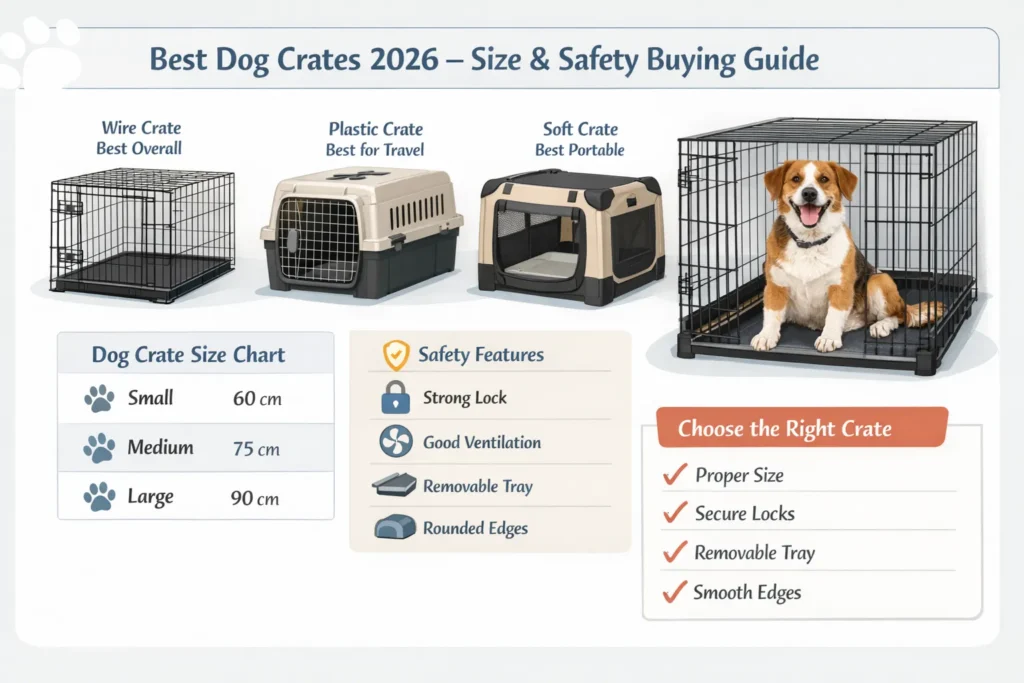
Wire crates are typically the best overall solution.
Plastic Dog Crates
Plastic crates are frequently used for transportation.
They provide privacy and protection.
Advantages
- Solid outer shell
- Airline-approved models available
- Lightweight structure
- Comfortable interior
Disadvantages
- Reduced airflow compared to wire crates
- Corners harder to clean
- Bulky storage
Best For
- Travel
- Nervous Dogs
- Vehicle transport
Plastic crates are often the best dog crate option for travel.
Soft Dog Crates
Soft crates are made using fabric panels and mesh windows.
They are lightweight and portable.
Advantages
- Extremely lightweight
- Easy to transport
- Comfortable interior
- Compact folding storage
Disadvantages
- Not chew resistant
- Not escape resistant
- Limited durability
Best For
- Calm dogs
- Temporary use
- Short trips
Soft crates work well for travel but not for powerful dogs.
Furniture Dog Crates
Furniture crates are designed to resemble home furnishings.
They integrate naturally into interior design.
Advantages
- Attractive appearance
- Quiet doors
- Matches décor
Disadvantages
- Higher cost
- Heavy structure
- Reduced airflow
Best For
- Apartments
- Design-focused homes
Furniture crates are increasingly popular in modern interiors.
Wire vs Plastic vs Soft Dog Crates
| Feature | Wire Crate | Plastic Crate | Soft Crate |
| Durability | High | Medium | Low |
| Ventilation | Excellent | Moderate | Good |
| Travel Use | Limited | Excellent | Good |
| Chew Resistance | High | Medium | Low |
| Cleaning | Easy | Moderate | Difficult |
| Price | €40–€150 | €50–€200 | €40–€120 |
Best Overall
Wire crates
Best Travel Choice
Plastic crates
Best Portable Option
Soft crates
How To Choose the Best Dog Crate
Choosing the best dog crates begins with selecting the correct dimensions and safety features.
A suitable crate should feel comfortable but not excessively large.
Dog Crate Size Guide (Most Important Step)
Your dog should be able to:
- Stand upright comfortably
- Turn around easily
- Stretch while lying down
A crate that is too small causes discomfort.
A crate that is too large slows house training.
How to Measure Your Dog
Measure:
- Nose to tail base
- Floor to head height
- Shoulder width
Then add:
5–10 cm (2–4 inches)
This ensures adequate space.
Dog Crate Size Chart
| Dog Size | Dog Weight | Crate Length | Example Breeds |
| XS | Under 5 kg | 45–55 cm | Chihuahua |
| Small | 5–10 kg | 60 cm | Dachshund |
| Medium | 10–25 kg | 75 cm | Cocker Spaniel |
| Large | 25–40 kg | 90 cm | Labrador |
| Giant | 40+ kg | 105–120 cm | Great Dane |
This size guide works for most dogs.
Puppy Growth Strategy
Puppies grow rapidly.
Buying multiple crates becomes expensive.
Instead:
Purchase a larger crate with divider panels.
Benefits
- Saves money
- Adjustable space
- Better training control
Divider panels simplify puppy training.
Dog Crate Material Guide
Materials influence durability and safety.
Selecting the right material is essential when choosing safe dog crates 2026.
Steel Dog Crates
Steel crates are the strongest choice.
Best For
- Strong Dogs
- Chewers
- Long-term use
Look For
- Thick wire gauge
- Powder-coated finish
- Rust resistance
Steel crates last many years.
Plastic Dog Crates
Plastic crates are ideal for travel.
Best For
- Travel dog crates EU
- Nervous dogs
Look For
- Reinforced doors
- Heavy screws
- Thick plastic walls
Plastic crates should feel sturdy and stable.
Dog Crate Safety Features
Safety features separate premium crates from cheap models.
Always look for:
- Double-door locks
- Rounded edges
- Non-toxic coating
- Strong weld joints
Avoid Unsafe Crates
Avoid crates with:
- Thin metal
- Weak latches
- Sharp corners
- Cheap plastic
Low-quality crates break easily.
Ventilation and Airflow
Good airflow keeps dogs healthy and comfortable.
Poor ventilation may cause:
- Overheating
- Stress
- Odors
Wire crates provide the best airflow.
Cleaning and Hygiene
Clean crates keep dogs healthy.
Look for:
- Removable trays
- Smooth surfaces
- Washable bedding
Many European dog owners use washable liners during wet seasons.
Best Dog Crates by Dog Type
Different dogs require different crate designs.
Choosing based on dog type improves success.
Best Dog Crates for Puppies
Puppies need crates designed for learning.
Look for:
- Divider panels
- Easy cleaning
- Adjustable size
Puppies have frequent accidents.
Best Dog Crates for Small Dogs
Small dogs require warmth and comfort.
Focus on:
- Soft bedding
- Quiet environment
- Proper insulation
Small dogs lose heat faster.
Best Dog Crates for Large Dogs
Large dogs require sturdy crates.
Look for:
- Reinforced steel
- Thick wires
- Strong locks
Large dogs exert more force.
Heavy Duty Dog Crates Europe (Escape Artists)
Some dogs escape easily.
Choose:
- Heavy-duty steel crates
- Reinforced corners
- Escape-proof locks
Avoid:
- Soft crates
- Thin wire crates
These are the best heavy-duty dog crates Europe.
Best Dog Crates for Apartments
Apartments require space-efficient designs.
Look for:
- Quiet doors
- Furniture-style crates
- Compact footprint
Ideal apartment crate solutions.
Best Dog Crates for Travel
Travel crates must be secure and reliable.
Choose:
- Lightweight models
- Airline-approved crates
- Strong doors
Ideal travel dog crates EU.
Travel crates should follow airline transport standards.
Dog Crate Training Guide
Training determines crate success.
Without training, even the best dog crates will fail.
Step 1 — Introduce Slowly
Start gradually.
- Leave the door open
- Place treats inside
- Allow exploration
Never force the dog inside.
Step 2 — Create Positive Experiences
Make the crate enjoyable.
Use:
- Toys
- Treats
- Praise
Feed meals inside the crate.
Step 3 — First Night Strategy
Place the crate near your bed.
Dogs feel safer nearby.
This reduces anxiety.
Step 4 — Build Routine
Use the crate consistently.
Crate during:
- Nighttime
- Nap time
- When leaving home
Routine builds confidence.
How Long Dogs Can Stay in Crates
Crate duration depends on age.
| Dog Age | Maximum Time |
| Puppy (2–4 months) | 2–3 hours |
| Puppy (4–6 months) | 4 hours |
| Adult Dogs | 6–8 hours |
| Senior Dogs | 4–6 hours |
Dogs require exercise and interaction.
Never crate longer than necessary.
Dog Crate Safety Guide
Safety is often overlooked.
But safety is essential.
Escape Risks
Dogs escape when:
- Latches fail
- Doors bend
- Wires break
Strong crates reduce escape risk.
Injury Risks
Check regularly for:
- Bent wires
- Sharp edges
- Broken locks
Damaged crates must be replaced.
Anxiety Damage
Dogs with anxiety may:
- Bite wires
- Bend doors
- Damage teeth
Heavy-duty crates reduce risk.
Common Dog Crate Mistakes
Avoid these mistakes.
1. Buying the Wrong Size
Too small:
- Stressful
- Uncomfortable
Too large:
- Slows potty training
2. Using Crate as Punishment
Crates must feel safe.
Never punish using the crate.
3. Too Much Crating
Dogs need:
- Exercise
- Social interaction
- Playtime
Crates are temporary spaces.
4. No Training
Dogs need gradual introduction.
Training prevents fear.
5. Poor Ventilation
Poor airflow causes overheating.
Especially in summer.
Best Dog Crate Features Checklist
Before buying confirm:
✔ Correct size
✔ Strong locks
✔ Good ventilation
✔ Removable tray
✔ Rust resistance
✔ Smooth edges
✔ Non-toxic materials
✔ Stable structure
This checklist helps identify safe dog crates 2026.
Expert Tips for Choosing the Best Dog Crates
These tips improve comfort and safety.
Tip 1 — Choose Slightly Bigger Crates
Dogs stretch while sleeping.
Extra room improves comfort.
Tip 2 — Cover Wire Crates
Crate covers help nervous dogs.
Creates a den-like environment.
Tip 3 — Use Proper Bedding
Best bedding includes:
- Orthopedic beds
- Washable pads
Comfort improves crate acceptance.
Tip 4 — Place Crate Correctly
Best locations:
- Quiet corner
- Living room
- Bedroom
Avoid:
- Direct sunlight
- Cold drafts
- Busy hallways
Pros and Cons of Dog Crates
Pros
✔ Improves training
✔ Keeps dogs safe
✔ Helps travel
✔ Reduces destructive behavior
✔ Creates routine
Cons
✘ Training required
✘ Some dogs resist crates
✘ Large crates require space
✘ Cheap crates break easily
Frequently Asked Questions
No.
When used correctly, crates provide security and comfort.
Crates should never be used as punishment.
Measure your dog and add 5–10 cm.
Your dog must stand and turn easily.
Yes.
Many dogs sleep better in crates.
Crates create a routine.
Heavy-duty wire crates are safest for strong dogs.
Plastic crates are safest for travel.
Conclusion — Choosing the Best Dog Crates
The best dog crates provide safety, comfort, and structure in your dog’s daily routine.
Choosing the right crate depends on:
- Dog size
- Temperament
- Lifestyle
For most dog owners:
- Wire crates are the best overall choice
- Plastic crates are best for travel
- Soft crates are best for calm dogs
Before purchasing:
- Measure carefully
- Choose durable materials
- Check safety features
- Train gradually
A high-quality crate can last for many years and help your dog feel secure and comfortable.
Investing in the Best Dog Crates is one of the smartest decisions a responsible dog owner can make.