Coming vs Comming: The Complete Guide to the Correct Spelling
Typed “Comming” and then paused, unsure if it looked right? You’re not alone — this is one of the most common spelling stumbles in English, and there’s a clear, logical reason it keeps happening. This guide covers the correct spelling, the real grammar rule behind it, where the word comes from, and every related question people search for.
1. What Is the Correct Spelling: Coming or Comming?
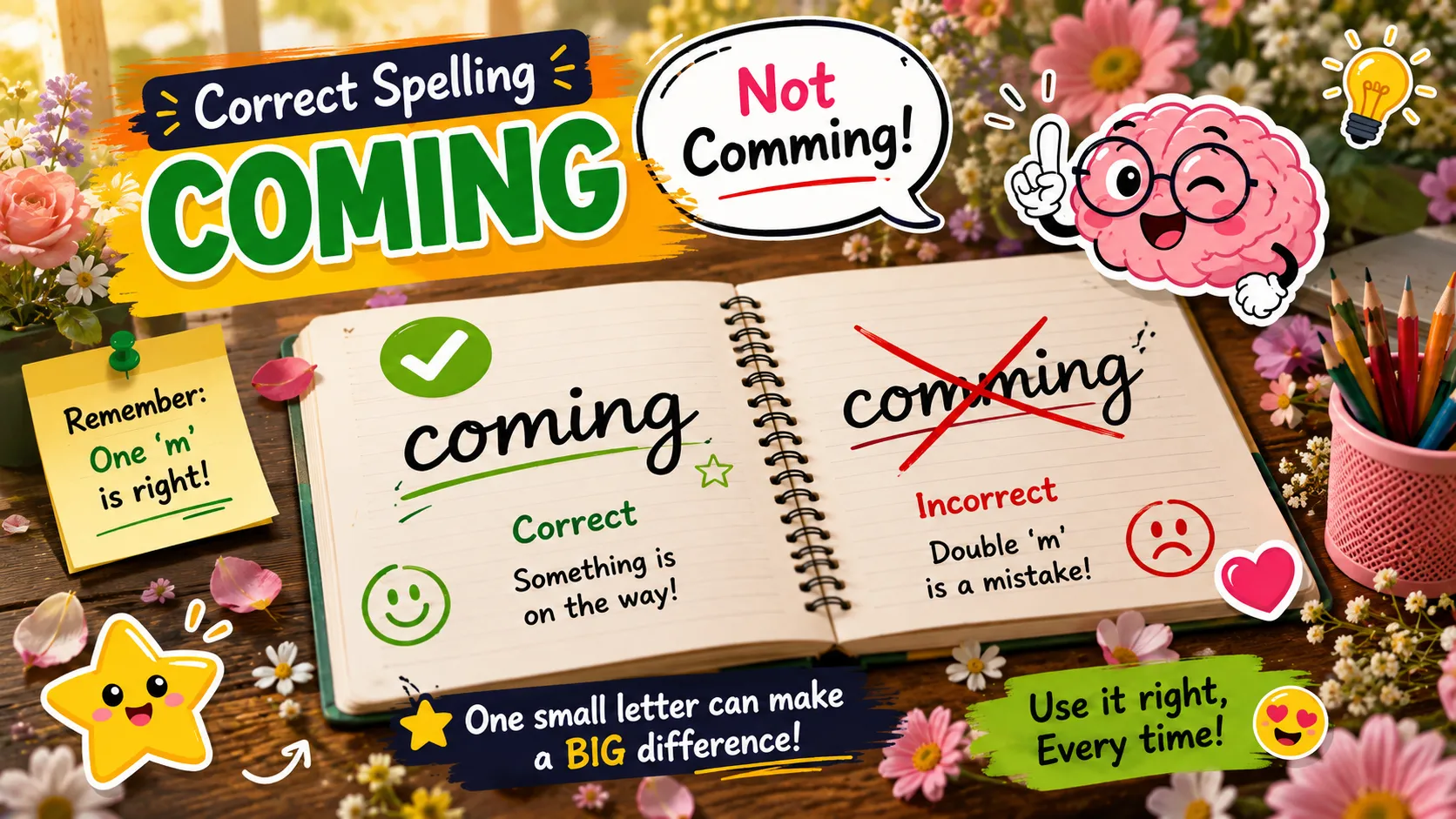
Coming is the only correct spelling. Comming is not a recognized word in any standard form of English — not American, not British, not Australian, not Canadian, and not in any formal or informal register.
There is no context in which the double-m spelling is acceptable. It is not an older variant, not a regional difference, and not a stylistic choice. It is simply a spelling error, almost always caused by applying the wrong grammar rule to the word.
If you remember nothing else from this article, remember this: write “coming,” never “comming.”
2. Coming vs Comming: Quick Comparison Table
| Coming ✅ | Comming ❌ | |
| Status | Correct standard English | Misspelling, not a recognized word |
| Part of speech | Verb (present participle), adjective, noun | None |
| Appears in | Formal writing, academic writing, business writing, casual writing | Should never appear anywhere |
| Example | “She is coming to the meeting.” | “She is comming to the meeting.” (incorrect) |
| Underlying rule | Silent-e drop rule | Misapplied consonant-doubling rule |
| Regional variation | None — identical across US, UK, AU, CA English | None |
| Dictionary status | Listed in every major English dictionary | Not listed in any dictionary |
3. Why Do People Misspell “Coming” as “Comming”?
The confusion isn’t random guesswork — it comes from a genuine, well-known English spelling pattern being applied to the wrong word.
Several common reasons drive the mistake:
- Pattern-matching from other -ing words. Words like “running” and “swimming” double their final consonant, so people assume “come” follows the same logic.
- The strong “m” sound. “Coming” is pronounced with a clear “m” sound, which can make a double letter feel more natural, even though it isn’t correct.
- Fast typing and autocorrect gaps. Quick typing sometimes produces doubled letters by habit, and not every spellchecker flags the error in casual writing.
- Limited exposure to the written form. People say the word constantly but may write it far less often, so the correct spelling never gets fully reinforced.
- Confusion with the rule itself, rather than the word. Understanding why certain words double their letters, and others don’t, is the actual fix — which is exactly what the next two sections cover.
4. The Consonant Doubling Rule (CVC Rule) Explained
English does have a real, well-established rule that doubles a final consonant before adding a suffix like -ing or -ed. This is often called the CVC rule: Consonant–Vowel–Consonant.
The rule applies when:
- The word ends in a single consonant.
- That consonant is preceded by a single vowel.
- The syllable is short and stressed.
Examples where the rule correctly applies:
- run → running
- swim → swimming
- stop → stopping
- plan → planning
- shop → shopping
This rule is real, common, and worth knowing — but it only applies to words that end in a bare consonant, not a silent e. That distinction is exactly where “coming” gets misclassified.
5. The Silent-E Rule: Why “Coming” Never Doubles the M
“Come” does not end in a bare consonant — it ends in a silent e. Silent-e words follow a separate, more senior rule that overrides the CVC doubling pattern entirely.
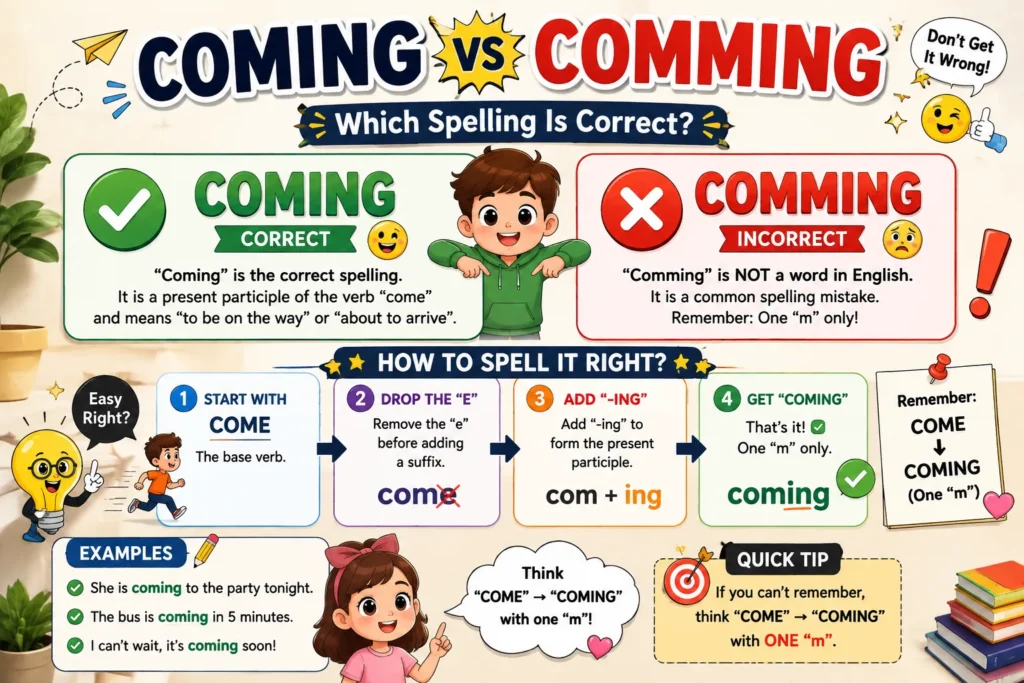
The rule: When a verb ends in a silent e, drop the e before adding -ing. Do not double the preceding consonant. The silent-e rule and the CVC doubling rule never apply to the same word.
This explains the correct forms below:
- come → com + ing → coming (not comming)
- write → writ + ing → writing (not writting)
- hope → hop + ing → hoping (not hopping, which is actually the -ing form of a completely different word, “hop”)
Several explanations floating around online claim “coming” avoids doubling because “the stress falls in the wrong place.” That explanation is imprecise, since “come” is a single syllable and stress isn’t really the deciding factor here. The reliable, teachable rule is simpler: silent-e verbs never double their final consonant, period. Once that clicks, it explains hundreds of similar words: hope, write, love, drive, bake, close, and many more.
6. Origin and History of the Word “Coming”
“Coming” traces back to the Old English verb cuman, meaning “to move toward” or “to arrive.” This word is closely related to Dutch komen and German kommen, all descending from the same ancient Germanic root.
As English spelling gradually standardized — especially after the arrival of the printing press and the first English dictionaries — the silent-e drop pattern became the fixed, universal way to form the -ing form of “come.”
Some sources note that spelling was far less consistent in early, pre-standardized English manuscripts, where double-consonant variants occasionally appeared in words that wouldn’t double today. That’s a historical footnote, not a loophole. In modern English, “comming” holds no recognized status as an older or alternate form — every major dictionary treats it purely as an error.
7. Parts of Speech: Verb, Adjective, and Noun Uses of “Coming”
“Coming” is a flexible word that functions in three different grammatical roles, which is part of why it appears so frequently in everyday writing.
- Describes an action in progress or about to happen.
- Example role: “I am coming.”As an adjective (meaning “approaching” or “about to happen”):
- Describes somethingupcoming or imminent.
- Example role: “the coming year.”
- Describes the act or event of arriving.
- Example role: “the coming of spring.”
8. How to Use “Coming” in a Sentence (Examples)
Verb form (present continuous tense):
- I am coming to the party Tonight.
- She is coming over after work.
- They were coming down the stairs when the lights went out.
- We are coming to visit next month.
- He has been coming to this gym for years.
Adjective form:
- The coming weeks will be busy.
- We have a big announcement coming soon.
- Spring is coming.
- The coming changes will affect the whole team.
- A storm is coming from the west.
Noun form:
- The coming of a new era.
- Christmas marks the coming of winter for many cultures.
- His coming was unexpected.
- The coming of the new policy caught everyone off guard.
- They celebrated the coming of the new year.
9. Common Idioms and Phrases With “Coming”
- Coming of age — the transition from childhood to adulthood.
- Coming up roses — a situation working out very well.
- Coming or going — feeling confused or overwhelmed.
- Coming out of your ears — having a large amount of something.
- Have it coming — deserving a consequence, positive or negative.
- First come, first served — related expression describing priority by order of arrival.
- Up and coming — describing someone or something showing early promise.
- Coming down to the wire — a situation reaching its final, tense moments.
10. Comming vs Coming: Common Mistakes Corrected
| ❌ Incorrect | ✅ Correct |
| She kept comming up with new ideas. | She kept coming up with new ideas. |
| Will you be comming to the wedding? | Will you be coming to the wedding? |
| I’m excited for this coming year. | I’m excited for this coming year. |
| The new update is coming soon. | The new update is coming soon. |
| He’s comming home tomorrow. | He’s coming home tomorrow. |
| We are comming together as a team. | We are coming together as a team. |
| The train is comming into the station. | The train is coming into the station. |
| A big change is coming | A big change is coming. |
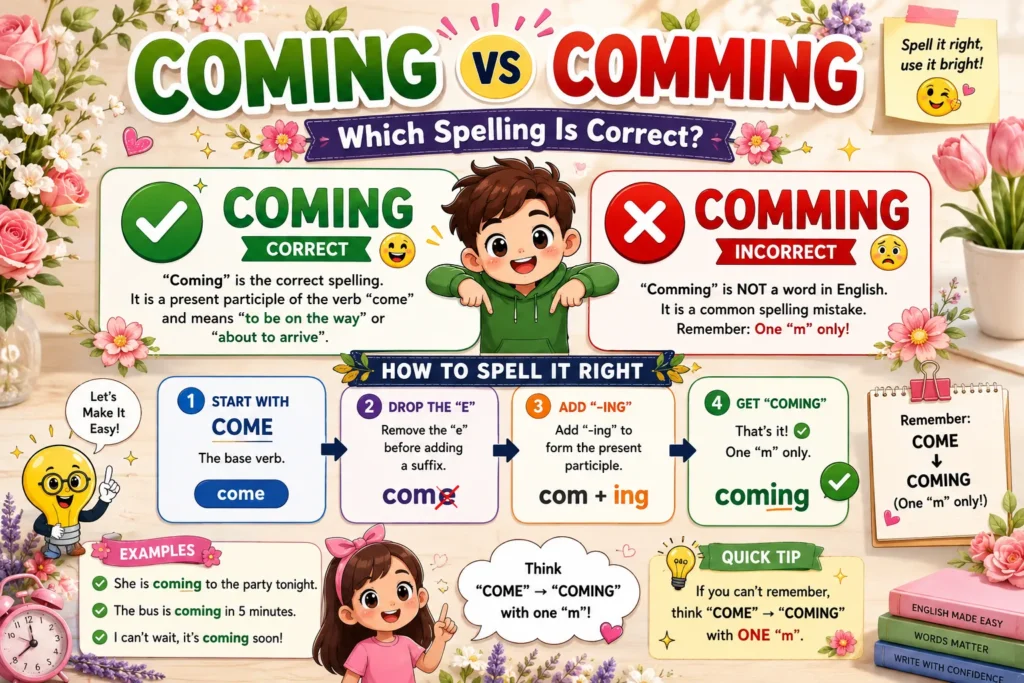
Memory trick: “Come, drop the e, add -ing.” Three steps, and the m is never doubled. If you catch yourself typing two m‘s, you’ve skipped step two.
11. Similar Words That Follow the Same Spelling Rule
These words all end in a silent e and follow the exme “drop the e, don’t double” pattern:
| Base verb | Correct -ing form | Common mistake |
| become | becoming | becomming |
| welcome | welcoming | welcomming |
| overcome | overcoming | overcomming |
| write | writing | writting |
| hope | hoping | hopping (different word) |
| love | loving | lovving |
| drive | driving | drivving |
| bake | baking | bakking |
| close | closing | clossing |
| smile | smiling | smilling |
12. Words That Break the Rule (Genuine Doubling Examples)
These words do not end in a silent e, so they correctly follow the CVC doubling rule instead:
| Base verb | Correct -ing form |
| run | running |
| swim | swimming |
| Stop | stopping |
| plan | planning |
| program | programming |
| shop | shopping |
| grab | grabbing |
| drop | dropping |
The test to apply every time: Does the base word end in a silent e, or a bare consonant after a short, stressed vowel? Silent e → drop it, add -ing, never double. Bare consonant after a short vowel → double the consonant.
13. Coming vs Comming: US vs UK English Differences
There is no difference between American and British English for this word. Unlike pairs such as traveling/travelling or canceled/cancelled, where UK English doubles a consonant that US English doesn’t, “coming” is spelled identically everywhere.
- US English: coming
- UK English: coming
- Australian English: coming
- Canadian English: coming
No dialect, region, or English-speaking country accepts “comming” as correct.
14. A Note on “Comming” vs the Unrelated Slang Term “Cumming”
If you arrived here after seeing “comming” used in a sexual or explicit context, that’s a separate and unrelated situation. In informal or adult writing, people sometimes misspell “cumming” (slang related to orgasm, itself already a nonstandard spelling) with an o instead of a u, landing on “comming.” That usage has nothing to do with the verb “come” meaning “to arrive,” and neither spelling is standard English.
For formal, professional, academic, or everyday writing, none of that applies — the correct word is simply coming.
15. How to Remember the Correct Spelling (Memory Trick)
A few simple tricks make this mistake disappear for good:
- The three-step rule: Come → drop the e → add -ing → coming.
- The “no double letters” rule: “Coming” never has two of the same letter in a row. If you’re about to type two m‘s, stop.
- Compare to “become”: If you know “becoming” is correct, “coming” follows the same pattern.
- Say it, then spell it slowly: Speaking the word first can help you notice the single, clean “m” sound before writing it.
- Visual check: C-O-M-I-N-G — six letters, one m, no repeats.
People Also Ask
Because “come” ends in a silent e. The rule is to drop the silent e before adding -ing, without doubling the preceding consonant. This Differs From Words like “run” or “swim,” which double their final consonant because they don’t end in a silent e.
It can be a verb (present participle, as in “I am coming”), an adjective (as in “the coming year”), or a noun (as in “the coming of spring”).
Some early, pre-standardized English writing shows inconsistent double-consonant spellings, but this isn’t recognized as a legitimate “older form” in any dictionary. In modern English, “comming” is simply incorrect.
No. Every form built from “come” — coming, comes, came — keeps a single m. The spelling never changes by doubling, in any tense or context.
Look for exactly one m and no repeated letters: C-O-M-I-N-G. If you see two m‘s, it’s incorrect — correct it to a single m before publishing or sending.
Conclusion
Coming is correct. Comming is not — not in a different tense, not in British English, not in casual writing, not ever. The reason isn’t stress patterns or arbitrary exceptions; it’s the same silent-e rule that governs hundreds of other English verbs like write, hope, and become. Learn that one rule, and this mistake disappears for good.