HUH Meaning in Text: What It Really Means & How to Reply
That split-second confusion is exactly why so many people search “Huh Meaning In Text.“ It looks like the simplest word in the English language — and in a lot of ways, it is — but its tone shifts completely depending on capitalization, punctuation, and who’s sending it. A “huh” from your best friend hits differently than a “huh” from someone you just started dating, and a “huh?” reads nothing like a “HUH?!”
This guide breaks down what “huh” actually means in texting, why it exists in almost every language on Earth, how it shows up differently across every major messaging platform, and how to reply so you don’t accidentally start a fight over four letters. We’ll also cover the psychology behind why such a short word can trigger such a long overthinking spiral, and what linguists actually know about where “huh” came from.
By the end, you’ll be able to read any “huh” text the way a linguist would — by context, not by panic — and you’ll know exactly how to reply so the conversation moves forward instead of stalling out on a single ambiguous word.
What Does “Huh” Mean in Text?
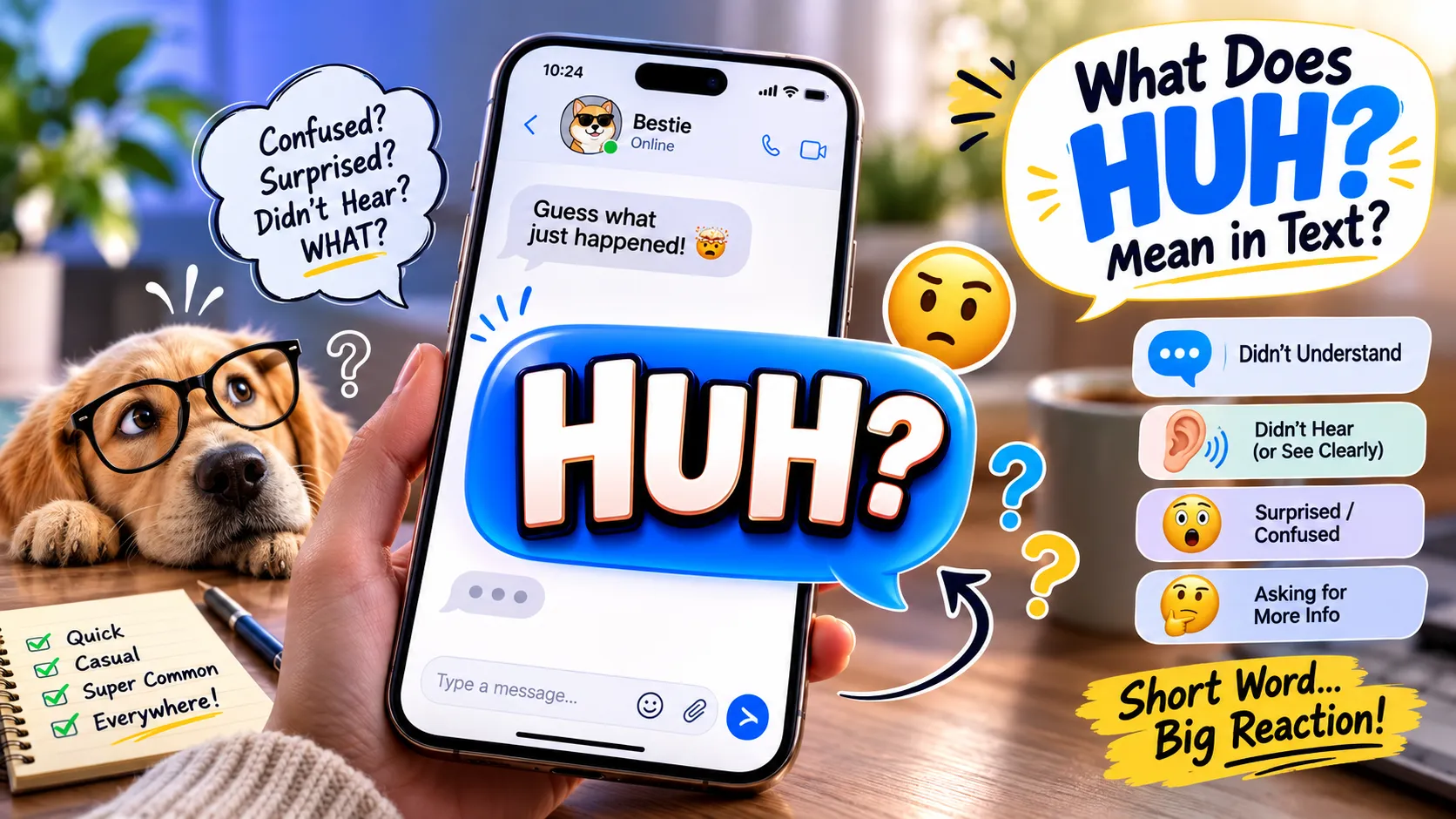
“Huh” is an informal interjection used to express confusion, surprise, disbelief, or a request to repeat something. It’s the text version of the sound people instinctively make out loud when they don’t fully process what they just heard.
At its most basic, “huh” is a placeholder for a much longer sentence. Instead of typing “I’m sorry, I don’t understand what you mean by that,” someone types “huh” and lets the other person fill in the blanks. It’s efficient, it’s honest, and it’s been part of human communication — spoken and written — for far longer than smartphones have existed.
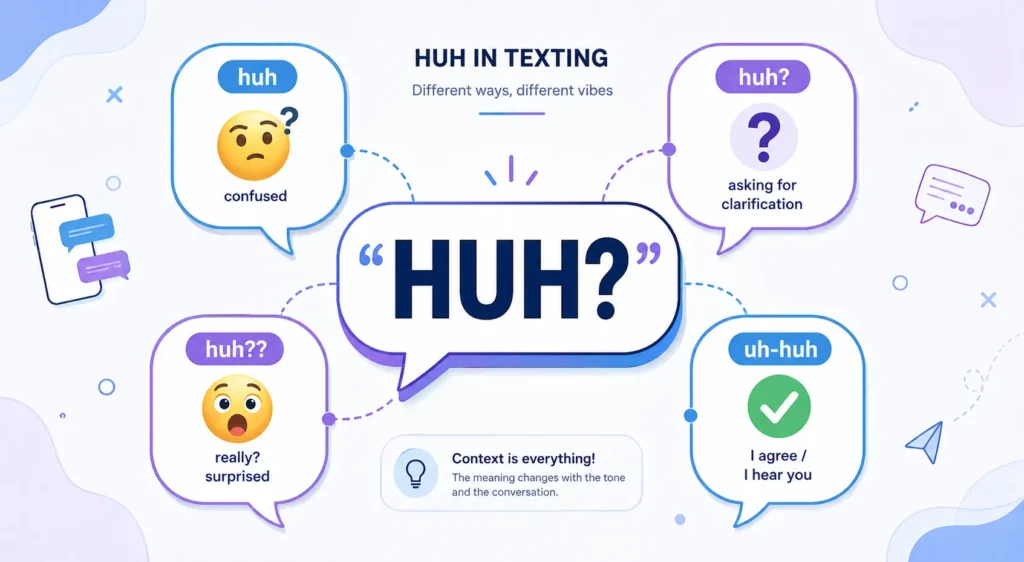
Here’s the short version, broken down by form:
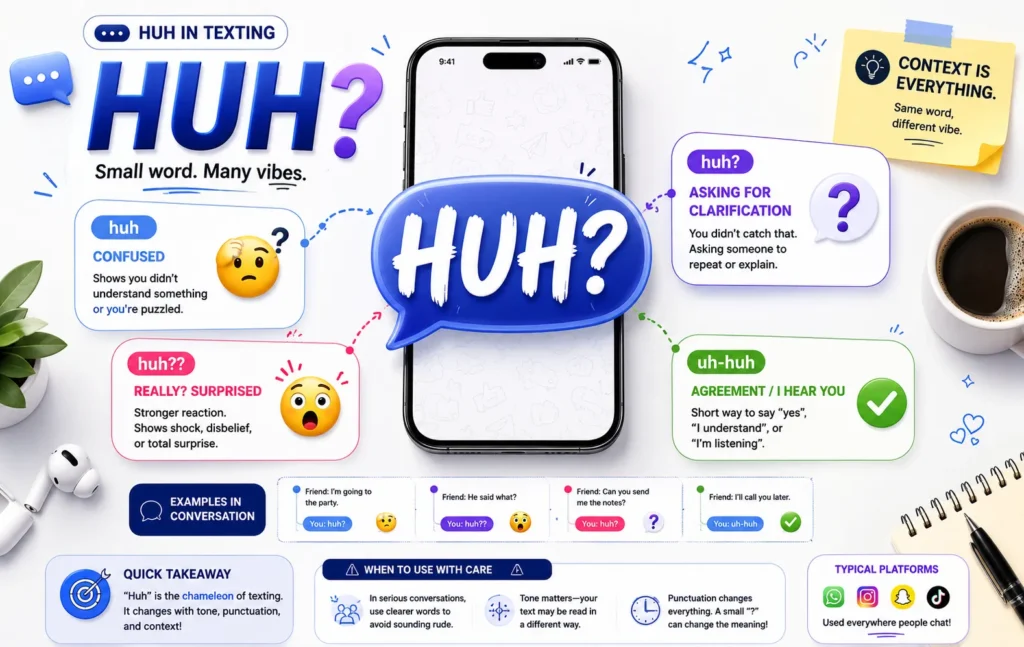
- “huh” → mild confusion or a passive reaction
- “huh?” → a genuine question: “can you repeat that?”
- “huh??” or “HUH?!” → strong disbelief or shock
- “uh-huh” → agreement (this one means “yes,” not confusion)
- “huh…” → thinking something over, not necessarily confused
Most of the anxiety around “huh” texts comes from the fact that it’s genuinely ambiguous without more context. Unlike a fully written sentence, “huh” doesn’t tell you why the other person reacted the way they did — only that they reacted. That gap is where overthinking lives, and it’s also exactly what this guide is designed to close.
Quick Meaning Summary
Before diving into the details, here’s a fast-reference table you can scan in a few seconds.
| Form | Meaning | Typical Tone | Best Response |
| huh | Mild confusion, low-effort reaction | Neutral/flat | Add a bit more context |
| huh? | Genuine request for clarification | Curious | Repeat or rephrase your message |
| huh?? | Strong confusion or disbelief | Surprised | Explain the surprising part directly |
| HUH | Shouting / emphatic disbelief | Intense | Slow down, clarify calmly |
| huh… | Processing, thinking it over | Reflective | Give them a moment, don’t over-explain |
| uh-huh | Agreement, “yes” | Affirming | No clarification needed — they agreed |
| huh, ok | Confused but going along with it | Passive acceptance | Offer a follow-up explanation anyway |
| huh lol | Light confusion, humor-softened | Playful | Match the light tone, clarify casually |
This table alone answers about 80% of the “what does this huh mean” questions people search for — the rest comes down to relationship, platform, and timing, which we’ll cover next.
Origin and History of “Huh”
“Huh” isn’t internet slang in the way “bet” or “rizz” is — it’s far older, and far stranger. Linguists have found near-identical confusion-sounds across unrelated languages worldwide: Dutch, Mandarin, Spanish, Icelandic, and dozens of others all have a short, rising, nasal-ish syllable that does the same job as the English “huh.” Researchers studying this cross-linguistic pattern argue that “huh” may be one of the closest things human language has to a universal word — not because it was borrowed between cultures, but because it evolved independently and repeatedly to solve the same conversational problem: signaling “I didn’t catch that” as fast and efficiently as possible.
Standard dictionaries back this up. Merriam-Webster defines it as an expression signaling surprise, disbelief, or confusion, or as an inquiry inviting an affirmative reply, while Dictionary.com describes it as an exclamation of surprise, bewilderment, disbelief, contempt, or interrogation. Collins English Dictionary adds a useful nuance: it’s often used at the end of a question when someone wants agreement, or to prompt a repeat or explanation. In other words, this wasn’t invented by texting — texting just gave it a keyboard.
Why “huh” appears in so many languages
Part of what makes “huh” special from a linguistic standpoint is how little effort it takes to produce. Say it out loud: your mouth barely moves, your voice rises slightly at the end, and it takes almost no muscular effort compared to a full word like “what” or “pardon.” Because confusion is such a common, universal experience in conversation, languages appear to have converged — independently — on a similarly low-effort sound to signal it. That’s different from most words, which are usually arbitrary and vary wildly from language to language.
From speech to screen
What texting did change is how “huh” carries tone. In speech, your voice pitch, volume, and facial expression tell the listener whether you’re confused, annoyed, or amused. In text, that job falls entirely to punctuation, capitalization, and timing — which is exactly why one “huh” can read as harmless and another can read as a red flag. Before texting, “huh” was a purely audible reaction. Now it’s a written artifact that has to carry the same emotional weight using only letters and punctuation marks, and that’s a much harder job.
This is also why so many people search for “huh meaning in text” specifically — it’s not that they don’t understand the word, it’s that they’re missing the vocal cues that used to do most of the interpretive work.
Documented use over time
“Huh” has appeared in written English for well over a century, long before digital messaging existed — in transcribed dialogue, dramatic scripts, and casual correspondence, wherever writers needed to represent the natural sound of confusion or surprise in speech. What’s changed isn’t the word itself, but the frequency and context in which people encounter it: a sound that used to appear mostly in spoken conversation or quoted dialogue now shows up constantly as a standalone message, stripped of any surrounding sentence.
That shift — from a sound embedded in speech to a message sent entirely on its own — is really what makes “huh” feel like a modern texting phenomenon, even though the word itself is ancient by comparison.
Why Is “Huh” So Popular in Texting?
“Huh” survives — and thrives — in digital conversation for a few practical reasons:
- It’s fast. Typing “huh?” takes less effort than “sorry, could you repeat that?” In a fast-moving group chat, speed matters more than politeness.
- It’s honest. Instead of pretending to follow along, it flags real confusion instantly, which actually improves communication in the long run.
- It’s flexible. The same three letters can express confusion, shock, sarcasm, disagreement, or mild interest depending on how it’s typed and where it’s used.
- It travels across platforms. It works identically in a text message, a DM, a group chat, a comment section, or a voice-to-text transcript — no explanation needed, no cultural translation required.
- It’s low-commitment. Sending “huh” doesn’t require the sender to fully process or articulate their reaction yet — it buys a few seconds to think while still responding.
- It signals authenticity. In a culture that increasingly values “keeping it real,” a blunt “huh” can feel more genuine than a polished, over-explained reply.
Put together, these traits make “huh” one of the most efficient words in the entire English language for digital communication — which is exactly why it isn’t going anywhere.
How “Huh” Is Actually Used
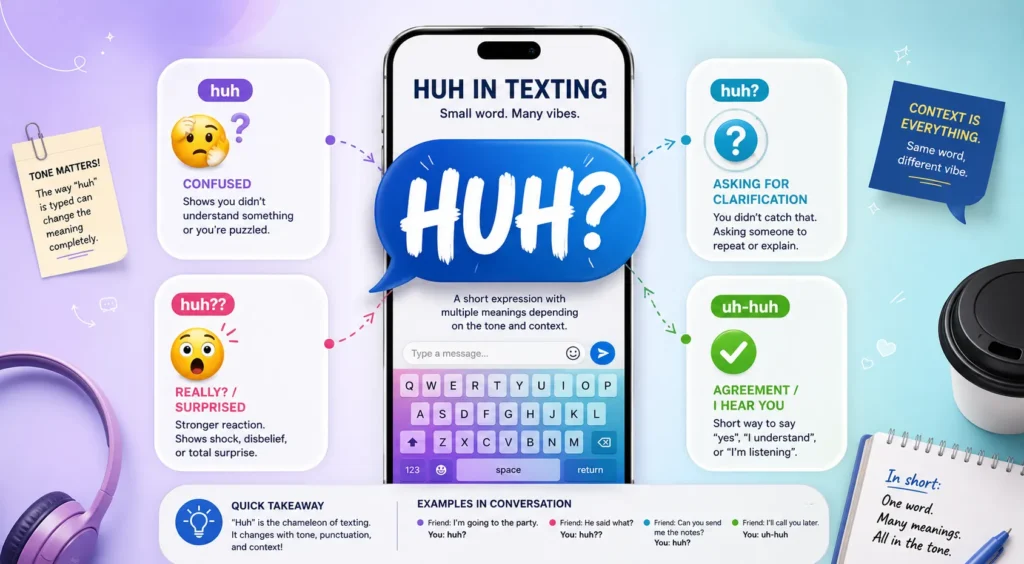
1. As a request for clarification. The most common use by far. Someone said something unclear, typed too fast, sent a message out of context, or referenced something the reader doesn’t have background on. In this case, “huh?” functions almost exactly like “what do you mean?” — it’s neutral, practical, and doesn’t carry emotional weight on its own.
2. As an expression of surprise or disbelief.f Used when new information contradicts what someone expected. This is the “huh” that shows up after unexpected news — a surprise promotion, a breakup announcement, a plot twist someone spoiled by accident. Here, the sender fully understood the words; they just weren’t ready for the meaning behind them.
3. As a filler while processing “Huh…” — especially with a trailing ellipsis — often shows someone is thinking, not confused. It’s a beat of silence turned into text, the digital equivalent of someone pausing mid-conversation to consider what you said before responding properly.
4. As sarcasm or dismissiveness: al In the wrong context, a flat “huh” (no punctuation, no follow-up) can read as unimpressed, dismissive, or passive-aggressive. This is where most misunderstandings happen, because the sender may not have intended any negativity at all — the flat tone is simply a side effect of typing quickly.
5. As a soft disagreement: Sometimes “huh” isn’t confusion at all — it’s a polite way of signaling “I see it differently” without starting an argument. “Huh, I actually thought it was great” reads as a gentle pushback rather than genuine confusion.
6. As a conversational bridge: In longer conversations, “huh” can act as a placeholder that keeps the conversation moving without committing to a full reaction yet — buying time before a more thoughtful reply follows.
Examples of “Huh” in Real Conversations
Text Message
A: I’ll send it late.r BHuhuh? Send what?
Here, “huh?” is a clean, literal request for clarification — no hidden emotion. B genuinely doesn’t know what “it” refers to.
A: I think I’m moving to another city next month.h B: huh?? A: yeah, just got a job offer
Here the double punctuation signals genuine surprise, not confusion — B understood the words, just not the news. The follow-up from A confirms it wasn’t a communication breakdown.
Instagram DM
A: I didn’t like that movie at all. ll B: Huh, I thought it was really good
This “huh” signals mild disagreement or surprise at a differing opinion — not misunderstanding. It’s a soft way of saying “that’s not what I expected you to say.”
Snapchat / Casual Chat
A: we’re not going anymore B: huh
No punctuation, no question mark — this one reads flat, almost annoyed. Tone is doing a lot of work here, and it’s the version most likely to be misread. Without more context, the receiver has no way to know if B is genuinely upset, mildly confused, or just typing quickly.
Discord (gaming context)
A: patch notes just dropped, they nerfed the whole class B: huh, that’s rough
Here, “huh” functions almost like “oh,” acknowledging surprising information without needing a full reaction.
Work Slack / Email context
A: We’re pushing the deadline up by a wee.k B: Huh — is there a reason for the change?
Notice the capitalization and dash here: even in a semi-professional context, “Huh” can work if it’s immediately followed by a clarifying question, softening what would otherwise read as blunt.
Family Group Chat
Mom: Dinner’s at 6 instead of 7 tonight.ht You: huh, works for me
A relaxed, low-stakes “huh” that signals mild surprise but full acceptance — common in casual family or friend threads where nobody’s reading deeply into tone.
Sarcastic Reddit / Comment Section Use
“huh, never would have guessed 🙄”
Here, “huh” is paired with an eye-roll emoji to explicitly flag sarcasm — a good example of how emoji pairing can completely override the “neutral” default meaning of the word.
“Huh” on Social Media
Each platform gives “huh” a slightly different flavor:
TikTok:k On TikTok, “huh” shows up constantly in comments and captions, usually stripped of its original literal meaning and used for comedic effect — reacting to something absurd, ironic, or unexpected (“huh??? people actually do this??”). It’s less “I don’t understand” here and more “I can’t believe this is real,” functioning closer to a reaction meme than a genuine question. InstagraInstagram
Instagr: On Instagram, “huh” appears both in comments (as a quick reaction to a surprising post) and in DMs (as a genuine clarification request). Context and thread history usually make the intended meaning obvious.
Snapchat: Because Snapchat conversations tend to be shorter and more casual, “huh” here is almost always low-stakes — a quick, disposable reaction rather than a deep or loaded response.
Facebook: On Facebook, especially in comment threads with older users, “huh” often appears closer to its original spoken meaning: a simple, sincere expression of not understanding a post or comment, without the ironic layer common on TikTok.
Reddit: Reddit comments frequently use “huh” as a one-word reaction to surprising information within a thread — often followed by a more detailed reply once the commenter processes what they read.
Discord:d In gaming and community Discord servers, “huh” is extremely common as a fast reaction to patch notes, drama, or unexpected announcements — usually neutral, sometimes genuinely confused if jargon-heavy messages are involved.
X (Twitter): On X, “huh” often appears as a standalone reply to a tweet, usually signaling mild disbelief or a request for the original poster to elaborate — functioning almost like a compressed “wait, what?”
“Huh” in Relationships and Dating Texts
This is where “huh” causes the most overthinking. A single “huh” from someone you’re dating can spark a spiral of interpretation — but in the vast majority of cases, it means exactly what it looks like: mild confusion or a request to repeat something, not rejection.
A few quick reads:
- “huh?” — genuinely didn’t understand your message; not a bad sign
- “HUH?!” — something you said surprised or confused them strongly; worth clarifying
- “huh, ok” — mildly thrown off but willing to move on
- “uh-huh” — this is agreement, not confusion at all
- “huh” (flat, no punctuation, long delay before it arrives) — worth paying attention to, since delayed flat replies sometimes do signal disengagement, though it’s still not a guaranteed negative sign
- “huh lol” — light confusion softened with humor, generally a good sign that the conversation is still comfortable.e
Why we overanalyze “huh” from someone we’re interested in
When you’re emotionally invested in a conversation, your brain treats every ambiguous signal as high-stakes, because the cost of misreading it feels large. A “huh” from a coworker about a meeting time gets zero analysis. That same “huh” from a romantic interest can get read and re-read a dozen times. This isn’t a flaw in the word — it’s a normal side effect of anxious attachment to outcomes we care about.
The safest move if you’re unsure: don’t guess. A simple “did that come across weird?” or “you good?” solves more than re-reading the text ten times ever will. Directly asking almost always resolves the ambiguity faster than trying to reverse-engineer someone’s emotional state from four letters.
“Huh” vs “Uh-Huh”: Key Difference
These two look similar but mean opposite things, and mixing them up is one of the most common texting slip-ups.
- “Huh” — confusion, surprise, or a request to repeat something
- “Uh-huh” — agreement, “yes,” or acknowledgment
If someone replies “uh-huh” to a question, they’re confirming it — not confused by it. The extra “uh” at the front changes the entire function of the word, shifting it from a request for information into a signal that information has already been received and accepted.
There’s also a middle-ground form worth knowing: “UH Huh?” with a comma or pause implied — this reads as hesitant confusion, distinct from both the confident agreement of “uh-huh” and the flatter confusion of a bare “huh.” Small spacing and punctuation differences like this genuinely change meaning in written form, even though they’d sound almost identical out loud.
Punctuation and Capitalization Meaning (huh/huh? / HUH??)
Punctuation carries almost all of “huh’s” emotional weight in text, since tone of voice isn’t available to do the job. Here’s a fuller breakdown:
| Form | Reading | When you’ll see it |
| huh | flat, low-effort, passive reaction | Casual acknowledgment, quick reaction |
| huh? | genuine, active request for clarification | Someone missed part of the conversation |
| huh?? | real confusion or mild alarm | Confusing or unexpected information |
| HUH | shouting/raised emphasis | Strong emotional reaction |
| HUH?! | strong disbelief or shock | Big, surprising news |
| huh… | thinking it over, not confused | Processing pause, not a request to repeat |
| Huh. | closed-off, matter-of-fact acknowledgment | Slightly cold, conversation-ending tone |
| huh lol | light confusion, humor-softened | Keeping the mood casual |
| huh?? lol | Confusion plus disbelief, still friendly | Reacting to something wild but not upsetting |
A useful rule of thumb: the more punctuation and capitalization stacked onto “huh,” the stronger the emotional charge behind it. A bare, lowercase “huh” is the emotional equivalent of a shrug. “HUH?!” is closer to a gasp.
It’s also worth noting that timing changes meaning just as much as punctuation. An instant “huh?” reads as a natural reaction. The same “huh?” sent after a long delay can read as far more loaded — as though the person sat with the message before deciding how, or whether, to respond.
Common Misunderstandings About “Huh”
Misconception 1: “Huh” is always rude. Not true. On its own, “huh” is neutral. Rudeness comes from context, timing, and relationship — not the word itself. Plenty of perfectly friendly conversations include a bare “huh” without any negative intent at all.
Misconception 2: It only means confusion. It also expresses surprise, disbelief, sarcasm, and mild disagreement, depending on punctuation and context. Treating every “huh” as a comprehension problem misses most of its actual uses.
Misconception 3: It’s Gen Z slang. It isn’t slang at all — it’s one of the oldest and most universal interjections in human language, long predating texting, smartphones, and even the internet itself.
Misconception 4: “Huh” and “uh-huh” mean the same thing. They don’t. “Huh” signals confusion; “uh-huh” signals agreement. Mixing them up is a common texting mistake that can genuinely cause miscommunication.
Misconception 5: It’s always appropriate to use casually. In professional or emotionally serious conversations, a bare “huh” can come across as careless or dismissive — better to use a fuller phrase like “could you clarify?” or “I want to make sure I understand.”
Misconception 6: A “huh” text always deserves a long analysis. Most of the time, “huh” is a low-effort, low-stakes reaction with no hidden meaning behind it. Overanalyzing a single word usually creates more anxiety than the message ever intended to cause.
Misconception 7: Silence before a “huh” reply always means something bad. Delayed replies can simply mean someone was busy, not that they’re upset or hesitant. Combining delay with tone is more reliable than judging delay on its own.
Related Terms and Alternatives
| Term | Meaning | Formality |
| What? | Direct confusion | Casual, blunt |
| Come again? | Polite request to repeat | Semi-formal |
| Sorry? | Polite clarification request | Formal-casual |
| Eh? | Mild confusion or indifference | Very casual |
| Wait, what? | Surprise + confusion combined | Casual |
| Come on. | Disbelief (not literal confusion) | Casual |
| Uh-huh | Agreement, “yes” | Casual |
| Pardon? | Formal request to repeat | Formal |
| Hm? | Mild curiosity or confusion | Casual, gentle |
| No way | Disbelief, shock | Casual |
Each of these alternatives carries a slightly different formality level and emotional charge. “Huh” sits in a fairly unique spot: casual enough for everyday texting, but flexible enough to express far more than pure confusion — which is exactly why it’s stuck around as one of the most-used reaction words in digital conversation.
Other Meanings of “HUH” (Beyond Texting)
Written in caps, HUH is also a real initialism and title elsewhere — worth knowing so you don’t confuse it with the texting interjection when it shows up in search results or elsewhere online:
- Howard University Hospital — a teaching hospital in Washington, D.C.
- Harvard University Herbaria — the botanical research collection at Harvard, based in Cambridge, Massachusetts.
- “Huh?” — a 1991 animated short film by Mike Judge, later a creative precursor to Beavis and Butt-Head.
- HuH — a 1994–1996 American music magazine.
- “HuH” — a 2010 song by the K-pop group 4Minute.
- Huh? (paralanguage) — the academic and linguistic term used to describe the cross-linguistic confusion-interjection discussed earlier in this guide.
None of these overlap with the texting usage, but they occasionally cause search confusion — so it’s worth a quick mention for anyone who landed here looking for the acronym or proper noun rather than the everyday texting slang.
Why these distinctions matter for search
Search engines and AI assistants increasingly try to disambiguate short, capitalized terms like “HUH” based on context clues in the surrounding query. Someone searching “HUH meaning” alongside words like “text,” “chat,” or “Snapchat” is almost certainly asking about the interjection covered throughout this guide. Someone searching “HUH” alongside “hospital,” “Harvard,” or “acronym” is looking for one of the proper nouns listed above instead. Keeping these categories separate helps avoid the kind of confused, catch-all content that mixes fabricated technical meanings with the real, everyday texting definition.
Cultural and Regional Usage
- Western texting culture — very common, informal, and rarely seen as rude in casual conversation among friends or peers.
- Professional/workplace communication — generally avoided in written form; longer, clearer clarifiers like “could you clarify?” are preferred to maintain a polished tone.
- Asian messaging etiquette — a bare “huh” alone can feel abrupt or overly direct in some cultural contexts; softer, more indirect phrasing is often preferred to preserve politeness norms.
- Middle Eastern texting norms — casual among close friends, but typically avoided in more formal or respectful exchanges, where tone and courtesy are prioritized.
- Global internet culture — used consistently across TikTok, Reddit, Discord, and meme culture regardless of region, largely because its brevity translates well across language barriers online.
- Cross-linguistic pattern — near-identical confusion-sounds appear in unrelated languages worldwide, not just English, which is part of why “huh” adapts so easily into global digital slang.
How to Respond When Someone Texts You “Huh”
Not every “huh” needs the same kind of reply. Matching your response to the tone of the original message keeps the conversation smooth instead of accidentally escalating it.
- “Sorry, let me explain that better — I meant…”
- “Ignore that, I meant to say…”
- “My bad, here’s what I was trying to say…”
- “I know, right? Wasn’t expecting it either.”
- “Yeah, it’s a lot — happened kind of suddenly.”
- “Crazy, I still can’t fully believe it myself.”
- “Lol my brain went somewhere else, one sec”
- “System error, please stand by 😂”
- “Let me try that sentence again”
When it’s professional or semi-formal
- “Happy to clarify — here’s what I meant.”
- “Let me rephrase that for clarity.”
- “Good question, let me explain the context.”
- “Did that come across weird?”
- “Everything good? Just checking.”
- “What part didn’t make sense?”
The common thread across all of these: adding a little more information almost always resolves a “huh” faster than trying to guess what caused it. Silence or a delayed non-answer tends to make the original confusion worse, not better.
Replies to avoid
A few responses tend to make “huh” conversations worse rather than better:
- Repeating the same message with no changes, which doesn’t address what confused the other person in the first place.
- Responding with a single “?” or “lol what,” which just adds more ambiguity on top of ambiguity.
- Going silent for a long stretch after a “huh?” — this is often what actually causes the overthinking spiral, more than the original word did.
The Psychology Behind Why We Overthink “Huh”
Short, ambiguous texts like “huh” trigger disproportionate amounts of overthinking because of a simple communication gap: written text removes tone of voice, facial expression, and body language — the three things humans rely on most heavily to judge intent in face-to-face conversation.
When those cues disappear, the brain doesn’t just accept the uncertainty — it fills the gap, usually with whatever emotional narrative feels most immediately relevant. If you’re anxious about a relationship, a flat “huh” can feel like rejection. If you’re stressed about work, a coworker’s “huh” can feel like criticism. The word itself hasn’t changed; the surrounding context in your own head has.
Explore More: https://dogizle.com/tp-meaning-in-text-ny-slang/
This is also why the same “huh” can be read completely differently by two different people receiving it in two different emotional states. Recognizing this pattern is often more useful than trying to memorize every possible meaning of “huh” — because in most cases, the fastest way out of the spiral is simply to ask, rather than assume.
People Also Ask
It’s an informal interjection expressing confusion, surprise, or a request for someone to repeat or explain what they said.
Not inherently. It’s neutral by default — tone, punctuation, and context determine whether it reads as rude, curious, or dismissive.
“Huh” (no punctuation) tends to read flat or passive. “Huh?” is a genuine, active question asking for clarification.
No. “Huh” signals confusion or surprise. “Uh-huh” signals agreement — the two are easy to mix up but mean opposite things.
All caps plus extra question marks intensify the reaction — usually signaling strong disbelief or shock rather than simple confusion.
Q6. Is “huh” appropriate to use at work?
Generally no. In professional messages, phrases like “could you clarify?” or “I’m not sure I follow” come across as more polished than a bare “huh.”
Conclusion
“Huh” might be the shortest message you’ll ever receive, but it’s rarely meaningless. At its core, it’s just a fast, human way of saying “I didn’t catch that” or “that surprised me” — a habit humans have carried into nearly every language and, now, every messaging app, DM inbox, and group chat on Earth.
The real meaning almost always comes down to three things: punctuation, timing, and relationship. A bare “huh” from a stranger reads very differently than a “huh??” from someone who just heard big news. A flat “huh” from a coworker means something completely different from the same “huh” sent by someone you’re dating. Instead of spiraling over four letters, look at the full conversation — the words around it, the platform it was sent on, and how quickly it arrived — and if you’re still unsure, it’s always faster to just ask than to guess.