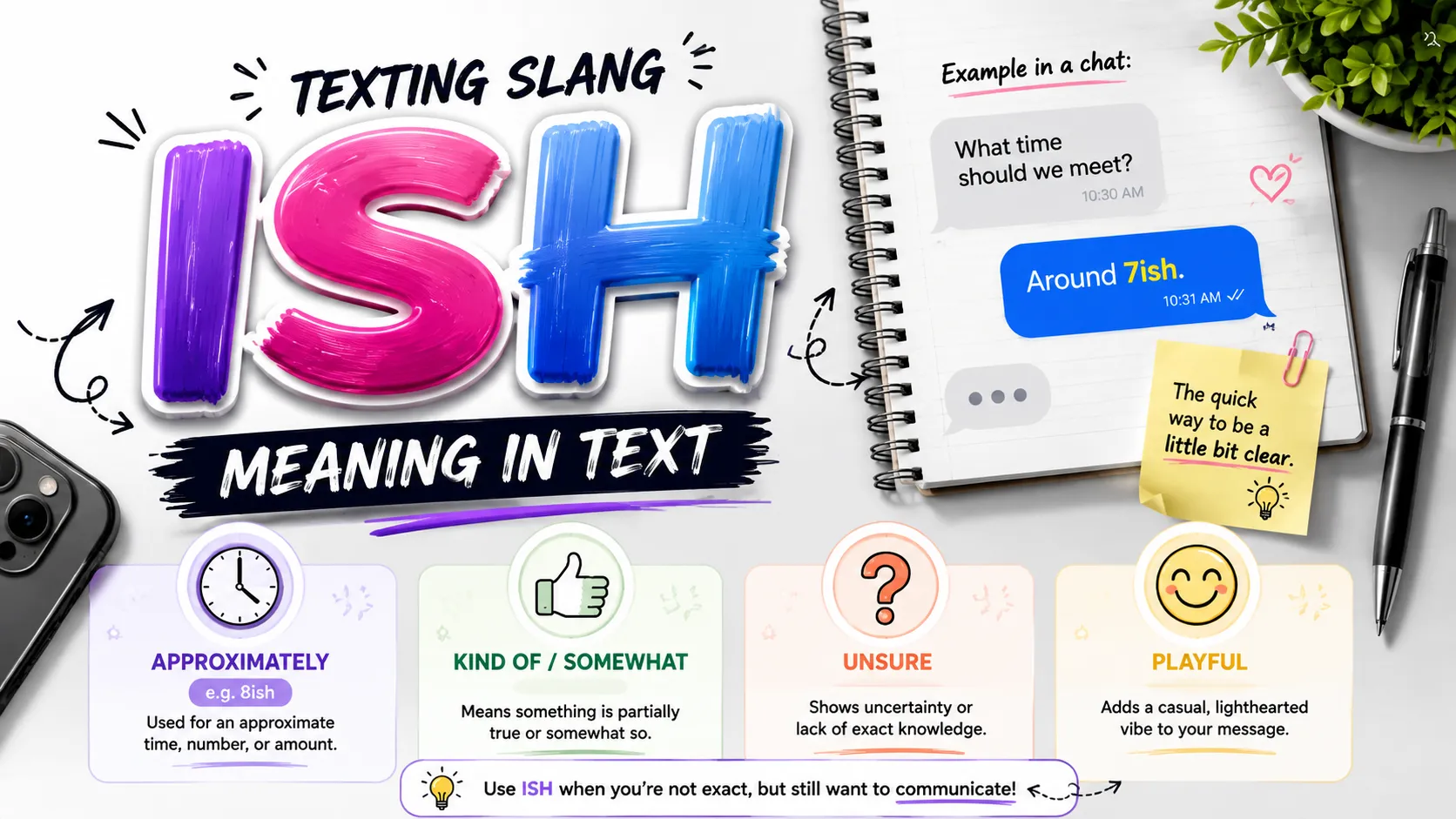
ISH Meaning in Text: What It Really Means, How to Use It, and How to Reply
Someone just texted you “I’ll be there 8ish” — or maybe it was “I’m Good-ish” — and now you’re stuck wondering exactly what that means. Are they committing to a time or not? Are they actually fine, or just being polite?
Here’s the quick answer, then the full breakdown.
Quick Meaning Summary
| Question | Answer |
| What does “ish” mean? | Approximately, kind of, or somewhat — it softens whatever it’s attached to |
| Part of speech | Informal suffix (tired-ish) or standalone word (yeah… ish) |
| Is it an acronym? | No — it doesn’t stand for anything |
| Is it rude? | Not usually — tone and context decide that |
| Where it’s used | Texting, Instagram/TikTok captions, dating apps, gaming, casual work chat |
| When to avoid it | Deadlines, contracts, serious emotional conversations, formal or cross-cultural communication |
What Does “Ish” Mean in Text?
“Ish” means approximately, kind of, or somewhat. Attached to a number, time, or feeling, it removes precision on purpose. It’s not shorthand for a longer phrase and it isn’t an acronym — it’s a suffix that’s been doing this exact job in English for centuries, now repurposed for fast digital conversation.
People reach for it to:
- Give a rough time without locking themselves into it (“8ish”)
- Soften an opinion so it doesn’t sound too strong (“tired-ish”)
- Avoid fully committing to an answer (“yeah… ish”)
- Keep a message feeling casual and low-pressure
Where “Ish” Actually Comes From
This is the part most guides skip or get wrong. “-ish” isn’t internet slang that appeared with texting — it’s a genuine Old English suffix (from -isc), historically used to build adjectives that describe a quality or origin, like “British,” “Danish,” or “foolish.” The Cambridge Dictionary still defines it this way: a suffix used informally to make a word “sound deliberately vague and approximate,” as in “oldish” or “reddish.”
Instead of only appearing at the end of a word (“reddish”), it now stands entirely on its own as a one-word reply — “Yeah, ish” — which is a genuinely new grammatical move that older dictionary definitions don’t fully capture.
Explore More:https://dogizle.com/awh-meaning-in-text/
The Core Meanings of “Ish”
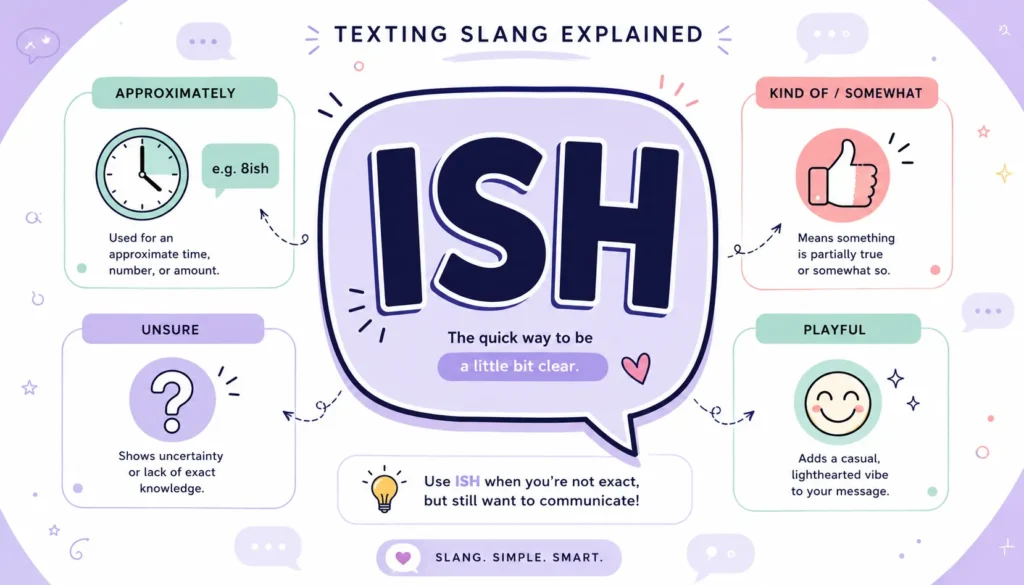
“Ish” isn’t a single, fixed meaning — it shifts slightly depending on what it’s attached to. Below are the four core ways it shows up in real conversations.
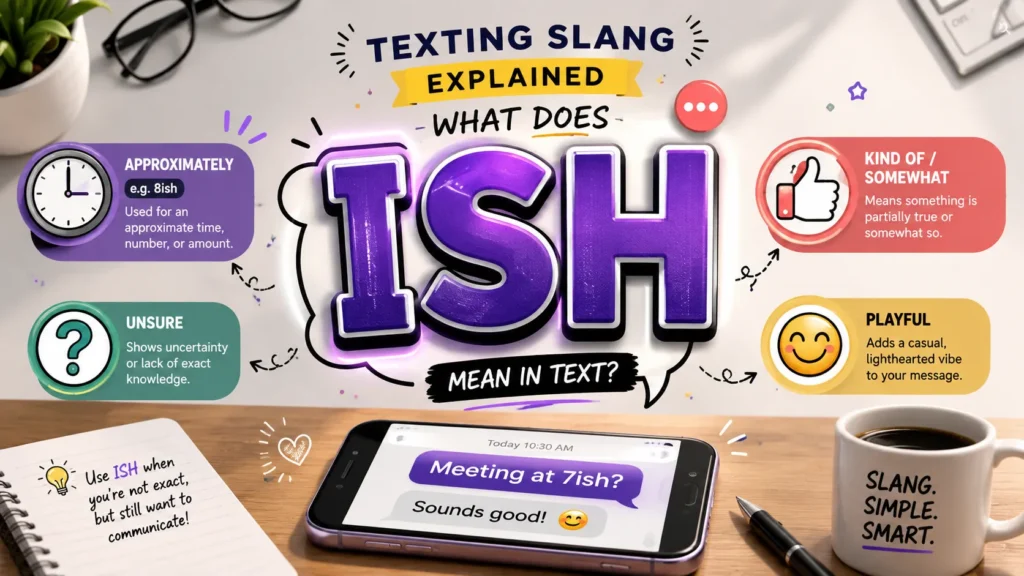
Ish as Approximately / About
The most common use — softening a number or time.
- “I’ll call you at 5ish.”
- “We landed around 9ish.”
- “It cost like 20 bucks-ish.”
This works well for casual plans and friendly meetups, but it doesn’t hold up in formal scheduling.
Ish as Kind Of / Somewhat
Softens a feeling, opinion, or state so it doesn’t sound too definite.
- “I’m hungry-ish.”
- “The movie was good-ish.”
- “I’m ready-ish.”
It signals “not fully” without needing to explain why.
Ish as Unsure or Non-Committal
Used alone as a hedge on a direct question.
- “Are we still on for tonight?” — “Yeah… ish.”
- “Do you like him?” — “Ish.”
This version can carry the most emotional weight, since it’s replacing a real yes-or-no answer.
Ish as a Playful, Identity-Softening Word
A Gen Z favorite for describing a vibe without fully claiming it.
- “We’re dating-ish.”
- “I’m adulting-ish these days.”
- “Rich-ish, if you don’t check my bank account.”
It adds humor and keeps the statement from sounding too serious.
How “Ish” Is Used Across Platforms
| Platform | Typical Use | Example |
| Texting / iMessage | Loose timing, mood check-ins | “Home by 6ish” |
| Dating apps | Soft-committing without full disclosure | “Looking for something serious-ish” |
| Gaming / Discord | Lowering expectations around skill or timing | “On at 10ish, I’m decent-ish at this” |
| Casual work chat | Flexible ETA in relaxed teams only | “Doc’s done-ish, final pass tomorrow” |
Ish on Social Media (Instagram, TikTok, Snapchat)
On social platforms, “ish” shifts from scheduling shorthand to a relatability tool:
- Instagram captions: “Gym-ish. Healthy-ish. Trying.” — signals effort without claiming perfection
- TikTok comments: “Same energy-ish 😂” — softens agreement into something more playful
- Snapchat stories: “Productive day-ish” — keeps the caption self-aware and low-pressure
The appeal is consistent across all three: it lets people post something real and imperfect instead of a polished, exact claim.
Is “Ish” Rude, Flirty, or Just Casual?
It’s almost never inherently rude — the tone comes entirely from context and what’s being asked.
Reads as fine/positive when:
- It’s used playfully or teasingly (“I like you-ish 👀”)
- Precision genuinely doesn’t matter to the conversation
Can read as evasive when:
- It answers a direct, emotionally loaded question (“Are we official?” — “Yeah… ish”)
- It replaces an answer someone actually needs (a deadline, a confirmation)
- It’s used repeatedly to avoid giving a straight answer
The psychology is simple: “ish” creates a small buffer of deniability. It lets the speaker commit just enough without fully committing — which is exactly why it feels safe in casual contexts and frustrating in serious ones.
How to Reply When Someone Says “Ish”
| Your Goal | Reply |
| Keep it casual | “Bet, see you then.” |
| Get a straight answer | “Around what time exactly?” |
| Play along / tease | “Ish? Give me a real number 😂” |
| Professional clarity | “Could you confirm a specific time, please?” |
Common Misunderstandings About “Ish”
“It means the person is being lazy.” Not necessarily — it’s often just relaxed, not careless.
“It’s the same as ‘IDK.'” No — “IDK” is total uncertainty; “ish” is partial commitment. They’re saying something, just not the exact version.
“It’s always rude or dismissive.” Tone-dependent. “See you at 6ish” is completely normal; “fine-ish” in the middle of an argument is a different story.
“It’s brand-new Gen Z slang.” The suffix itself predates texting by centuries — Gen Z just detached it into a standalone word.
“Ish” vs. Similar Softening Slang
| Term | Meaning | Best For |
| Ish | Approximately / kind of | Times, moods, soft commitments |
| Kinda / Sorta | Somewhat, to a degree | Opinions, feelings |
| Lowkey | Slightly, secretly | Admitting something mildly |
| Highkey | Strongly, openly | The opposite of lowkey — full commitment |
| Mid | Average, unimpressive | Reviews and reactions |
When You Should Avoid Using “Ish”
- Deadlines and professional commitments — “I’ll send it by 4ish” reads as unreliable to clients or managers
- Serious emotional conversations — hedging on “do you love me?” can genuinely hurt
- Cross-cultural or non-native-English conversations — the vagueness doesn’t always translate
- Contracts, invoices, or any formal written communication — precision is the whole point
People Also Ask
It means approximately, kind of, or Somewhat — it makes whatever it’s attached to less exact.
Not usually. It only reads as rude or evasive when it’s used to dodge a direct, important question.
Around 5 o’clock — not exactly 5:00, but close to it.
Somewhat okay — not great, not bad, just acceptable.
No. It doesn’t stand for anything; it’s an informal suffix that can also stand alone.
Conclusion
“Ish” is a small word doing a specific job: it softens whatever it’s attached to, trading precision for a more relaxed, human tone. It means approximately, kind of, or somewhat — never a strict yes, no, or exact figure. Use it freely with friends, in captions, and in low-stakes plans. Save the exact language for Deadlines, Commitments, and conversations where clarity actually matters. Once you know the difference, you’ll never misread an “8ish” text again — and you’ll know exactly when someone’s giving you a real answer, ish or not.
This guide covers informal texting and social media usage. Tone always depends on relationship context and prior conversation history — when in doubt, ask directly.