Aww Meaning in Text: The Complete Guide to Every Context, Tone, and Response
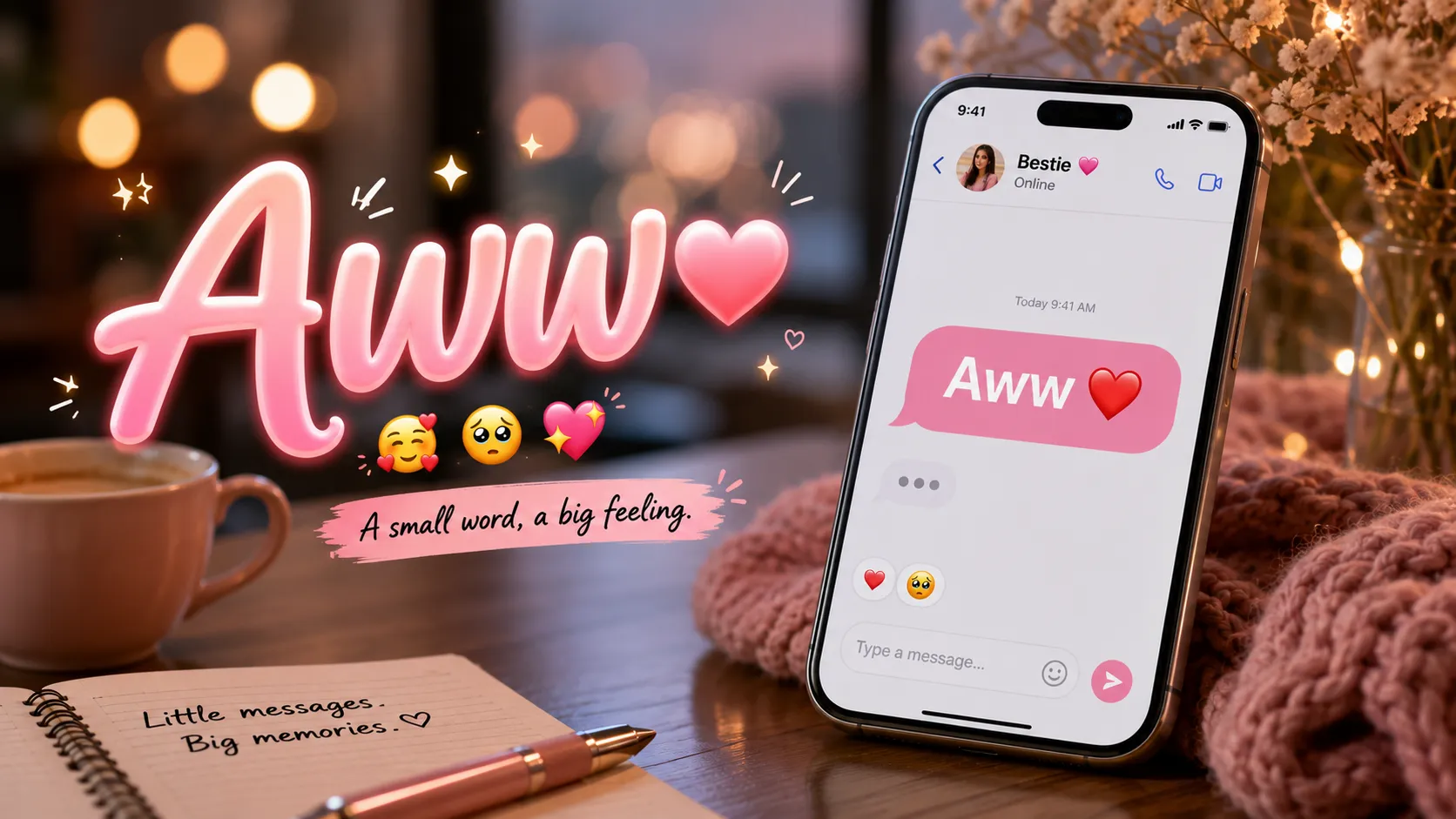
That’s it. No punctuation, no explanation, no emoji. And now you’re staring at your phone wondering — is that sweet? Sympathetic? Flirty? Polite? A little bit of pity?
Here’s the honest answer: “aww” isn’t one word with one meaning — it’s a single sound doing the job of a whole sentence, and the sentence changes depending on who sends it, what came before it, and how many w’s are in it. Most guides online will tell you it “means affection or sympathy” and leave you exactly as confused as you started. This guide won’t. Below, you’ll get an actual framework for reading “aww” correctly, every time — plus the platform-specific, gender-specific, and tone-specific breakdowns that most articles only mention in passing.
Quick Answer
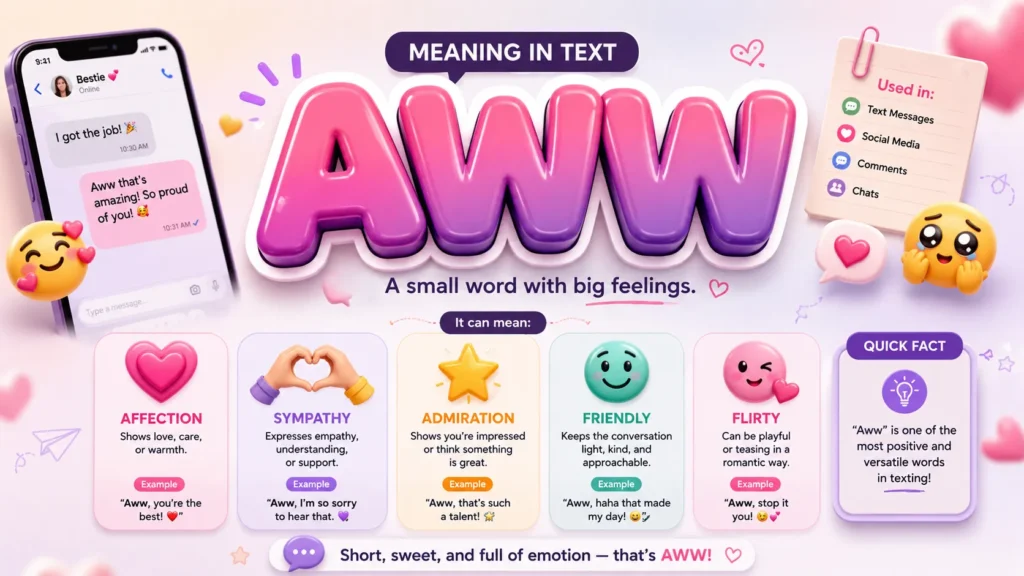
“Aww” is an interjection — a vocal reaction, not a “real” word in the dictionary sense — used in texting to express a soft, immediate emotional response: affection, sympathy, admiration, or tenderness. It’s the written version of the sound people naturally make when they see something cute, hear something sweet, or want to show they care. On its own, it’s almost always warm; its exact flavor (romantic, friendly, sympathetic, sarcastic) is set entirely by context, punctuation, emoji, and the relationship between the two people texting.
What “Aww” Actually Means (And Why It’s Not Really a “Word”)
Linguists classify “aww” as a primary interjection — a category that also includes “ouch,” “wow,” and “shh.” Unlike verbs or nouns, interjections don’t build sentences; they are the sentence. They exist purely to transmit an emotional state in real time, which is exactly why “aww” works so well in texting: it replaces a whole reaction (“that is so sweet and it’s making me feel warm inside”) with three letters.
More specifically, “aww” is onomatopoeic — it mimics the actual sound humans make involuntarily when they feel emotionally moved. Say it out loud slowly: the open, drawn-out vowel physically resembles a sigh or a coo. That’s not an accident. Researchers who study this reaction (often called the “aww response” or, more formally, kama muta — a Sanskrit-derived term meaning “moved by love,” used in psychology to describe the warm, sometimes tearful feeling triggered by tenderness) have found it’s a near-universal human reflex to cuteness and sincerity, which is part of why “aww” translates so easily across cultures and platforms.
In text, it does three jobs at once:
- Emotional shorthand — conveys a feeling instantly, without needing a full sentence
- Tone softener — makes a reply feel warmer and more human, especially useful in a medium (text) that strips out tone of voice and facial expression.
- Conversational filler with intent — sometimes it’s not deep, it’s just a fast, safe, positive way to acknowledge something without over-committing to a bigger respons.e
Where “Aww” Comes From: A Brief History
“Aww” didn’t start as internet slang — it’s older than texting by centuries. The sound itself (spoken as “aw”) shows up in English going back to expressions of pity and tenderness in everyday speech. What changed with the rise of chat, forums, and social media in the 2000s–2010s was spelling behavior: people started typing out the sound exactly as they’d say it, and — critically — started stretching the vowel with extra w’s to signal intensity (“aw” → “aww” → “awww” → “awwww”).
This is a broader pattern linguists call expressive lengthening, and it’s the same reason people type “sooo good” or “nooo way.” It’s not laziness or bad grammar — it’s a deliberate way to encode how much emotion you’re feeling using only letters, since text can’t carry pitch or volume. “Aww” was an early and enduring example of this, and it’s now fully embedded across every major platform — comments, captions, DMs, and reaction threads.
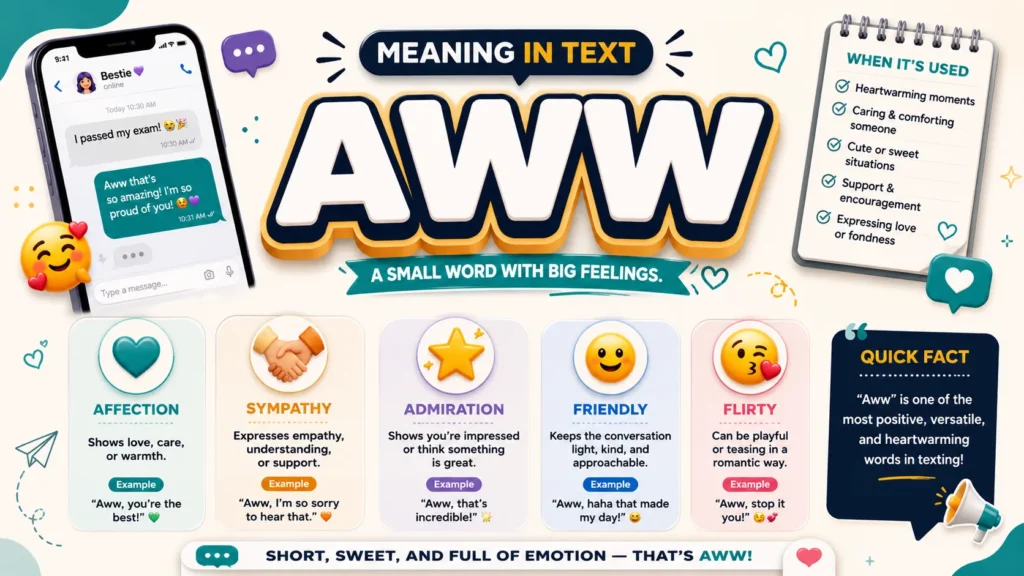
The 6 Core Meanings of “Aww” in Text
Most guides list two or three uses. In reality, “aww” covers at least six distinct emotional registers. Knowing which one you’re looking at is the actual skill here.
| Meaning | What triggers it | Example |
| Affection | Something cute, sweet, or endearing (pets, babies, couples) | “Aww, your dog is adorable 🥺” |
| Sympathy | Someone shares bad news or a small disappointment | “Aww, I’m sorry your flight got delayed” |
| Admiration | Someone shares an achievement or kind gesture | “Aww, that’s so thoughtful of you” |
| Mild disappointment | Plans fall through, something the sender wanted doesn’t happen | “Aww, I really wanted to go” |
| Polite filler / safe reply | Sender doesn’t know what else to say but wants to respond positively | Someone mentions a mundane update → “Aww nice” |
| Sarcasm / mock pity | Used with a flat or clipped tone to mock, deflect, or gently mock someone | “Aww, did that hurt your feelings?” |
The mistake almost every other article makes is treating these as interchangeable. They’re not — and the next section is how you actually tell them apart.
The “Aww” Tone-Decoder: How to Actually Read the Meaning
This is the part competitors skip. Instead of “it depends on context” with no follow-up, here’s a real checklist. Run any “aww” you receive through these four questions:
1. How many w’s, and is there punctuation?
- Aw / Aww thanks — casual, light, low emotional intensity
- Awww / Awwww ❤️ — genuinely moved, higher warmth
- Aww. (with a hard period, no emoji) — often flatter, sometimes sarcastic, dismissive, or just rushed
2. Is there an emoji, and which one?
- 🥺❤️🥹😍 → sincere, affectionate, often romantic-leaning
- 😂🙄 → likely sarcastic or teasing
- No emoji at all → ambiguous by default; weigh the other three signals more heavily
3. What did YOU just say?
- You shared something vulnerable or sad → “aww” = sympathy
- You shared something cute or sweet → “aww” = affection/admiration
- You shared a mundane life update → “aww” = polite filler, not deep meaning
- You said something the sender disagrees with or finds silly → “aww” may be gently mocking
4. Does the conversation continue, or does it stop?
- “Aww” followed by a question or more messages → genuine engagement, likely real interest
- “Aww” as the last word, conversation goes quiet → often just a polite close, not necessarily flirting or deep feeling.ng
Run those four checks, and you’ll correctly read the tone in the vast majority of real conversations — which is more useful than any “it just depends” disclaimer.
Aww Meaning in Text from a Girl
When a girl sends “aww,” it most often signals warmth, sweetness, or appreciation — but the specific flavor shifts by relationship:
- From a friend: Usually straightforward affection or sympathy. Low ambiguity.
- From someone she’s dating or interested in: “Aww” paired with emojis, quick replies, and follow-up questions often signals genuine affection or mild flirting — especially in response to something you did or said that felt thoughtful.
- In response to a compliment: Often a polite, appreciative acknowledgment — “aww, thank you” — not necessarily romantic on its own.
- In response to bad news you shared: Sympathy, plain and simple.
The single biggest mistake people make here is assuming “aww” = romantic interest by default. It’s frequently just kindness. The tone-decoder checklist above is far more reliable than the sender’s gender alone.
Aww Meaning in Text from a Guy
Guys statistically use “aww” less often in casual conversation than girls do (it reads as more traditionally “soft” in some social circles), which means when a guy does send it, it often carries slightly more weight — though not always.
- From a guy who rarely texts emotionally: An unprompted “aww” can be a genuine signal he’s touched or interested, since it’s outside his normal texting register.
- From a naturally expressive guy: It may simply be his normal way of reacting — no extra significance.
- As a reply to a photo: Context matters enormously. “Aww you’re cute” reads differently than a plain “aww” with no follow-up.
- As sympathy: Just as common as from a girl — many guys use “aww” specifically to show emotional support without an emotionally heavy full sentence.
“Aww” vs “Aw” vs “Awe”: Don’t Mix These Up
These three get confused constantly, and only one article in the current search results even mentions it — briefly. Here’s the full breakdown:
| Word | Part of Speech | Meaning | Example |
| Aw | Interjection | Same core meaning as “aww,” just shorter/softer | “Aw, that’s kind of you” |
| Aww | Interjection | Standard texting spelling; slightly more emphasis than “aw” | “Aww, I love that” |
| Awe | Noun/Verb | A completely different word — describes overwhelming wonder, reverence, or amazement (e.g., standing in awe of the Grand Canyon) | “I was in awe of the view” |
“Awe” and “aww” are not interchangeable, even though they sound similar out loud. “Awe” is about being overwhelmed by something vast, powerful, or impressive; “aww” is about being emotionally warmed by something small, cute, or touching. Typing “I’m in awwe” is a common autocorrect-driven typo, not a real usage.
Does the Number of W’s Actually Matter?
Yes — and it’s one of the more reliable signals in the whole system. Vowel-lengthening in texting is a well-documented way people encode intensity without needing capital letters or exclamation points (which can feel aggressive).
| Spelling | Typical Intensity | Typical Use |
| Aw | Very light | Quick, casual acknowledgment |
| Aww | Standard | Everyday sweetness or sympathy |
| Awww | Elevated | Genuinely moved, more emotional weight |
| Awwww+ | High | Strong emotional reaction, often paired with emoji |
Going beyond 4–5 w’s (“awwwwwww”) usually signals playful exaggeration rather than literal increased emotion — similar to typing “yesssss” instead of “yes.”
Is “Aww” Flirty? How to Tell the Difference
This is one of the most-searched follow-up questions, and the honest answer is: it can be, but it isn’t by default. Here’s how to separate flirty “aww” from friendly “aww”:
Signals it’s likely flirty:
- Paired with 🥺, 😍, ❤️, or similar emojis
- Comes with a follow-up compliment or question
- Happens in a conversation that already has flirtatious undertones
- Sent quickly, as part of an active back-and-forth
- Used in response to a photo of you specifically
Signals it’s likely just friendly:
- Short, standalone reply with no emoji
- Sent in response to something objectively cute/sweet unrelated to your appearance
- Conversation doesn’t continue afterward
- Consistent with how that person talks to everyone (check their message history if you’re unsure)
The relationship context always outweighs the word itself. “Aww” from someone you’ve been flirting with for weeks carries different weight than the same word from a coworker.
Can “Aww” Be Sarcastic or Negative?
Yes, and this deserves more than the one throwaway line most competitor articles give it. Sarcastic “aww” typically shows up in these patterns:
- Mock sympathy: “Aww, did you lose? So sad.” — used to gently tease rather than comfort
- Dismissiveness: “Aww, cute.” said flatly in response to someone oversharing or bragging — can signal the sender finds it excessive rather than genuinely endearing
- Passive deflection: A single “aww.” with a hard period and nothing else, especially after an emotionally loaded message, can read as a brush-off rather than real engagement.
The giveaway is almost always the Absence of warmth signals: no emoji, no elongation, no follow-up, combined with a context where genuine sympathy would normally include more words. When in doubt, look at how that person uses “aww” in other, unambiguous conversations — everyone has a baseline.
“Aww” Across Platforms: What Changes Where
| Platform | How “Aww” Typically Functions |
| iMessage / WhatsApp / SMS | Most personal use case — usually genuine affection or sympathy, since it’s a 1:1 conversation with context you both share |
| Instagram comments/DMs | Common under cute or wholesome posts; in DMs, often a light, low-commitment way to react to a story or photo |
| TikTok comments | Used heavily on animal, baby, and “wholesome” content; largely public performance of emotion rather than personal — don’t over-read individual comments |
| Snapchat | Frequently flirtier due to the app’s more intimate, photo-first culture, especially in response to selfies |
| Dating apps (Tinder, Bumble, Hinge) | Often a low-pressure way to show warmth early on without committing to a big response — a good sign, but not a guarantee of strong interest on its own |
| Discord / gaming chat | Less common; usually reactive to a genuinely funny or wholesome moment in-game, rarely deep |
| Slack/workplace chat | Rare and best used sparingly — casual enough to read as unprofessional in formal threads, but fine in relaxed team channels (“aww, congrats on the launch!”) |
“AWW” as an Acronym: The Non-Slang Meanings
Separate from the emotional interjection, AWW (capitalized) occasionally appears as an initialism in specific professional contexts. These are unrelated to the texting slang and shouldn’t be confused with it:
- Occupational health records: sometimes used for “Absent With Work” (leave/attendance tracking)
- Aviation/weather systems: occasionally used informally for weather-watch style alerts in specific regional systems
- Academic/statistics contexts: rare, non-standardized use as shorthand in specific fields
These usages are uncommon and almost always clarified by their surrounding context (a workplace HR document vs. a text message) — if you’re seeing “AWW” in a casual chat, it’s the emotional interjection, not an acronym.
How to Respond to “Aww” (By Scenario)
| What They Said | Good Response |
| Aww after you shared something cute | “Right?! I couldn’t stop looking at it either” |
| Aww after you shared sad/bad news | “Thank you, that means a lot” |
| Aww after a compliment you gave them | “You deserve it 🙂” |
| Aww that feels flirty | “Aww yourself 😏” or lean into the tone they set |
| Aww that feels sarcastic | Address it directly and lightly: “Wow, okay 😂” or just move the topic forward |
| Aww as a one-word reply and conversation stalls | No need to overanalyze — reply naturally or let it close; a single “aww” often just means “noted, that’s nice,” not a cue to escalate |
The general rule: match their energy. A stretched-out, emoji-heavy “awwww 🥹” invites a warmer reply than a flat “aww.”
Common Misconceptions About “Aww” in Text
- “Aww always means romantic interest.” False — it’s one of the most common all-purpose warm reactions in texting and is used constantly between friends, family, and strangers with zero romantic undertone.
- “More w’s always means more feelings, no exceptions.” Mostly true, but past a certain point it becomes playful exaggeration rather than a literal intensity scale.
- “Aww is childish or meaningless.” It’s used across all age groups and in professional-adjacent casual settings — it’s not generational slang the way some texting terms are.
- “A one-word ‘aww’ means someone is uninterested.” Not necessarily — some people are naturally low-word texters regardless of how they feel; look at their overall pattern, not one message in isolation.
- “Aww and Aw mean different things.” They don’t — “aw” is simply the more compact spelling of the same interjection.
Quick Reference Cheat Sheet
- Core meaning: warmth, affection, sympathy, or admiration expressed as a short vocal reaction
- Word type: interjection, onomatopoeic
- More w’s = more intensity (up to a point)
- No emoji + hard punctuation = check for sarcasm or dismissiveness
- Emoji (🥺❤️😍) + fast reply = likely sincere or flirty, depending on relationship
- “Aww” ≠ “Awe” — different words, different meanings
- From a girl or guy — gender matters less than relationship context and conversation pattern
- On dating apps — a good early sign, not a guarantee of strong interest
People Also Ask
Most often it signals warmth, sweetness, or sympathy. It can be flirty depending on emojis, response speed, and the existing relationship, but it’s frequently just a kind, low-stakes reaction.
Similar core meaning — Affection, Sympathy, or admiration. Because some guys use “aww” less often in everyday texting, an unprompted one can sometimes carry slightly more emotional weight, though this varies person to person.
Mostly, but not always. It can express sympathy for something negative, mild disappointment, or, in flatter tones without emoji, mild sarcasm or dismissiveness.
It can be, especially paired with emoji like 🥺 or ❤️ and quick, engaged replies. On its own, without those signals, it’s more often just friendly.
None in meaning — “aww” is simply a slightly more emphasized spelling of the same interjection. Both express the same core emotion.on
No. “Awe” describes overwhelming wonder or reverence (a completely different word), while “aww” expresses warmth toward something cute or touching.
Conclusion
“Aww” looks simple, but it’s carrying a lot of information in three letters: warmth, sympathy, admiration, mild disappointment, or occasionally sarcasm — and the only way to know which one you’re looking at is to read it in context rather than in isolation. Check the punctuation, the emoji, what prompted it, and whether the conversation keeps going. Do that, and you’ll stop staring at your phone wondering what a one-word text actually meant.