SIC Meaning in Text: What It Really Means (2026 Guide)
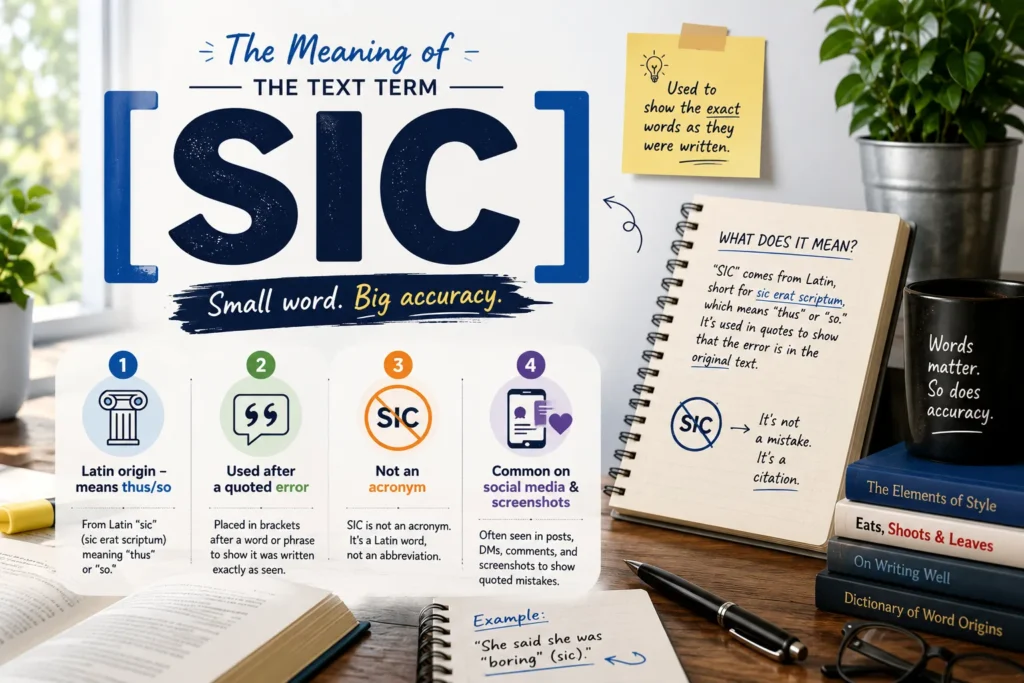
SIC means “intentionally so written.” It’s placed in brackets — [sic] — immediately after a word or phrase in a quote to show that a spelling mistake, grammar error, or unusual wording appeared exactly that way in the original source. It is not a correction and not a typo by the person quoting — it’s a transparency marker that says “I copied this exactly, errors and all.”
2. Quick Meaning Summary
| Aspect | Detail |
| Full meaning | “Intentionally so written” |
| Language of origin | Latin |
| Full phrase | Sic erat scriptum (“thus was it written”) |
| First used in English | Around 1856 |
| Typical format | [sic] in brackets, placed right after the error |
| Is it an acronym? | No — it’s a Latin adverb, not an abbreviation |
| Common context | Quotes, journalism, legal documents, screenshots, social captions |
| Rude? | Not inherently — depends on tone and frequency of use |
3. Origin and History of SIC
“Sic” is a Latin adverb meaning “thus” or “so.” It’s a shortened form of sic erat scriptum — literally, “thus was it written.” Editors began using it in English print around 1856 to mark quoted errors without silently correcting them, borrowing from earlier scholarly traditions used when transcribing manuscripts and historical documents.
One persistent myth worth correcting: “sic” is not an acronym. It’s often claimed to stand for “spelling is correct,” “spelled incorrectly,” or “said in context.” These are all backronyms — phrases invented after the fact to fit an existing word — not the real origin. Merriam-Webster and the Oxford English Dictionary both confirm the true origin is the Latin adverb.
Adding to the confusion, English also has an unrelated word “sic” — the verb meaning “to attack” (as in “sic ’em!”), which comes from an old form of “seek,” not Latin. In Scots English, “sic” simply means “such.” Three different words, one spelling.
4. Why Is SIC Popular Now?
“[Sic]” has always existed in journalism, legal writing, and academic citation — but it’s become far more visible in the last decade for one simple reason: screenshots.
When people repost tweets, texts, or comments, they increasingly add “[sic]” to signal “I didn’t edit this, the mistake is theirs.” As social media turned every user into an amateur editor quoting other people’s words, a once-niche editorial convention became a familiar sight outside of print for the first time.
5. SIC Meaning in Text Messages and Chats
In everyday one-on-one texting, “[sic]” is genuinely rare. People don’t usually quote themselves mid-conversation, so there’s rarely a reason to flag an error that way. Where it does show up in texting-adjacent spaces:
- Group chats, when someone forwards or screenshots a message from elsewhere
- Quoting a third party (“she literally texted me ‘i dont no [sic] why he left'”)
- Playful or sarcastic use, flagging a friend’s typo for a laugh rather than out of necessity
If you see it in a live back-and-forth conversation, it’s almost always someone being deliberately dramatic or humorous about a small mistake — not a genuine editorial correction.
6. SIC Meaning on Social Media
Usage shifts slightly by platform, but the underlying purpose stays the same: flagging an exact, unedited quote.
- X (Twitter): Most common home for [sic] — used when quote-tweeting or screenshotting someone else’s typo-filled post.
- Reddit: Frequently used in comment threads quoting another user’s post, often paired with mild mockery.
- Instagram/TikTok captions: Occasionally used ironically, flagging intentional lowercase or “unbothered” caption style rather than an actual mistake.
- Facebook: Common in shared posts and comment sections quoting news articles or other users verbatim.
- Discord: Less common, but appears when members quote a mistyped message from earlier in the chat log.
7. How to Use [Sic] Correctly
Knowing what it means isn’t the same as knowing how to format it. Here’s the full rule set:
| Rule | Correct | Incorrect |
| Brackets, not parentheses (formal writing) | “recieve [sic] the package” | “recieve (sic) the package” |
| Placed immediately after the error | “The defendant was their [sic] at the scene” | “The defendant was their at the scene [sic]” |
| No period needed | [sic] | [sic.] |
| Often italicized (style-guide dependent) | [sic] | — |
| Used sparingly | One [sic] per genuinely confusing error | [sic] after every minor typo |
Golden rule: only add [sic] when the error could genuinely confuse the reader, or when you need to prove a mistake isn’t yours. Flagging every trivial typo reads as pedantic rather than precise.
8. Examples of SIC in a Sentence
- Formal/legal: “The witness stated the suspect was ‘their [sic] at the time.'”
- Journalism: “The mayor’s tweet read, ‘We are exicted [sic] to announce the new park.'”
- Social media: “caption: ‘best day of my life fr fr [sic]'” — used ironically to flag deliberate lowercase/text-speak style
- Academic: “The 1892 letter reads, ‘I have recieved [sic] your correspondence.'”
9. Is SIC the Same as “Sick”?
No. These are two different words that just happen to look similar in casual typing:
- “Sic” (editorial mark): Latin-derived, means “thus written,” always appears in brackets after a quote.
- “Sick” (slang, sometimes typed “sic”): An informal way of saying something is awesome — “that trick was sic!” This usage got extra visibility from Slipknot’s 1999 song “(sic),” which led some fans to associate the spelling with “sick” rather than the Latin term.
If someone texts “that’s so sic” with no brackets and no quote attached, they mean “sick” (cool) — not the editorial term.
10. Is Using [Sic] Rude?
It depends on intent and frequency, not the word itself.
Not rude when:
- Quoting official documents, legal statements, or historical text
- Preserving accuracy in journalism or academic writing
- The error could genuinely confuse a reader
Can feel rude or mocking when:
- Used after every small, obvious typo
- Deployed purely to highlight someone’s mistake for a laugh
- The quoted message was clearly a quick, casual text — not a formal statement
Language commentators, including The New Yorker’s Louis Menand, have described sic as capable of functioning as a “damning interpolation” — polite on the surface, condescending underneath, depending on how it’s used.
11. Other Meanings of SIC
| Field | Meaning |
| Business/Government | Standard Industrial Classification (SIC) code — identifies a company’s industry |
| Materials Science | SiC — Silicon Carbide, used in semiconductors |
| Medicine | SICS — Small Incision Cataract Surgery |
| Aviation | S.I.C. — Second-in-Command (co-pilot) |
| Music | (sic) — a 1999 Slipknot song, source of “stay sic” fan slang |
| Scots English | Sic — meaning “such” |
| English verb | Sic — meaning “to attack,” as in “sic ’em” |
12. Common Misunderstandings About SIC
- “It’s an acronym.” It isn’t — it’s a Latin adverb. The “spelled incorrectly” backronym is a myth.
- “It’s the same as ‘sick.'” Different word, different origin, different context.
- “It always means the writer is annoyed.” In formal writing, it’s neutral — purely about accuracy.
- “You can put it anywhere in the sentence.” It belongs directly after the specific error, not at the end of a long quote.
- “It needs a period.” It doesn’t — [sic] is a complete bracketed insertion, not an abbreviation.
13. Related Terms and Similar Meanings
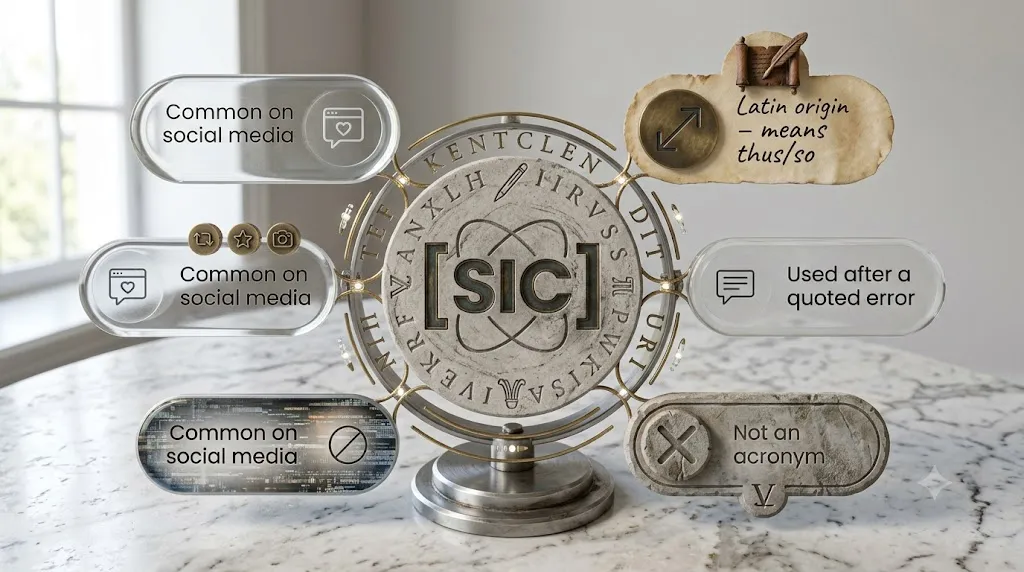
- Sic erat scriptum — the full Latin phrase behind “sic”
- [Emphasis added] — a similar bracketed editorial note, used when a quoting writer adds bold/italics not in the original
- Verbatim — describes an exact word-for-word quote, related in spirit to sic
- SIC code — Standard Industrial Classification code, an unrelated business/government abbreviation
- SiC — Silicon Carbide, an unrelated materials-science term
14. People Also Ask
It shows the writer is quoting something exactly as it was originally written, mistakes included — proving the error isn’t theirs.
Q2 Is SIC an acronym?
No. It’s a Latin adverb meaning “Thus,” short for sic erat scriptum. Claims that it stands for “spelled incorrectly” are false backronyms.
Square brackets — [sic] — are the standard, formal convention. Parentheses (sic) are common informally but less precise.
Not inherently. It becomes rude mainly when used repeatedly to mock small, harmless mistakes rather than to preserve genuine accuracy.
No, though the two get confused because they’re typed the same. “Sic” (editorial) shows quote accuracy; “sick” (slang) means something is impressive.
From the Latin phrase sic erat scriptum — “thus was it written” — first adopted in English print around 1856.
Yes — it’s common when screenshotting or quote-posting someone else’s typo-filled message, though tone matters since it can read as mocking.
Yes. Besides the editorial mark, “SIC” also refers to a Standard Industrial Classification code, silicon carbide (SiC), and the unrelated verb meaning “to attack” (as in “sic ’em”).
15. Conclusion
“Sic” is a small word with one specific job: proving that a quoted mistake belongs to the original writer, not to whoever is quoting them. It’s Latin, not an acronym; it’s neutral by default, not automatically rude; and while it’s showing up more in captions, screenshots, and comment threads, it’s still fundamentally an editorial tool — easy to use correctly once you know the three rules: bracket it, place it right after the error, and don’t overdo it.