OFN Meaning in Text: What It Really Means (All 3 Definitions)
You got a text or a TikTok comment with “OFN” in it, and now you’re stuck. Is it an inside joke? A typo? Some new internet code you missed?
Relax — you’re not behind. OFN is a slang abbreviation that has three real meanings, and which one applies depends entirely on the context of the conversation. Here’s the fast answer, then the full breakdown.
What Does OFN Mean in Text?
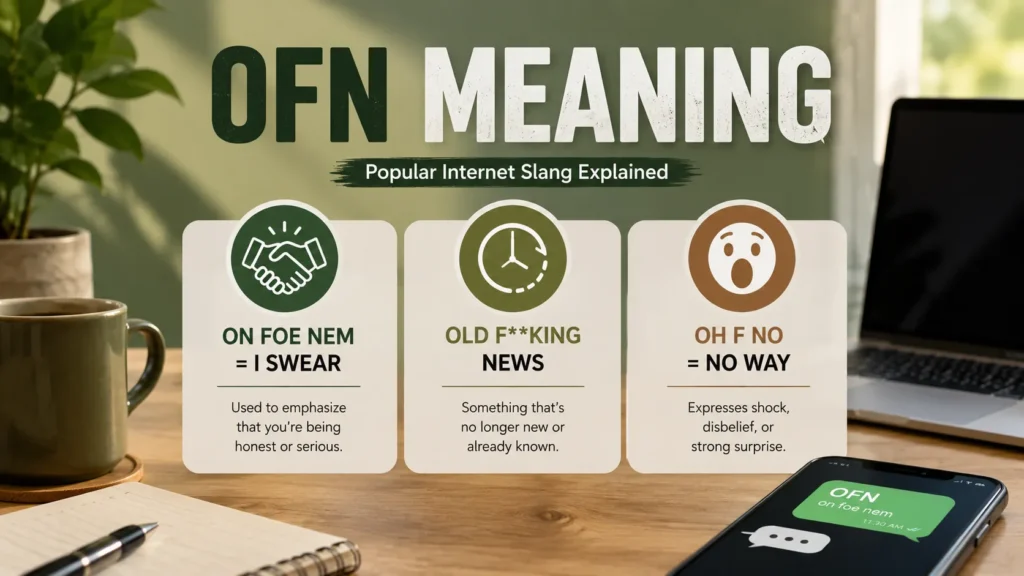
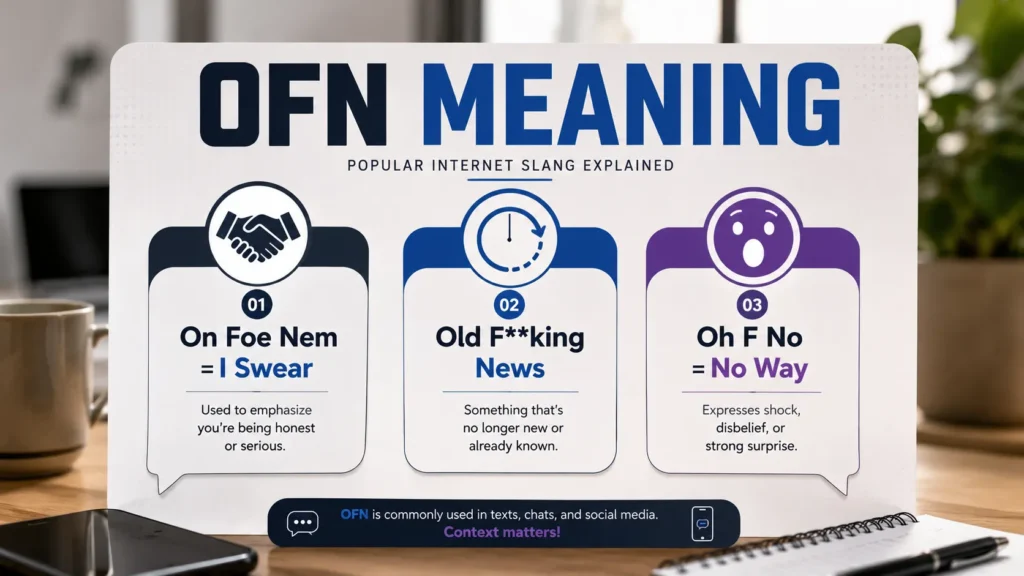
OFN most commonly stands for “On Foe Nem” (also written “On Foenem”) — a Chicago-rooted slang oath meaning “I swear” or “for real.” Depending on context, it can also mean “Old F**king News” or “Oh F**k No.”
Quick Answer: OFN Meaning Summary
| Most common meaning | “On Foe Nem” — an oath meaning “I swear” / “for real” |
| Also means | “Old F**king News” — dismissing outdated info |
| Also means | “Oh F**k No” — a sharp negative reaction |
| Origin | Chicago street/AAVE slang, spread through hip-hop and drill music |
| First popularized | Mid-to-late 2010s, tied to Chicago rap culture |
| Where you’ll see it | TikTok comments, Snapchat, Instagram, group chats, X (Twitter) |
| Tone | Casual only — never use it in professional or formal writing |
The 3 Real Meanings of OFN Explained
Unlike most texting acronyms, OFN doesn’t have one settled meaning — it has three, and mixing them up is the #1 reason people misread a text.
On Foe Nem — The Most Common Meaning
This is the version you’ll see most often, especially on TikTok, Snapchat, and in comment sections. It’s short for “on foe nem” (sometimes written “on foenem” or “on foe n em”), and it functions as an oath — a way of saying “I swear,” “for real,” or “I’m being 100% honest.”
The confusion starts with the word “foe” itself. In everyday use, “foenem” doesn’t mean “enemies” the way the dictionary word “foe” does — it’s AAVE slang for your people: friends, family, or your close crew (“folks and them,” shortened over time to “foe nem”). So when someone says “OFN, I didn’t do that,” they’re essentially swearing on the people closest to them.
Example:
Person A: “Did you really pull an all-nighter for that exam?” Person B: “OFN, I didn’t sleep at all 😭”
Old F**king News — The Dismissive Meaning
In older or more sarcastic contexts, OFN means “old f**king news.” It’s a way of shutting down gossip or information the person already knew about — basically “tell me something I don’t know.”
Example:
Person A: “Did you hear Jake and Mia broke up?” Person B: “OFN, that happened like a month ago.”
Oh F**k No — The Reaction Meaning
Less common but still active, OFN can be a quick, punchy way to react to something with disbelief or hard refusal — the texting equivalent of recoiling.
Example:
Person A: “They want us back in the office 5 days a week.” Person B: “OFN. Absolutely not.”
How to Tell Which Meaning Is Intended
Look at what came right before it:
- Someone making a claim or promise → almost always meaning #1 (the oath)
- Someone responding to news or gossip → meaning #2 (“old news”)
- Someone reacting to a demand, request, or bad idea → meaning #3 (“oh f no”)
Where Does OFN Come From? (Origin and History)
OFN traces back to Chicago street slang, specifically to the South Side, where “foenem” (folks and them / foe and them) was used to refer to one’s close circle — friends, family, and associates. Saying something “on foenem” carried the same weight as swearing “on my mama” or “I swear on everything” — a way to back up a statement with the people you’d never lie in front of.
The term moved from local slang into wider hip-hop culture through Chicago drill and rap artists in the mid-to-late 2010s, and from there it spread to TikTok, Instagram, and Snapchat, where it’s now used far beyond Chicago — often by people who have no idea it started as a regional AAVE phrase tied to a specific city and culture.
You’ll see some sites claim “foe nem” is short for “foes and enemies” and refers to swearing on rivals. That version exists as a secondary folk explanation, but the dominant, better-documented meaning — the one that actually matches how the phrase is used today — is “folks and them” (your people), not “enemies.” Treat the “enemies” story as community folklore rather than settled etymology.
Why Is OFN So Popular Right Now?
OFN’s popularity comes down to speed. It’s a two-syllable oath that fits into a text or comment faster than typing “I swear I’m being honest,” which makes it a natural fit for TikTok comment culture and Snapchat’s fast, back-and-forth chat style.
It also rode the same wave that carried Chicago drill music into mainstream hip-hop in the late 2010s — as that music and its slang spread on streaming and social platforms, phrases like “on foenem” spread with it, eventually detaching from their regional origin and becoming generic internet slang used by people who’ve never set foot in Chicago.
OFN on Snapchat, TikTok, and Instagram
| Platform | How It’s Typically Used |
| TikTok | Mostly comment sections — reacting to a claim in a video (“OFN this happened to me too”) or tagged onto captions for emphasis |
| Snapchat | Casual snaps/chats to swear something is true, or to react to a friend’s story |
| Comments and captions, usually the “I swear/for real” meaning | |
| Group chats/X (Twitter) | Any of the three meanings, depending on the thread — most often reacting to news (#2) or backing up a claim (#1) |
Common Misspellings and Variants of OFN
- OFN
- On foenem / on foe nem / on foe n em
- OFN grave (an intensified version — “on foenem grave,” swearing on something more serious)
- OFNG
Common Misunderstandings About OFN
- “OFN always means enemies.” Not quite — the “foes and enemies” reading is a secondary folk explanation. The dominant, everyday meaning of “foenem” is “folks and them” (your people), not rivals.
- “OFN only has one meaning.” It doesn’t. Missing the “old f**king news” or “oh f**k no” readings is the most common reason people misinterpret a text.
- “OFN is an unrelated business acronym.” In finance and nonprofit contexts, OFN can stand for “Opportunity Finance Network” — a completely different, unrelated organization. If you see OFN in a business or finance article, it’s almost certainly not the slang term.
- “OFN is offensive or a slur.” It isn’t. It’s informal slang with real cultural roots, not a derogatory term.
Is OFN Rude or Offensive?
No — OFN itself isn’t offensive. It’s informal slang, not a slur, and using it isn’t disrespectful. That said, it’s strictly casual: don’t use it in work emails, school assignments, or any formal writing. It’s also worth being mindful that the phrase carries real cultural roots in Chicago AAVE — using it is fine, but understanding where it comes from (rather than treating it as a random meme acronym) is part of using slang responsibly.
Related Terms and Similar Meanings
- No cap — “I’m not lying,” similar to OFN’s oath meaning
- On god — another truth-swearing oath, used almost interchangeably with “on foenem”
- Deadass — “seriously/for real,” overlaps with OFN meaning #1
- FR FR (“for real for real”) — emphasis/truth marker, same family as OFN
- Cap / no cap — the broader lying vs. truth-telling slang pair that OFN’s oath usage belongs to
People Also Ask
Most commonly, OFN means “on foe nem” — a casual way of swearing something is true. It can also mean “old f**king news” or “Oh F**K No,” depending on context.
Yes. OFN is simply the abbreviated form of “on foenem” / “on foe nem.”
It originated in Chicago street slang, where “foenem” referred to one’s close friends and family (“folks and them”). It later spread through hip-hop culture and social media.
Not in its most common usage. While a folk explanation ties “foe” to “enemies,” the widely used and better-supported meaning is “folks and them” — your close circle, not your rival
The phrase has spread widely and is used across the country in casual texting, but it’s good practice to understand its AAVE/Chicago origin rather than using it without context.
It’s an intensified version of the oath — “on foenem grave” — used to swear even more seriously than a standard OFN.
Conclusion
OFN isn’t a one-definition acronym — it’s three overlapping meanings that all trace back to the same Chicago-born phrase, “On Foenem.” Whether someone’s swearing something’s true, dismissing old news, or reacting with disbelief, context is your best decoder ring. Now that you know all three, you’ll never have to guess again — and if you’re curious about other texting acronyms with layered meanings, check out our other slang breakdowns below.
This article is for informational purposes only and reflects common usage as of 2026; slang meanings can shift by region and community.