WRD Meaning in Text: What It Really Means (And How to Use It)
Quick answer: WRD is texting slang for “word.” It’s used to show agreement (“I agree,” “that’s true”), acknowledgment (“got it,” “I hear you”), or surprise (“really?” “no way”). It traces back to the hip-hop-era phrase “word is bond” and shows up most on Snapchat, TikTok, Instagram, Discord, and group texts. It’s casual slang — save it for friends, not work messages.
Getting a text that just says “wrd” can be confusing if you’ve never seen it before — is it a typo? A new abbreviation? Something you’re supposed to already know? It’s neither complicated nor new. This guide covers exactly what WRD means, where the slang actually comes from, how punctuation quietly changes its meaning, how it’s used differently across platforms, and — the part most explainer articles skip — how to reply to it so the conversation doesn’t die.
What Does WRD Mean?
WRD is a shortened spelling of “word.” In texting, “word” isn’t used literally — it functions as a reaction. Depending on context, it signals one of three things:
Quick Meaning Summary
| Meaning | What it signals | Example |
| Agreement | “I agree” / “exactly” / “true” | A: “This weather is brutal.” → B: “wrd” |
| Acknowledgment | “I hear you” / “got it” / “noted” | A: “I’ll be 20 mins late.” → B: “wrd, no rush” |
| Surprise or disbelief | “Really?” / “no way” / “for real?” | A: “I just got the job!” → B: “WRD?! Let’s gooo” |
The exact shade of meaning usually comes down to punctuation, capitalization, and tone — not the letters themselves. More on that below.
Origin and History of WRD
WRD isn’t a modern invention — it’s a shorthand for slang that’s decades old.
- 1980s–90s: The phrase “word” and the longer “word is bond” became widely used in hip-hop and African American Vernacular English (AAVE) to affirm that something was true or trustworthy — essentially, “I give you my word.”
- Early internet era: As chatrooms, AIM, and early SMS took over, “word” got clipped for speed and character limits, eventually landing on the spelling WRD.
- Post-2020: The abbreviation spread rapidly across TikTok, Snapchat, Instagram, and Discord as short, low-effort reaction slang became standard in fast-paced digital chats.
WRD’s roots go back to a phrase about truth and trust in Black American vernacular culture — the modern texting version has kept the core meaning (affirmation) while losing most of the original weight and becoming a lighter, everyday reaction.
Why Is WRD Popular?
WRD sticks around for the same reason most reaction slang does: it’s fast to type, low-effort, and instantly understood by anyone active on social media. It fits the pace of platforms built around quick exchanges — Snapchat stories, TikTok comment sections, group chats — where a full sentence response often isn’t necessary. It also carries a bit of cultural credibility from its hip-hop origins, which gives it more personality than a plain “ok” or “yeah.”
How Punctuation Changes the Meaning
This is the detail most guides gloss over, and it’s the single most useful thing to know about WRD:
| Format | Typical meaning | Example |
| wrd (no punctuation) | Plain agreement | “wrd, same here” |
| wrd. (period) | Flat, matter-of-fact agreement | “wrd.” |
| WRD (all caps) | Stronger emphasis or emotion | “WRD that’s insane” |
| wrd? (question mark) | Asking for confirmation — “for real?” | “wrd? since when” |
| wrd 😂 / wrd 😮 | Emoji sets the emotional tone | “wrd 😭 I can’t” |
| wrdd / wrddd (stretched spelling) | Exaggerated agreement or hype | “wrddd facts” |
If you remember one rule: a question mark turns WRD from a statement into a request for confirmation.
How Is WRD Used in Real Conversations?
WRD almost always functions as a reaction, not an opener — it responds to something someone else said rather than starting a new topic. It’s typically dropped in as a standalone reply, sometimes followed by a short add-on (“wrd, no rush,” “wrd, that’s crazy”) to soften what could otherwise read as a dry one-word answer.
Example Conversations
Example 1 — Agreement
A: “Traffic today was actually insane.” B: “wrd, took me an hour to get home”
Example 2 — Acknowledgment
A: “Heads up, I might be 10 minutes late.” B: “wrd, all good”
Example 3 — Surprise
A: “I just found out I got into the program!” B: “WRD?! Congrats, that’s huge”
Example 4 — As a question
A: “She’s actually moving to another city next month.” B: “wrd? since when”
Example 5 — Snapchat-style check-in
A: [sends a Snap of a concert] B: “wrd 😮 wish I was there”
WRD on Social Media (Platform-by-Platform)
WRD means roughly the same thing everywhere, but the way it gets used shifts slightly by platform:
- Snapchat — Extremely common as a quick reaction to a Snap or story; fits the app’s fast, disappearing-message style. Sometimes doubles as a casual check-in between friends who talk regularly.
- TikTok — Shows up constantly in comment sections to agree with a creator’s point or react to a relatable clip.
- Instagram — Common in DMs and comment replies as a one-word reaction to something surprising or relatable.
- Facebook — Less common, but appears in comments among younger users, usually mirroring the same “agreement” meaning.
- Discord — Used in gaming and community servers to quickly confirm a plan or co-sign a teammate’s message.
- Reddit — Occasionally used in comment threads, particularly in pop-culture, gaming, or meme-focused subreddits.
- X (Twitter) — Used in replies to co-sign someone’s take (“wrd, say it louder for the people in the back”).
Common Misunderstandings About WRD
- “WRD means weird.” Not quite — some people type “wrd” as a fast, sloppy shorthand for “weird” (“that’s kinda wrd”), but this is a spelling coincidence, not the slang’s actual meaning. Context makes it obvious which one is meant almost every time.
- “WRD and WRYD are the same thing.” They’re not. WRYD means “what are you doing” — a completely different, question-based abbreviation that just happens to share letters with WRD.
- “WRD is rude or dismissive.” It isn’t inherently — it’s a genuine, casual way to agree or acknowledge something. It can read as short or low-effort in an otherwise longer conversation, so tone and relationship context matter more than the word itself.
- “WRD has one fixed, official definition.” Like most slang, its exact feel shifts with punctuation, emoji, and the relationship between the people texting — there’s no single rigid rule beyond “affirmation of some kind.”
How to Reply to WRD
Getting a one-word “wrd” back can feel like a conversational dead end — but it usually isn’t. Here’s how to keep the conversation moving depending on what kind of WRD you received:
- If It’s Plain Agreement (“wrd”): They’re already on your side — build on what you said instead of repeating it.
- If it’s a question (“wrd?”): They want confirmation. Add a detail or reassurance: “yeah for real, it happened this morning.”
- If the conversation feels like it’s fizzling: Reply with a follow-up thought, a question, or a new topic rather than matching their one-word energy.
- If you want variety instead of always typing “wrd”: try “fr,” “facts,” “exactly,” “no cap,” or “bet” — note that “bet” leans toward confirming an action (“I’ll do it”), while WRD leans toward validating a statement (“that’s true”).
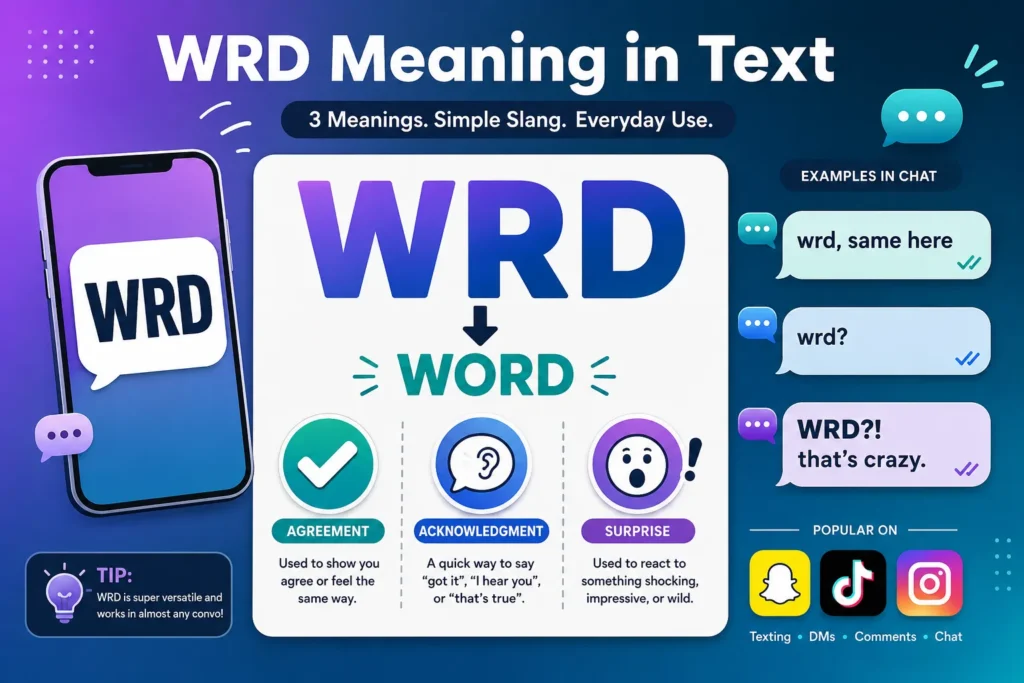
What does WRD actually mean? Here’s the quick breakdown — agreement, acknowledgment, or surprise, depending on how it’s used. 👇
WRD vs. Similar Slang Terms
WRD frequently gets confused with — or lumped in alongside — other short texting abbreviations. Here’s how they actually differ:
| Term | Meaning | How it differs from WRD |
| WYD | “What you doing?” | A question that starts a conversation; WRD responds to one |
| WRYD | “What are you doing?” | Same idea as WYD; unrelated to WRD despite similar spelling |
| WOD | “Word” (identical meaning) | Near-identical to WRD; used interchangeably |
| Bet | “Okay” / “I’ll do it” | Confirms an action rather than validating a statement |
| YK | “You know” | Adds emphasis to a statement instead of reacting to one |
| OFC | “Of course” | A stronger, more explicit form of agreement than WRD |
| IYKYK | “If you know, you know” | References insider knowledge, not agreement |
| Fr / No cap | “For real” / “not lying” | Emphasizes truthfulness; similar tone, different origin |
When (Not) to Use WRD
WRD is strictly informal. It works well in:
- Texts with friends
- Group chats
- Social media comments and DMs
- Gaming chat
It’s best avoided in:
- Work emails or messages to colleagues you don’t know well
- Formal or professional writing
- Messages to people unfamiliar with slang, who may just reply with “what does that mean?”
People Also Ask
WRD is short for “word,” used to Express Agreement, Acknowledgment, or surprise depending on context and punctuation.
The same as everywhere else — it’s a quick reaction to a Snap, story, or message that shows agreement or acknowledgment.
No. WYD means “what you doing” and asks a question; WRD is a reaction or response, not a conversation-starter.
Occasionally people type “wrd” as fast shorthand for “weird,” but that’s a spelling coincidence rather than the slang’s real meaning — context usually makes the intended meaning clear.
Not inherently. It’s a genuine, casual way to agree or acknowledge something, though it can read as low-effort in a longer conversation depending on tone.
It comes from the hip-hop-era phrase “word” / “word is bond,” rooted in AAVE, used to affirm truth or trustworthiness before being shortened for texting.
No — it’s casual slang best kept to texts, DMs, and social media rather than work or formal communication.
Conclusion
WRD Is Short, Flexible teTting slang rooted in the much older phrase “word is bond.” In everyday use it almost always signals agreement, acknowledgment, or surprise, and the exact shade of meaning comes down to punctuation, emoji, and context rather than the letters themselves. Once you recognize the pattern, you won’t need to pause and decode it again.