BBC Meaning in Text: What It Really Means (And How to Tell Which One Someone’s Using)
You saw “BBC” in a text, a comment, or a caption — and now you’re not sure if someone’s talking about the news, a joke, or something you’d rather not guess at in front of your boss. That confusion is normal. BBC Is One Of The Few Acronyms That Lives A Genuine Double Life Online, and getting it wrong in the wrong setting can be awkward.
Here’s the short answer, then the full breakdown so you never have to guess again.
Quick Answer
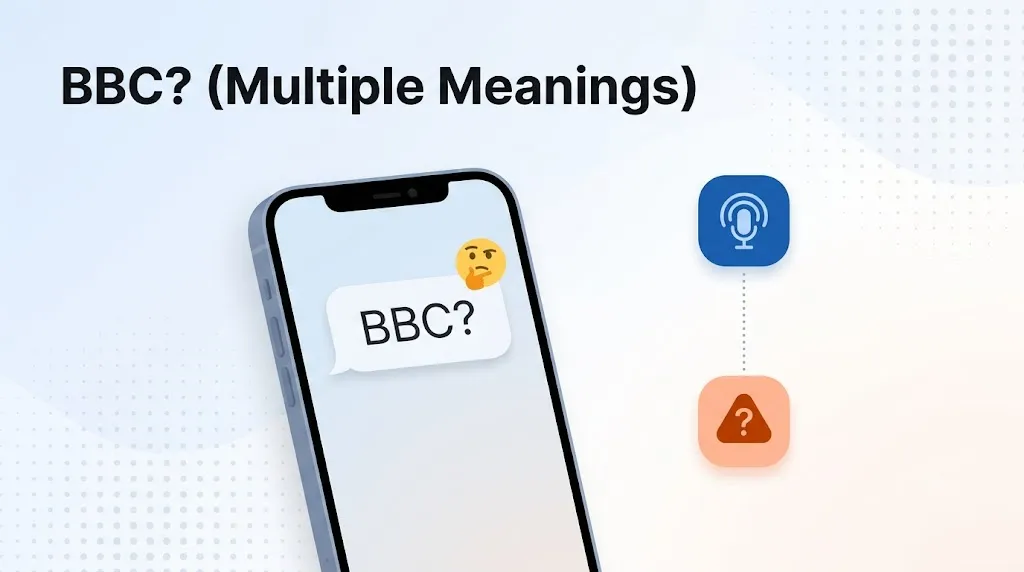
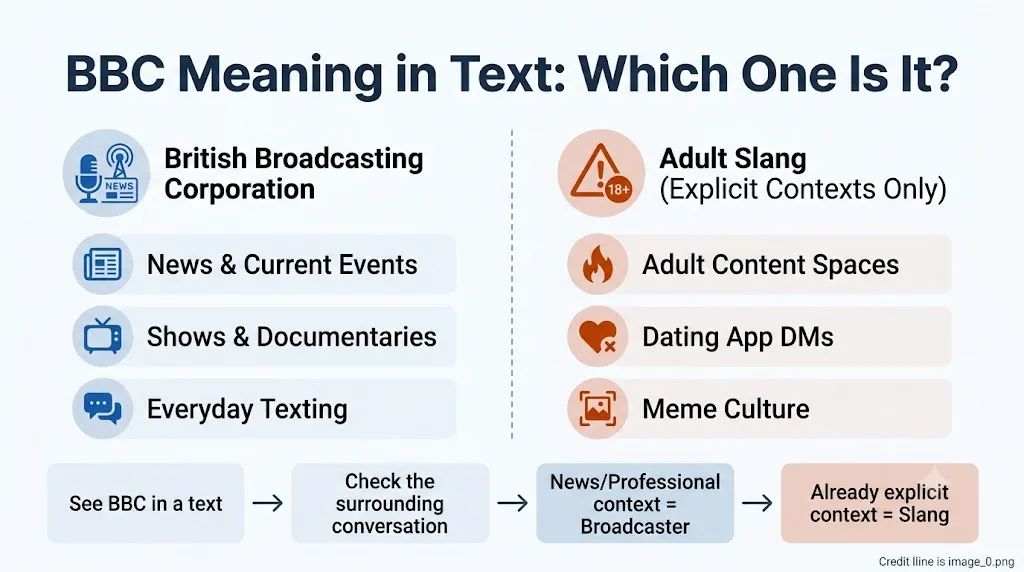
In text and online chat, “BBC” almost always means one of two things:
- British Broadcasting Corporation — the UK’s public news and media organization. This is the meaning used in news, professional, academic, and most everyday conversations.
- Adult sexual slang — a crude term referencing Black male anatomy, used in explicit or adult-oriented contexts, memes, and dating apps.
Which one applies depends entirely on where you saw it and who sent it. A tweet about a documentary and a comment on a dating app profile are not using the same word — they just happen to share three letters.
The Two Real Meanings of BBC
1. British Broadcasting Corporation (the original, and still the most common, meaning)
The BBC was founded in 1922 as the British Broadcasting Company and became a public corporation in 1927, making it one of the oldest and most recognized media organizations in the world. In text and online conversation, this meaning dominates whenever the context is:
- News, current events, or politics (“Did you see that BBC piece on the election?”)
- TV or documentaries (“BBC just dropped a new nature series”)
- Radio or podcasts (BBC Radio 1, BBC Sounds)
- Sports coverage (BBC Sport match updates)
- Any formal, professional, or academic conversation
If BBC shows up in a group chat about current events, an email, a LinkedIn comment, or a conversation with someone you don’t know well, this is the safe default interpretation.
2. Adult slang (informal, explicit, context-restricted)
In certain corners of the internet — adult forums, some dating app profiles, NSFW memes, and explicit content — BBC is used as slang referencing Black male anatomy. It’s crude, explicit, and not appropriate for professional, academic, or general-audience settings.
This usage grew out of adult content communities in the early-to-mid 2000s and later spread into meme culture, where it’s sometimes used ironically or as shock humor rather than literally. It is not a term used casually by most people in everyday texting — it shows up almost exclusively in adult-themed spaces, and its presence in a message is usually unmistakable from the surrounding content.
The bottom line: if the conversation, profile, or content around the message is already explicit or adult-oriented, that’s the meaning being used. If it isn’t, it almost certainly isn’t.
How to Tell Which Meaning Is Being Used
Use this quick decision path:
| Ask yourself | If yes → likely meaning |
| Is the conversation about news, TV, sports, or current events? | British Broadcasting Corporation |
| Is this a professional, academic, or family group chat? | British Broadcasting Corporation |
| Is the surrounding content, profile, or thread already explicit/adult? | Slang usage |
| Are other clearly sexual terms or emojis used nearby? | Slang usage |
| Are you genuinely unsure and the sender is someone you trust? | Just ask — see how to respond |
Context is doing 100% of the work here. The word itself doesn’t change; the room it’s said in does.
BBC on Different Platforms
WhatsApp / iMessage / SMS: Almost always the broadcaster, unless the chat itself is already adult-oriented. Family and friend group texts referencing “BBC” are overwhelmingly about news or shows.
Instagram: Comments under news posts, documentary trailers, or sports pages → broadcaster. Comments on adult content or certain meme accounts → slang.
TikTok: Mixed. Captions discussing UK news, BBC shows, or journalism → broadcaster. It also occasionally appears as a coded term to dodge content moderation filters in adult-adjacent corners of the app — another reason surrounding context matters more than the letters themselves.
Dating apps (Tinder, Bumble, Hinge): This is the one setting where the slang meaning shows up with real frequency, particularly in bios or DMs with explicit intent. If it appears alongside other sexually explicit language, that’s your answer.
Email: Virtually never slang. In professional email, if you see “BBC,” people almost always mean the broadcaster — or they’ve mistyped BCC (see below).
BBC vs. BCC (People Mix These Up Constantly)
These get confused because they look alike, but they’re unrelated:
| Term | Meaning | Where you’ll see it |
| BBC | British Broadcasting Corporation (or, in adult contexts, explicit slang) | Texts, social media, news |
| BCC | Blind Carbon Copy — a way to email someone without other recipients seeing their address | Email clients (Gmail, Outlook) |
If someone says “I BBC’d you on that email,” they almost certainly meant BCC — a simple typo, not a coded message.
Other Meanings You’ll See Claimed Online (And Why They’re Mostly Fake)
What is real: individual friend groups sometimes invent their own private shorthand and just happen to land on “BBC” for something totally unrelated — a group’s inside joke, a gaming clan tag, a project codename. That’s not a broader internet slang meaning, though; it’s a one-off backronym that only means something inside that specific chat. If a friend uses “BBC” in a way that fits neither the broadcaster nor the adult slang meaning, it’s probably exactly that — their own shorthand, not universal slang. Ask them.
If a Parent Sent You Here
If you’re a parent who spotted “BBC” in your child’s messages or a comment section, here’s the practical version:
- In the vast majority of everyday teen texting, “BBC” is not being used sexually — it’s far more commonly tied to news, school assignments referencing BBC articles, or general internet chatter.
- The slang meaning is real and does circulate in meme culture and some corners of social media, but it’s typically tied to explicitly adult content, not casual conversation. If you see it appearing alongside adult content, sexual emojis, or on a platform/account that’s clearly NSFW, that’s worth a direct, calm conversation.
- Rather than assuming the worst from one acronym, look at the surrounding conversation — the same rule that applies to everyone applies here. One word rarely tells the whole story; the thread around it does.
- If you want to talk to your child about it, a simple, non-accusatory question works best: “I saw ‘BBC’ in a chat — what does that mean in your group?” Most of the time, the answer will be mundane.
How to Respond If You’re Not Sure
You don’t need to decode it in your head — you’re allowed to just ask. A few low-friction options:
- “Wait, BBC as in the news, or…?” — lighthearted, gives the other person room to clarify without it being a big deal.
- If the context already looks explicit and you’re not comfortable with that — it’s fine to say so directly and change the subject, or exit the conversation.
- In professional or formal settings, default to the broadcaster meaning and move on — it’s extremely unlikely to mean anything else in that context.
People Also Ask
Is BBC always sexual slang online? No. The broadcaster meaning is still the most common usage by far across news, TV, Sports, And General Conversation. The slang meaning is real but confined mostly to adult-oriented spaces.
If you mean the broadcaster, yes — it’s a widely understood, everyday abbreviation. If you’re unsure how your audience will read it, spell out “the BBC” or “BBC News” the first time to avoid any ambiguity.
BBC refers to the British Broadcasting Corporation (or adult slang, in explicit contexts). BCC stands for Blind Carbon Copy, an email function. They’re unrelated — the overlap is just three similar-looking letters.
BBC refers to the British Broadcasting Corporation (or adult slang, in explicit contexts). BCC stands for Blind Carbon Copy, an email function. They’re unrelated — the overlap is just three similar-looking letters.
Meme culture sometimes repurposes slang ironically or as shock humor, detached from its literal meaning. If a usage doesn’t fit either main definition, it’s likely a joke, an inside reference, or platform-specific shorthand
hand rather than a “hidden” third meaning.
Conclusion
At the end of the day, “BBC” Isn’t A Mystery — It’s A Context Test. In the vast majority of texts, comments, and chats you’ll ever see it in, it means exactly what it’s meant since 1922: the British Broadcasting Corporation. The adult slang meaning is real, but it only shows up when the conversation around it is already explicit — it doesn’t ambush you out of nowhere in a normal group chat.
So the next time “BBC” pops up and gives you pause, skip the guessing game. Look at who sent it, what platform you’re on, and what the rest of the conversation is actually about. That’s almost always enough to answer it correctly in a few seconds — no decoder ring required.
If texting shorthand like this keeps tripping you up, you’re not alone — acronyms like BCC, NSFW, and dozens of dating-app-specific terms cause the same kind of confusion every day. Check out our full Texting Acronyms Glossary to get ahead of the next one before it catches you off guard.