Ditto Meaning in Text: What It Really Means (2026)
If someone just texted you “Ditto” and you’re not 100% sure how to take it, you’re not alone. It’s one of those words everyone recognizes but almost nobody can define on the spot. Here’s the short version — and everything else you might want to know after it.
What Does “Ditto” Mean in Text?
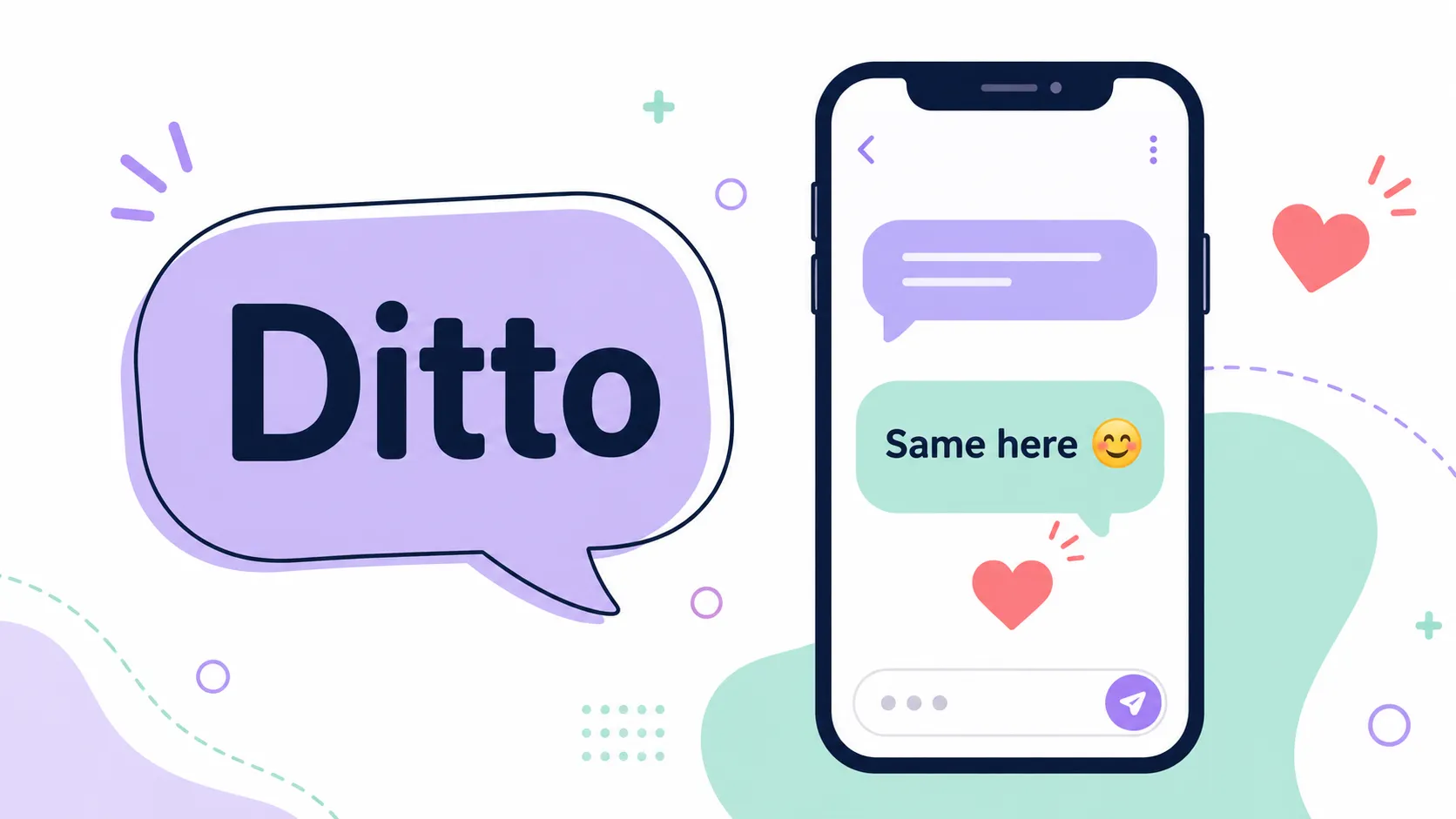
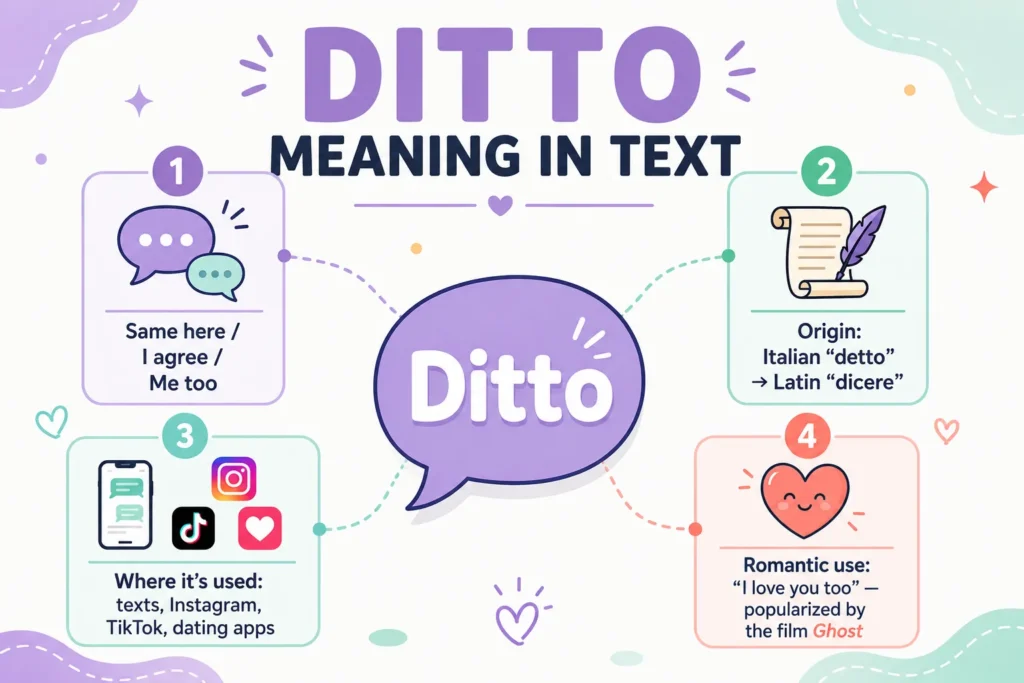
In texting, “ditto” means “same here,” “I agree,” or “me too.” It’s a one-word way to confirm that whatever the other person just said applies to you too, without retyping their sentence.
If a friend texts “I’m exhausted today” and you reply “ditto,” you’re saying you’re exhausted too. If someone says “That was such a good movie” and you reply “ditto,” you’re agreeing completely. It works as a stand-in for repetition — echoing a feeling, opinion, or statement in the fewest possible characters.
Quick Meaning Summary
| Aspect | Detail |
| Meaning | “Same here,” “I agree,” “me too” |
| Word type | Originally a noun/adverb; used informally as an interjection in texting |
| Tone | Casual, warm, neutral-to-affectionate |
| Best used in | Texts, DMs, comments, casual chats |
| Avoid in | Formal emails, professional reports, academic writing |
| Common platforms | iMessage/WhatsApp, Instagram, TikTok, dating apps |
| Romantic use? | Yes — popularized by the 1990 film Ghost |
| Related to Pokémon? | No — separate meaning, see disambiguation below |
Why Is “Ditto” Still Popular in 2026?
“Ditto” has stayed relevant for a simple reason: it does more social work than its single word suggests. It’s faster to type than “same here,” warmer than a thumbs-up emoji reaction, and less formal than “I concur” — which makes it a natural fit for fast-moving group chats, comment sections, and DMs where tone and speed both matter. Recent pop-culture moments (NewJeans’ song, ongoing Ghost references) have also kept it circulating among younger users who might otherwise reach for newer slang.
Origin and History of “Ditto”
“Ditto” didn’t start on a phone screen — it’s nearly 400 years old. The word entered English in the early 1600s from the Tuscan Italian dialect word ditto, a variant of detto, the past participle of dire (“to say”), which traces back to the Latin verb dīcere (“to say” or “speak”). It’s a direct linguistic cousin of words like “dictate,” “dictionary,” and “dictum.”
The earliest recorded English use, from 1625, appeared in travel writing to avoid repeating a month in a list of dates — something like “the 28th ditto” instead of writing out the month again. From there, merchants and bookkeepers adopted it in ledgers and account books to avoid rewriting repeated items, and by the late 1600s it had picked up its now-familiar general sense of “the aforesaid” or “the same.” English speakers eventually pushed it further than Italian ever had, using it as a noun, adjective, adverb, and even a verb by the 1700s.
The physical “ditto mark” (″) — those two small tick marks used under a repeated item in a list — comes directly from this usage and is still taught in some accounting and stenography contexts today.
Its leap into casual spoken and written agreement (rather than just repeated data) developed over the 19th and 20th centuries, and by the time SMS texting took off, “ditto” was perfectly suited for a format that rewarded short, efficient replies.
How “Ditto” Is Used in Texting
In modern digital conversation, “ditto” typically shows one of three things:
- Agreement — confirming you feel or think the same way.
- Shared experience — signaling you’ve been through the same thing.
- Affection or warmth — especially in response to a compliment or emotional message.
It’s almost always informal. You’ll see it far more often in a text thread with friends than in a work Slack message or a client email.
Examples of “Ditto” in Conversation
- Friend 1: “I can’t wait for the weekend.” Friend 2: “Ditto.”
- A: “I really don’t want to go to that meeting.” B: “Ditto, honestly.”
- A: “You looked great today.” B: “Ditto ❤️”
- A: “This traffic is unbearable.” B: “Ditto. I’ve been stuck for 20 minutes.”
“Ditto” on Social Media
The word adapts slightly depending on the platform:
- Instagram comments: Used to echo agreement with a caption or another commenter — often paired with an emoji.
- TikTok: Appears in comment sections and occasionally in on-screen text overlays to show quick agreement with a trend, sound, or opinion.
- X (Twitter) / group chats: Used as a fast reply to avoid quote-repeating a whole post or message.
Across platforms, the appeal is the same: it says a lot with very little effort, which fits how people actually communicate online.
Romantic and Pop-Culture Use of “Ditto”
“Ditto” carries a well-known romantic layer, largely thanks to the 1990 film Ghost, where Sam (Patrick Swayze) responds to Molly’s “I love you” with a quiet “Ditto” — because he can’t quite say the words directly. That scene cemented “ditto” as an indirect, emotionally loaded way of saying “I love you too.”
More recently, the word got a fresh wave of attention through NewJeans’ 2022 song “Ditto,” which reintroduced the word’s yearning, romantic undertone to a new generation of listeners — and it shows up frequently on dating apps like Tinder, Bumble, and Hinge as a lighter, less-intense way to reply to a compliment or shared interest without overcommitting emotionally.
“Ditto” vs. Ditto the Pokémon — Don’t Confuse Them
If you searched “ditto meaning” and landed here expecting the pink, shape-shifting Pokémon, you’re thinking of a different “Ditto.” Ditto the Pokémon is a fictional creature that can transform into any other Pokémon it sees, and its name likely nods to the same root idea — “copying” or “the same as.” But the two uses are unrelated in modern context: one is a slang term for agreement, the other is a game/anime character. If you’re texting a friend and they reply “ditto,” they mean “same here” — not a reference to the Pokémon franchise, even if the name overlap is a fun coincidence.
Professional and Technical Uses of “Ditto”
Outside casual texting, “ditto” still shows up in a few specific fields:
- Accounting And Record-Keeping: Its original use — avoiding rewriting repeated line items in a ledger or list.
- Science and lab notes: Occasionally used to indicate a repeated value or observation without rewriting it.
- Aviation and technical logs: Sometimes used informally to flag repeated data entries.
These uses are far more literal than the emotional, conversational sense of texting “ditto” — it’s simply marking repetition, not agreement or feeling.
Common Misunderstandings About “Ditto”
- “Ditto is only romantic.” Not true — it’s neutral by default and works in almost any casual context, not just love confessions.
- “Ditto is rude or dismissive.” Also false. When used with warmth or an emoji, it reads as friendly and validating, not curt.
- “Ditto only works as a direct reply.” It’s commonly used as a standalone response, but it can also apply loosely to a broader shared sentiment, not just the literal last sentence someone typed.
- “Ditto is a modern internet abbreviation.” It’s actually one of the older words in casual slang — predating texting by roughly 400 years.
Alternatives to “Ditto”
If you want to mix up how you express the same idea:
- Same here
- Me too
- Likewise
- Agreed
- Same
- I feel that
- For real
- Facts
Regional and Global Usage
“Ditto” is widely recognized and used across the U.S., U.K., Canada, and Australia. In other English-speaking regions, equivalents like “same,” “me too,” or, in parts of South Asia, playful phrases like “same pinch” serve a similar social function. The core idea — echoing agreement briefly — is close to universal, even if the exact word varies.
People Also ASK
It means “same here,” “I Agree,” or “Me too” — a quick way to confirm you feel or think the same as what was just said.
Not exactly. It’s a standard English word that’s simply used informally in casual texting and chat, rather than being a coined internet abbreviation.
No. It’s generally read as friendly and casual. Tone and context (like an added emoji) shape how warm or flat it feels.
Yes, in the right context. This usage was popularized by the 1990 film Ghost and has been reinforced by more recent pop culture, like NewJeans’ song “Ditto.”
No. They share a name coincidentally, but the texting slang and the fictional Pokémon character are unrelated.
Conclusion
At its core, “ditto” is a nearly 400-year-old word doing a very modern job: letting you agree, empathize, or express affection in a single word instead of a full sentence. Whether it shows up in a group chat, an Instagram comment, or a dating app reply, it almost always means the same thing — “same here.” Keep it casual, save it for informal conversations, and reach for “Agreed” or “likewise” instead when the setting calls for something more formal. If a related term has you second-guessing your next reply, the linked guides below break down similar slang the same way.