DTF Meaning: What It Stands For and Everything You Need to Know About Direct-to-Film Printing
If you’ve searched “DTF Meaning,” you’ve probably landed on two very different answers. Let’s clear that up in one sentence, then spend the rest of this guide on the one that actually matters if you’re building an apparel or print-on-demand business.
What Does DTF Stand For?
In the printing and apparel industry, DTF stands for Direct-to-Film. It’s a digital printing method that transfers full-color, high-detail designs onto fabric using a special film, adhesive powder, and heat — instead of printing straight onto the garment itself.
Outside of printing, DTF is also used online as slang with an unrelated, informal meaning tied to casual social media culture. If that’s what you were looking for, you’re in the wrong place — but if you’re researching printing equipment, transfers, or starting an apparel business, DTF (Direct-to-Film) printing is exactly what this guide covers.
The Short Answer (TL;DR)
DTF printing is a heat-transfer process where a design is printed onto PET film, coated with adhesive powder, cured, and then pressed onto fabric with a heat press. It works on almost any fabric — cotton, polyester, blends, nylon, even leather — without pretreatment, and produces vibrant, durable, full-color prints that hold up on both light and dark garments.
A Quick History: Where Did DTF Printing Come From?
DTF printing isn’t decades old like screen printing or embroidery. It emerged in the early 2020s, gaining rapid traction among small and mid-size print shops before major equipment manufacturers began releasing dedicated DTF machines. It was developed as a response to the limitations of Direct-to-Garment (DTG) printing — specifically DTG’s dependence on cotton fabrics and time-consuming pretreatment. DTF solved that by moving the printing step off the garment entirely and onto a transferable film, making the process faster, more flexible, and usable across nearly any textile.
That timing matters: DTF’s rise tracks almost exactly with the explosion of print-on-demand and small-batch custom apparel businesses, which is why it’s become the go-to method for entrepreneurs rather than just large factories.
How DTF Printing Works: The Full Process
Here’s the complete workflow, step by step:
- Design preparation. The artwork is processed through RIP (Raster Image Processing) software — such as Onyx, Wasatch, or CADlink — which mirrors the image and separates the color and white ink layers.
- Printing on PET film. A DTF printer lays down CMYK ink for the design, followed by a white ink layer that acts as the opaque backing/underbase. This is what makes DTF prints pop on dark fabric.
- Applying adhesive powder. While the ink is still wet, a hot-melt TPU (thermoplastic polyurethane) adhesive powder is applied over the print. It sticks only to the inked areas.
- Curing. The film passes through a curing oven or heat tunnel, melting the powder into a smooth, even adhesive layer and locking in the design.
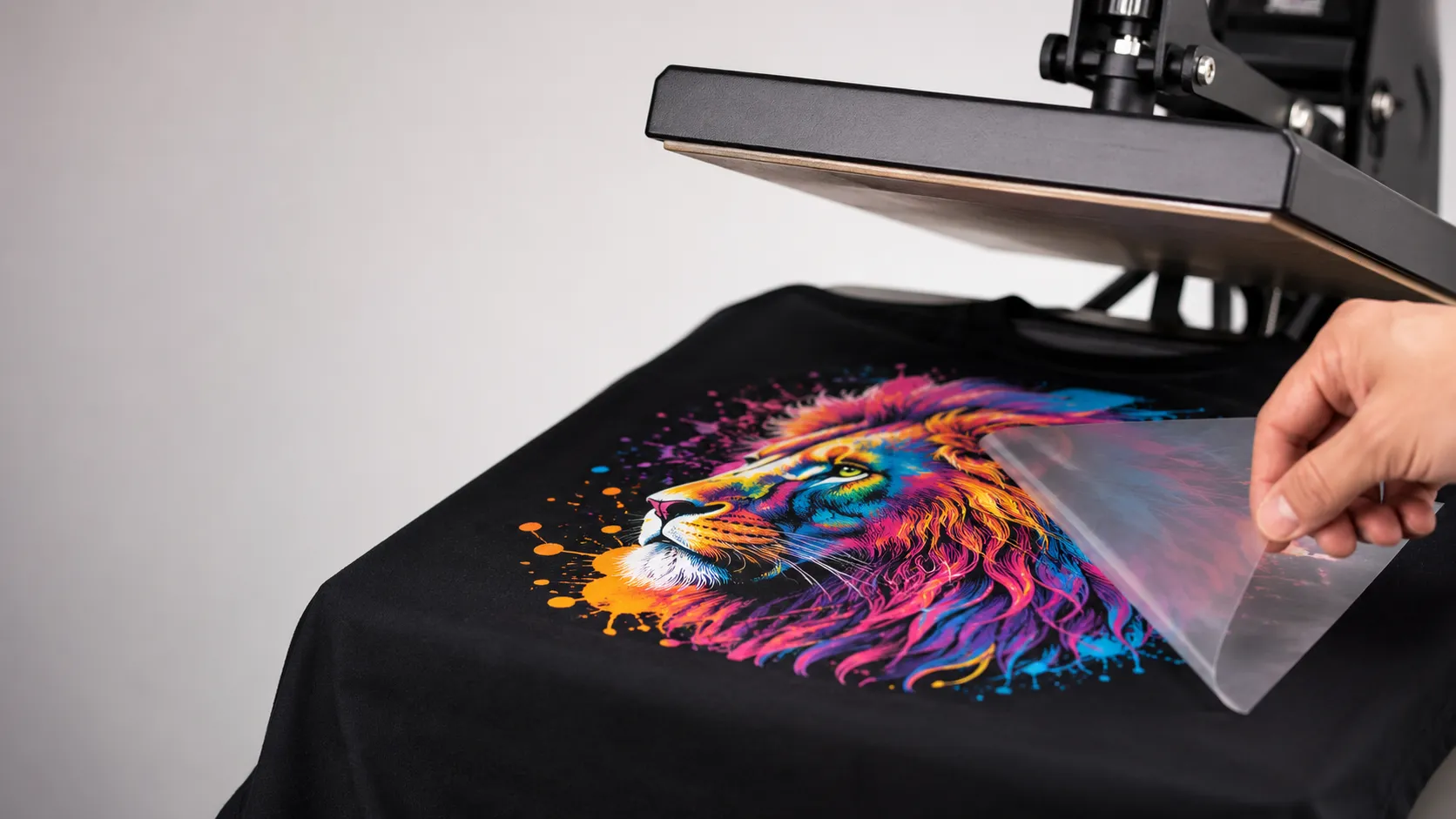
- Heat pressing. The cured film is placed face-down on the garment and pressed — typically at 160–170°C (320–338°F) for 10–15 seconds — activating the adhesive and bonding the design to the fabric fibers.
- Peeling. Once pressed, the PET film is peeled away — either hot-peel or cold-peel, depending on the film — leaving behind a soft, flexible, full-color print.
Many shops add a second, lighter “post-press” with a Teflon or parchment cover sheet to improve adhesion and softness.
DTF Glossary: Key Terms You’ll Run Into
| Term | Meaning |
| PET Film | The clear polyester film the design is printed onto before transfer |
| Hot-Melt Powder | TPU adhesive powder that bonds the ink to the fabric under heat |
| White Underbase | The white ink layer printed beneath colors for opacity on dark fabric |
| Gang Sheet | A single film sheet packed with multiple designs to save on printing costs |
| RIP Software | Software that processes and mirrors artwork for accurate DTF printing |
| Cold Peel / Hot Peel | Whether the film is removed after cooling or immediately after pressing |
DTF vs. Other Printing Methods: The Complete Comparison
This is the side-by-side breakdown most competing articles skip — and it’s the single most useful thing you can show someone deciding between methods.
| Method | Fabric Range | Dark Fabric Results | Setup Cost | Best For | Learning Curve |
| DTF | Cotton, poly, blends, nylon, leather | Excellent (white underbase) | Moderate ($3K–$10K+) | Small batches, on-demand, complex full-color art | Moderate |
| DTG (Direct-to-Garment) | Best on 100% cotton | Requires pretreatment | Moderate–High | Photorealistic prints on cotton | Moderate |
| Screen Printing | Most fabrics | Good, with underbase | Low per-run, high per-color setup | Large bulk orders, simple color counts | High (skill-intensive) |
| Sublimation | Polyester/poly-coated only | Poor (needs light fabric) | Low–Moderate | All-over prints, mugs, light polyester apparel | Low–Moderate |
| Heat Transfer Vinyl (HTV) | Most fabrics | Good | Low | Simple text/single-color designs, low volume | Low |
| Embroidery | Most fabrics | N/A (thread-based) | Moderate–High | Logos, patches, premium branding | Moderate–High |
Bottom line: DTF wins when you need full-color, photo-quality designs on a wide variety of fabrics — especially dark garments — without pretreatment and without the per-color setup cost of screen printing.
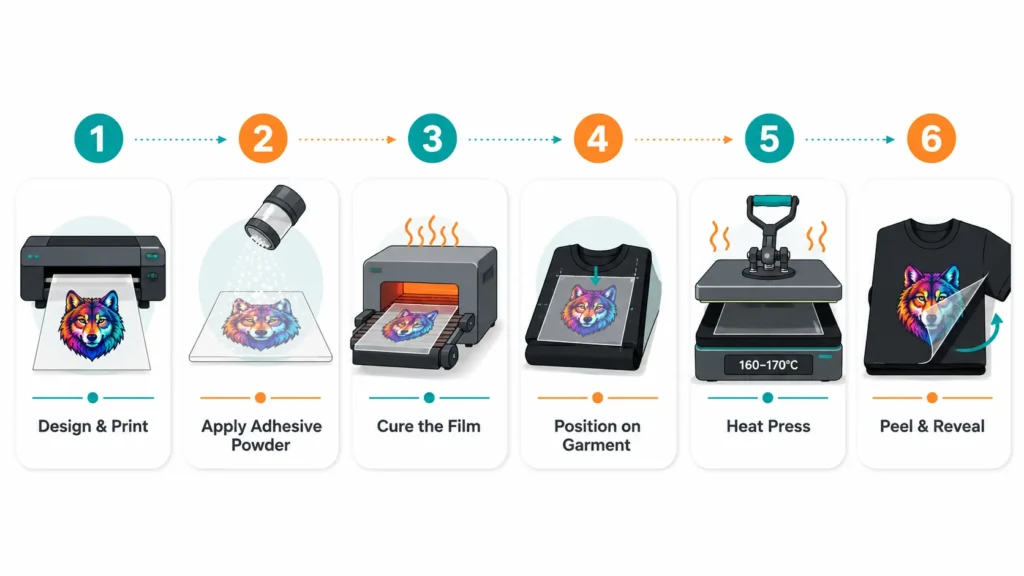
6 simple steps — from printing the design to peeling the final transfer.
Pros and Cons of DTF Printing (An Honest Look)
Most articles only list benefits. Here’s the full picture.
Pros
- Works on almost any fabric type, including blends and dark colors
- No pretreatment required, unlike DTG
- Handles full-color, gradient, and photorealistic designs in a single pass
- Transfers can be printed in advance and stored, decoupling design from production
- Cost-effective for both one-off and bulk orders
- Prints are flexible and durable, resisting cracking when properly cured and pressed.
Cons (rarely mentioned elsewhere)
- Hand-feel: DTF prints sit slightly on top of the fabric and can feel a bit heavier or more “plastic-like” than screen printing on large solid-color areas, especially with cheaper film or powder.
- Powder mess: Hot-melt powder application and shaking create fine dust that requires proper ventilation and cleanup equipment.
- Upfront learning curve: Getting curing temperature, press time, and pressure dialed in takes trial and error — under-curing or over-pressing is the #1 cause of peeling.
- Equipment investment: A full setup (printer, curing oven or tunnel, heat press, RIP software) costs more upfront than HTV or basic screen printing.
- Film and powder are consumables: Ongoing costs for PET film, ink, and powder need to be factored into per-unit pricing.
How Much Does DTF Printing Cost?
Real numbers, not vague ranges:
Startup costs:
- Entry-level DTF printer: $1,500–$6,000
- Curing oven or heat tunnel: $500–$3,000 (some entry printers include a small built-in curing unit)
- Heat press: $300–$1,500
- Ink, film, and powder starter supplies: $300–$800
- Total realistic starting budget: roughly $3,000–$10,000+, depending on whether you buy an all-in-one system or build a manual setup piece by piece.
Ongoing per-transfer costs typically run $0.50–$3.00 per print, depending on design size, ink coverage, and whether you’re using gang sheets to print multiple designs per film run (which significantly lowers cost per unit).
Common DTF Printing Problems and How to Fix Them
A gap in almost every competing article — here’s what actually goes wrong and why:
| Problem | Likely Cause | Fix |
| Cracking after wash | Under-curing or under-pressing | Increase press time/temperature slightly; confirm powder is fully melted before pressing |
| Peeling at edges | Insufficient pressure or wrong peel timing | Check heat press pressure calibration; match peel type (hot/cold) to your film |
| Ghosting/blurry print | Film shifted during printing or pressing | Secure film properly; check printer belt tension |
| Dull or faded colors | Incorrect white ink layer or ink saturation settings | Adjust RIP software white ink density and layering order |
| Powder clumping unevenly | Powder applied to ink that’s already partially dry | Apply powder immediately after printing while ink is still wet |
Who Should Actually Use DTF Printing?
DTF makes the most sense for:
- Small and start-up apparel businesses that need low minimums and fast turnaround
- Print-on-demand sellers who can’t predict order volume in advance
- Shops handling multi-color, photorealistic, or gradient designs that screen printing can’t do cost-effectively
- Businesses printing on mixed fabric types (cotton, poly-blends, nylon) without switching processes
- Patch and emblem makers wanting full-color detail beyond what embroidery allows
It’s less ideal for extremely large bulk runs of simple, one- or two-color designs — screen printing is usually cheaper per unit at high volume.
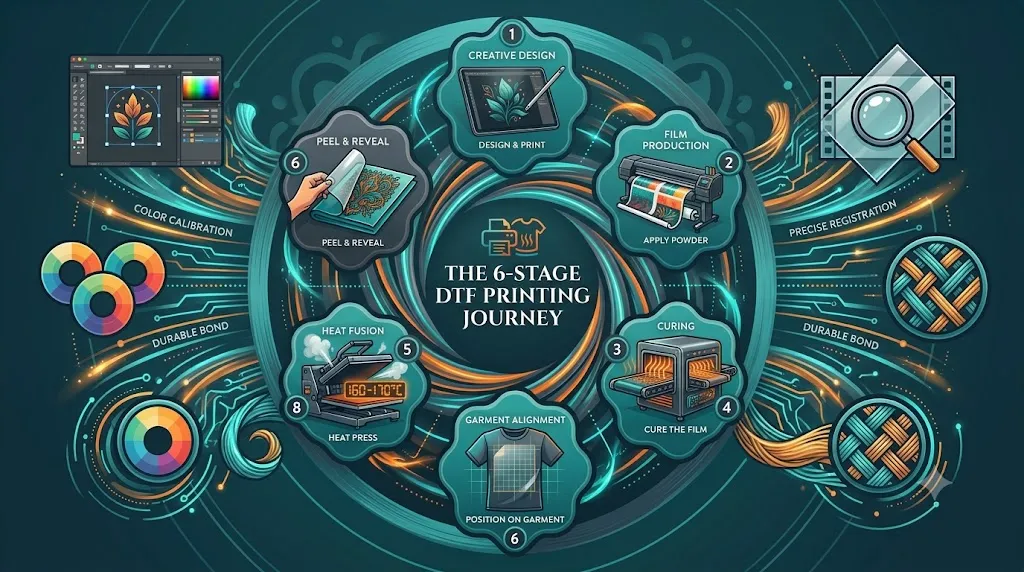
6 simple steps — from printing the design to peeling the final transfer.
Is DTF Printing Worth It in 2026?
For most small-to-mid custom apparel businesses, yes. The combination of low per-order flexibility, wide fabric compatibility, and full-color capability makes DTF one of the most practical entry points into custom printing today — provided you budget realistically for the equipment, curing setup, and the learning curve on temperature/pressure calibration. The businesses that struggle with DTF are usually the ones that skip curing/press-time testing, not the technology itself.
People Also Ask
DTF stands for Direct-to-Film, a heat-transfer printing method where designs are printed on film, coated with adhesive, and pressed onto fabric.
No. DTG (Direct-to-Garment) prints ink straight onto a pretreated garment, while DTF prints onto a film first and then transfers the design using heat — DTF works on more fabric types and doesn’t require pretreatment.
No. This is one of DTF’s biggest advantages over DTG — no pretreatment step is needed before pressing.
Cotton, polyester, blends, nylon, and even non-traditional surfaces like leather and canvas.
When cured and pressed correctly, DTF prints typically withstand 50+ washes without significant cracking or fading.
Conclusion
DTF (Direct-to-Film) printing has quickly become one of the most practical ways to produce vibrant, durable, full-color designs on almost any fabric — without the pretreatment headaches of DTG or the per-color setup costs of screen printing. Whether you’re launching a print-on-demand shop, expanding an existing apparel business, or just trying to figure out if DTF is the right investment, the core takeaway is simple: it’s a flexible, cost-effective method best suited for small-to-mid volume, full-color, multi-fabric work — as long as you budget realistically for equipment and take the time to dial in your curing and press settings.
If you’re ready to move from research to action, the next step is choosing the right printer and film combination for your volume and budget — and testing your press settings on a few sample garments before taking on client orders.