Introduction
If someone just texted you “luv” and you’re not sure whether that’s a big deal or not — you’re not alone. “Luv” is an informal, dictionary-recognized spelling of “love,” and it’s one of the most misunderstood small words in modern messaging, because its meaning bends depending on who sends it, where, and why.
People search for “LUV meaning” for a handful of very different reasons: some just got a text with it and want to know how serious it is; some are naming a baby and found “Luv” in a Sanskrit name list; some saw “LUV” pop up on a stock ticker and had no idea it was Southwest Airlines. This guide answers all of it — the texting slang, the real history (which isn’t what most articles claim), the baby name, and every other place “LUV” shows up.
What Does “Luv” Mean?
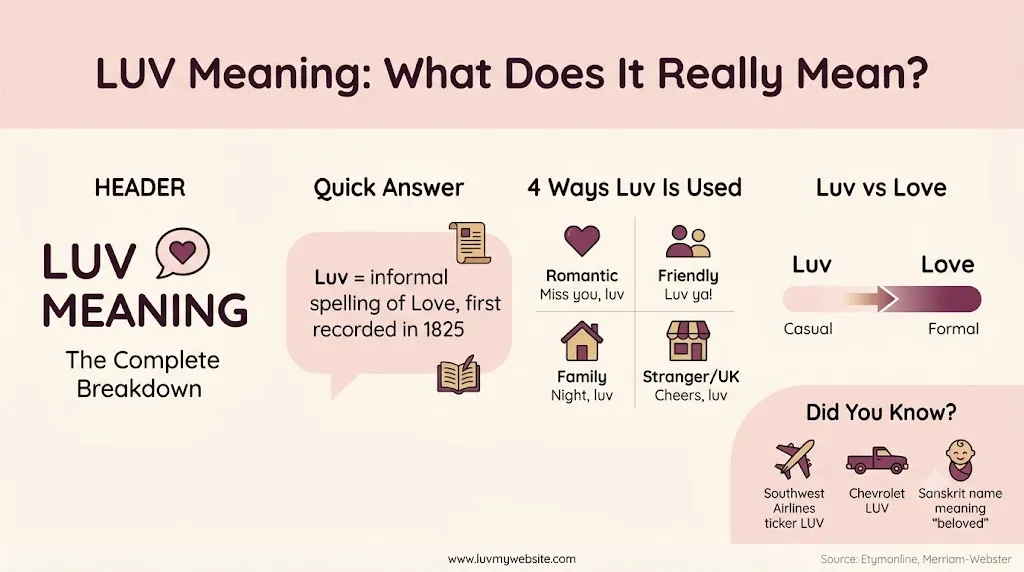
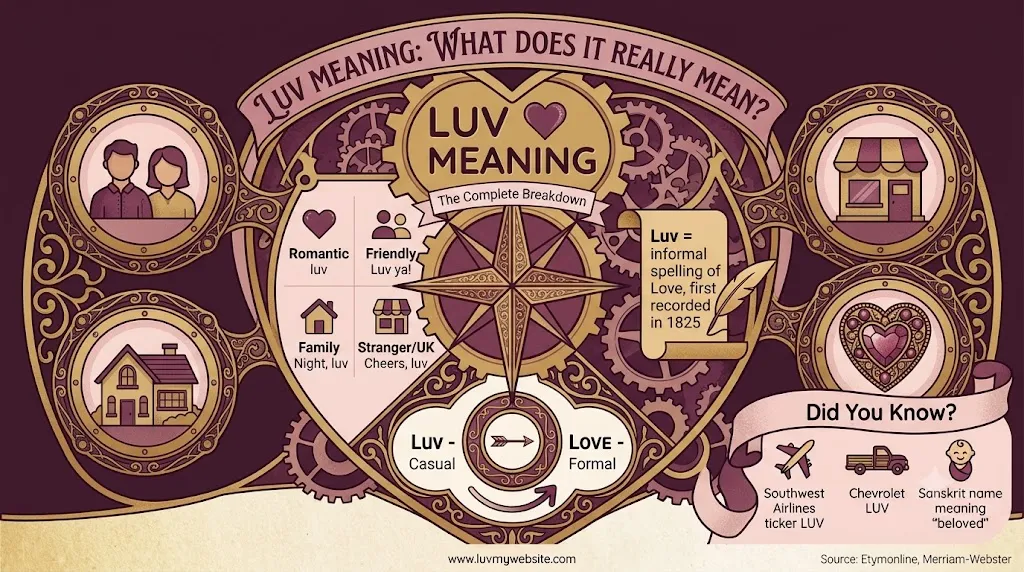
At its core, luv is a non-standard, informal spelling of the word “love,” used as both a noun and a verb. Major dictionaries — Merriam-Webster, Cambridge, and Collins — all define it the same way: a casual, dialect-influenced variant that mirrors how “love” is actually pronounced in relaxed speech.
The difference from “love” isn’t the definition — it’s the register. Swapping the spelling signals that a message is casual, affectionate-but-light, or spoken in a particular dialect, rather than a formal declaration of deep emotion. Think of it as a dial between two words:
like → luv → love
That’s why you’ll see it from a partner, a friend, a stranger behind a shop counter, or a teenager signing off a text — the word flexes depending on who’s using it.
Origin and History of “Luv”
Nearly every article ranking for this keyword claims “luv” was invented by texting to save characters. That story doesn’t hold up.
According to the Online Etymology Dictionary, “luv” is documented as an affectionate, dialectal spelling of love dating back to 1825 — over 170 years before the first text message was sent (the first SMS, “Merry Christmas,” went out in 1992). The spelling emerged to represent regional and working-class British pronunciation of “love,” where the vowel sound shifts closer to “uv.”
So what did texting actually do? It didn’t invent “luv” — it popularized and accelerated a spelling that already existed, for two real reasons:
- Character-count pressure: Classic SMS was capped at 160 characters, so shorthand like “luv,” “u,” and “ur” got adopted heavily.
- Tone-marking, not space-saving: Once casual spelling normalized online, people kept using “luv” even without a character limit, because it had come to signal informality and warmth on its own.
Knowing the real history matters — it’s the difference between a page repeating a myth and one that’s actually accurate.
Is “Luv” Still Popular Today?
Yes — “luv” remains in everyday use, though its role has shifted. It’s less common now as a full replacement for “love” in long-form writing, and more common as a quick, low-stakes sign-off in texts, captions, and comments, where a full “love you” might feel like too much for the context. It also persists as a spoken address term in the UK and parts of the Commonwealth, largely unaffected by digital trends. In short: it hasn’t faded; it’s just settled into specific, well-understood niches rather than being used everywhere “love” could go.
Luv Meaning in Text and on Social Media
This is the most common way people encounter the word today. In texts, DMs, captions, and comments, “luv” typically expresses one of four things, depending on context:
| Context | What “Luv” Signals | Example |
| Romantic | Affection, softer than a full “I love you” | “Miss you, luv 😘” |
| Friendly | Warmth between close friends, no romance implied | “Luv ya, see you tomorrow!” |
| Family | Casual, everyday affection | “Night, luv — sleep well.” |
| Stranger/Service | A friendly address term, common in the UK | “Here’s your change, luv.” |
The key rule: “luv” rarely carries the same emotional weight as writing out “love.” It expresses care without escalating intensity — which is exactly why it’s popular in early dating, platonic friendships, and cultures where “love” is used sparingly.
Is “luv” flirty or just friendly?
It depends on three things: the relationship, the platform, and what came before it in the conversation. A “luv u” from someone you’ve been messaging daily for two weeks reads differently than a “cheers, luv” from a barista. Tone markers around it (emoji, punctuation, frequency) matter more than the word itself.
Luv on Different Platforms
- TikTok: Used in captions and comments as a quick, upbeat sign-off to followers or friends — rarely romantic, mostly community-warmth.
- Instagram: Common in comment replies and DM sign-offs; tone depends heavily on emoji pairing (a heart emoji shifts it romantic, a plain “luv ya” stays platonic).
- Snapchat: Used casually between close friends and partners, often shorthand for a quick “love you” at the end of a snap caption.
- Facebook: Skews slightly older-audience and more literal — closer to “love” in meaning, often used by family members.
- Reddit: Rare outside of quoting someone else’s message or discussing the term itself; Reddit’s text culture leans toward full words.
- Discord: Common in friend-group servers as casual affection (“luv u guys”), rarely romantic given the group context.
- X (Twitter): Used in quick replies and quote-tweets, often paired with humor rather than sincerity.
Luv vs. Love: What’s the Actual Difference?
| Luv | Love | |
| Formality | Informal, casual | Standard, formal-capable |
| Emotional intensity | Lighter, understated | Full emotional weight |
| Typical setting | Texts, DMs, captions, spoken dialect | Writing, speech, formal declarations |
| Common relationships | Friends, early dating, casual acquaintances | Partners, family, deep commitment |
| Risk of misreading | Higher — meaning depends on context | Lower — meaning is explicit |
| Dictionary status | Recognized as non-standard/informal | Standard headword |
Grammatically, both function identically — as a noun (“my luv”) or verb (“I luv this song”). The difference is entirely the social signal the spelling sends, not the underlying meaning.
Common “Luv” Phrases, Decoded
| Phrase | Typical Meaning |
| “Luv u” | Casual affection; common between partners and close friends |
| “Luv ya” | Platonic warmth; very common sign-off among friends |
| “Cheers, luv” | British informal address term; not romantic, often used with strangers |
| “Alright, luv?” | British greeting (“how are you?”); not a declaration of feeling |
| “Night, luv” | Affectionate goodnight, romantic or familial |
| “Take care, luv” | Gentle, caring sign-off; friendly or familial |
Quick tell: phrases pairing “luv” with a question or greeting (“alright, luv?”) are almost always platonic British address terms, not affection statements.
How to Respond When Someone Calls You “Luv”
- From a partner or someone you’re dating: Mirror the tone — a casual “luv u too” or a light emoji keeps things at the same emotional level they set.
- From a friend: Respond in kind (“luv ya too!”) — no need to overanalyze it.
- From a stranger (UK/Australia context): Treat it like “sir,” “miss,” or “mate” — a polite acknowledgment is enough. It’s not personal.
- In a professional setting: Best avoided altogether, both giving and receiving. If a colleague uses it casually, a neutral “thanks!” is the safest reply.
Regional Usage: Is “Luv” British?
“Luv” as a friendly address term (not just texting shorthand) has strong roots in British and Commonwealth English, particularly working-class dialects in England, where it’s used the way “hon,” “dear,” or “mate” might be used elsewhere — often by shopkeepers, bus drivers, or older speakers addressing someone regardless of gender or familiarity.
In the US and Canada, “luv” is used almost exclusively as digital shorthand — in texts, captions, and DMs — rather than as a spoken address term. You’re far less likely to hear an American stranger say “here you go, luv” out loud.
This split matters because misreading it is a common source of confusion: a UK shopkeeper saying “cheers, luv” is being polite, not flirtatious — while the same word in an American text thread usually does carry some affection.>
Common Misunderstandings About “Luv”
- “It’s just internet slang.” Not true — it’s a dictionary-recognized spelling dating to 1825, long before the internet.
- “It always means romantic interest.” Often it doesn’t; context, not the word itself, decides that.
- “It’s only used by couples.” It’s just as common between friends, family, and even strangers in the UK.
- “It’s childish or unserious.” In many dialects, it’s simply an everyday informal address term, not a marker of immaturity.
- “Luv” and “love” mean different things. They don’t — the dictionary definition is identical; only the tone differs.
Related Terms and Similar Meanings
| Term | Relation to “Luv” |
| Bae | Also casual affection; typically romantic, used for a partner |
| Hun / Hon | Similar friendly address term, used across the US and UK alike |
| ILY / ILU | Acronym for “I love you,” more literal than “luv” |
| ILYSM | “I love you so much” — higher intensity than either “luv” or “ILY” |
| Xoxo | Affectionate sign-off, more about warmth/kisses-hugs than the word “love” itself |
Other Meanings of LUV (Not Related to Love)
Capitalized, “LUV” is also a real-world abbreviation and ticker across several unrelated fields:
- Southwest Airlines (NYSE: LUV): Southwest’s stock ticker is LUV, chosen as a nod to the airline’s original hub at Dallas Love Field and its long-running “Heart”/customer-first branding.
- Chevrolet LUV: A compact pickup truck (“Light Utility Vehicle”) sold by Chevrolet from the 1970s through the 1990s, built on an Isuzu-designed platform.
- Large Unilamellar Vesicle (LUV): In biochemistry, a type of liposome — a spherical lipid membrane structure — used in drug-delivery and membrane research.
- Light Utility Vehicle: A general military/automotive classification for small, lightweight support vehicles.
- Entertainment: “Luv”/”LUV” is also the title of a 1967 Broadway play and film, a 2012 film, a K-pop group, and multiple song titles (Janet Jackson, Tory Lanez, Charlie Puth).
If you landed here for one of these instead of texting slang, the sections above give you the direct answer.
Luv as a Baby Name
- Origin: Sanskrit/Hindi.
- Meaning: Most sources translate it as “beloved” or “particle”; in Hindu tradition, Luv (लव) is the name of one of the twin sons of Lord Rama and Sita in the Ramayana, alongside his brother Kush.
- Usage today: Used almost exclusively as a boy’s name in most regions, occasionally appearing for girls in a small number of Western records. It remains an uncommon name overall, valued for its brevity and dual resonance — the Sanskrit mythological meaning alongside the everyday English association with “love.”
- Pronunciation: “luhv,” rhyming with the English word “love.”
This naming sense is entirely separate from the texting slang — they share spelling and, fittingly, a loose thematic link to affection.
People Also Ask
Yes — recognized by Merriam-Webster, Cambridge, and Collins as a non-standard, informal spelling of “love,” not slang invented online.
Functionally yes, but socially no — it signals a lighter, more casual tone, even though the dictionary definition is identical.
Yes. “Luv ya” between friends is extremely common and reads as platonic warmth, not romantic interest.
It’s a regional friendly address term, similar to “dear” or “mate,” historically common in working-class English dialects — not flirtatious or personal.
Generally yes — best avoided in work emails or formal writing, where “love” itself would also be inappropriate.
No. It’s documented in writing as early as 1825. Texting popularized it but didn’t create it.
Conclusion
So, what does “luv” really mean? At its heart, it’s simple: an informal, affectionate spelling of “love“ — one that’s been around since 1825, long before texting ever existed. What makes it interesting isn’t the word itself, but how much it flexes depending on who says it: a partner texting “luv u,” a friend signing off with “luv ya,” or a shopkeeper in London saying “cheers, luv” to a total stranger all mean very different things, even though they’re spelling the same word the same way.
Beyond texting, “LUV” pulls double duty as Southwest Airlines’ stock ticker, the name of a classic Chevrolet pickup, a Sanskrit name meaning “beloved,” and even a term in biochemistry — proof that three letters can carry a surprising amount of history and range.