K Meaning in Text: Why “K” Feels So Cold (And What It Actually Means)
Quick answer: In texting, “K” Is Shorthand For “Okay” — a one-letter acknowledgment that a message was received. But research on digital communication shows the feeling behind “K” has almost nothing to do with the letter itself and everything to do with punctuation, message length, and relationship context. A bare “K” is the shortest possible reply in English, and psychologically, shortness reads as distance.
That’s the paradox nobody searching “k meaning in text” actually gets a straight answer to — until now.
Quick Meaning Summary
| Meaning | Shorthand for “okay” |
| Category | Text/chat slang, abbreviation |
| Tone | Neutral by default; reads as cold or curt with a period, no punctuation, or a break from someone’s normal texting style |
| Warmer alternatives | “kk,” “k!,” “k 👍,” “okay!,” “sounds good” |
| Also stands for | Thousand (finance), Kelvin/potassium (science), kill (gaming), kilometer (fitness) |
| First recorded root (“OK”) | Boston Morning Post, March 23, 1839 |
You’ve almost certainly been on one side of this exchange: you send something that took thought, and you get back a single letter. No punctuation. No emoji. Just “k.” Your brain immediately starts running diagnostics. Are they mad? Busy? Over the conversation? Over me?
This guide answers the question properly — not with a recycled definition, but with the actual linguistics research behind why “K” hits the way it does, a full comparison of every variant (“k,” “kk,” “ok,” “okay,” “k.”), how the meaning shifts across WhatsApp, iMessage, Snapchat, Instagram, TikTok, and Discord, and a simple framework for deciding whether a “K” you received was actually meant to be cold.
What Does “K” Mean in Text?
At face value, “K” is a truncation of “OK,” which is itself short for “okay.” It functions as:
- An acknowledgment — “message received and understood”
- An agreement — a quick “yes” to a plan, time, or request
- A conversation-closer — often the last word before a chat ends
That’s the literal meaning, and it’s where most other guides on this topic stop. But literal meaning and perceived meaning are two different things in texting — and the gap between them is exactly why so many people search this phrase in the first place. Nobody Googles “k meaning in text” because they don’t know it means “okay.” They Google it because someone sent them a “K” and it felt like something else.
The Real Origin of “K” (It Starts With a 19th-Century Newspaper Joke)
Most articles on this topic vaguely credit “K” to texting-era character limits and leave it there. The actual history is more interesting and goes back nearly 200 years before smartphones existed.
“OK” first appeared in print in the Boston Morning Post on March 23, 1839, as part of a fad among newspaper editors for intentionally misspelled abbreviations used as inside jokes — “OK” stood for “oll korrect,” a comedic misspelling of “all correct.” Most of these joke abbreviations died out within a year or two. “OK” survived, largely because it got a second life as a nickname during Martin Van Buren’s 1840 presidential campaign — his hometown nickname was “Old Kinderhook,” and “OK” clubs became a rallying cry for his supporters. That accidental promotional boost is the reason “OK” outlived every other 1830s newspaper abbreviation and became one of the most recognized words on the planet.
Fast-forward to the SMS era of the late 1990s and early 2000s: character limits and multi-tap keypads made every keystroke costly, so “okay” got trimmed to “ok,” then further trimmed to the single letter “k.” Once smartphones and character-limitless messaging apps removed the practical need for the shortcut, “K” stuck around anyway — but its function quietly shifted from saving keystrokes to sending a tone.
Why a Single “K” Feels Cold: The Psychology Behind It
This is the part almost every competing article skips entirely, and it’s the actual answer to what people are searching for.
Texting strips out tone of voice, facial expression, and timing — the cues humans normally use to read intent. Researchers have found that texters compensate by treating small formatting choices (punctuation, capitalization, response length) as substitutes for those missing cues.
The clearest evidence comes from a widely cited Binghamton University study (Gunraj et al., published in Computers in Human Behavior), which had participants read text exchanges ending in one-word affirmative replies like “Okay,” “Sure,” or “Yep.” The researchers found that when those replies ended with a period, readers rated them as noticeably less sincere than the same reply with no punctuation at all — and the effect only showed up in text messages, not in handwritten notes carrying identical wording. A follow-up by the same team found the opposite pattern for exclamation points: they made short replies read as more sincere, not less.
Applied to “K,” this explains a lot:
- “k” (no punctuation) — the most neutral version; brevity reads as efficiency, not necessarily coldness
- “k.” (with a period) — the period adds a finality that studies associate with lower perceived sincerity, which is why “k.” is the version most people flag as passive-aggressive
- “K!” or “k!” — the exclamation point pushes it back toward enthusiasm
- . “kk” — doubling the letter mimics the rhythm of a slightly longer, more effortful reply, which is why it consistently reads as friendlier than a single “k”
In other words: it was never really about the letter “K.” It’s about effort signaling. Every extra character, emoji, or punctuation mark is a small, unconscious signal of how much energy someone was willing to spend on their reply — and readers pick up on that signal, even if they couldn’t explain the rule out loud.
K vs. Kk vs. Ok vs. Okay vs. K. — Full Comparison
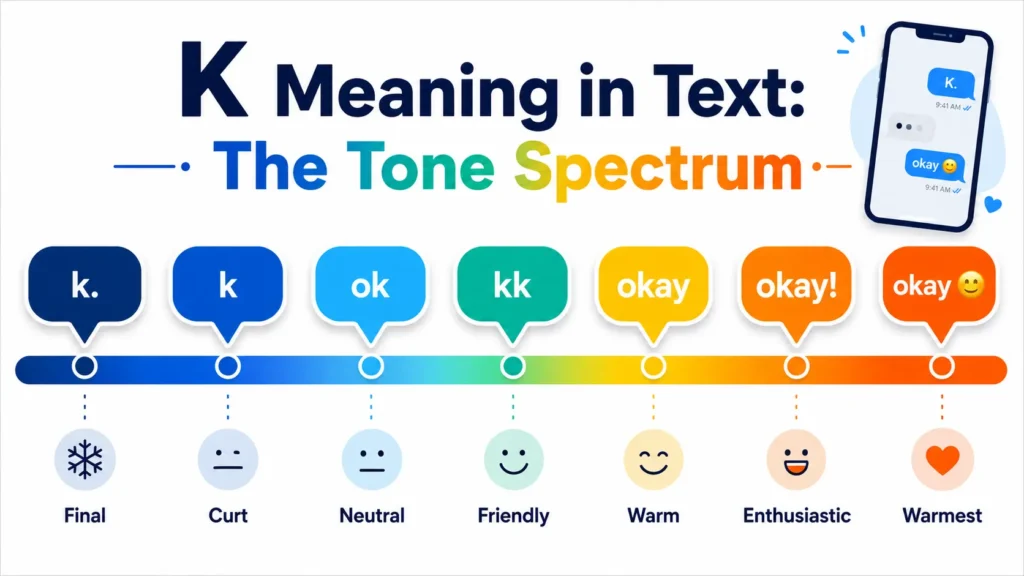
No competing article puts this side by side. Here’s the full spectrum, from coldest to warmest, based on general texting-culture consensus and the punctuation research above.
| Variant | Perceived Tone | Typical Use Case | Risk of Misread |
| k. | Coldest / final | Ending a conversation, often after conflict | High — reads as annoyed or done |
| k | Neutral-to-curt | Fast acknowledgment among close friends | Medium — depends entirely on relationship |
| kk | Friendly, casual | Confirming plans, gaming, group chats | Low |
| ok | Neutral, slightly more formal than “k” | General confirmation, semi-formal chats | Low-medium |
| okay | Warm, complete | Professional or unfamiliar contexts | Low |
| okay! / okay 🙂 | Warmest | Close friends, family, dating | Very low |
| k 👍 / k 🙂 | Softened neutral | Same as “k” but tone-corrected with an emoji | Low |
Takeaway: the letter count and the presence of an emoji or exclamation point matter more than the word choice itself. Someone who habitually types in full sentences suddenly dropping to a bare “k” is a bigger signal than the “k” alone.
Is “K” Rude? A Simple Decision Framework
Instead of guessing, run the message through four quick checks:
- Does it have a period? A “k.” after a request or plan is the version most associated with a curt or final tone.
- Is this out of character for them? If someone who normally sends full sentences suddenly replies “k,” the change is more meaningful than the word itself.
- What came before it? A “k” after a joke or casual update is almost always neutral. A “k” after you apologized or explained something is more likely to carry weight.
- Is there an emoji or exclamation mark? “k 😊,” “k!,” and “kk” are consistently read as warmer than a bare “k.”
If you answered “yes” to #1 or #2, there’s a reasonable chance the sender is short on time, distracted, or mildly annoyed — not necessarily furious. If it’s a recurring pattern rather than a one-off, that’s a conversation worth having directly rather than diagnosing from a single text.
How People Use “K” in Daily Conversations
Acknowledgment: “I’ll meet you at 6.” → “k”
Agreement: “Let’s grab coffee tomorrow.” → “k, sounds good”
Fast confirmation under time pressure: “On my way.” → “k”
Passive signal of disengagement: used deliberately, in some cases, to end a conversation without explanation
The same three letters can carry any of these meanings — which is precisely why context always outranks the word itself.
K Meaning Across WhatsApp, iMessage, Instagram, Snapchat, TikTok & Discord
The core meaning of “K” doesn’t change platform to platform, but the social stakes of sending it do:
- WhatsApp / iMessage: The most common home for “the cold K,” since these are typically 1:1, higher-intimacy conversations where tone is scrutinized more closely.
- Instagram DMs: Often used to close out a casual exchange; lower stakes since Instagram conversations tend to be less continuous.
- Snapchat: A quick “k” frequently confirms a snap was seen rather than carrying emotional weight — the ephemeral nature of the app lowers the perceived stakes.
- TikTok comments/DMs: Used casually and quickly, often stripped of the “coldness” reading because comment-section culture already favors short replies.
- Discord / gaming chat: “K” is almost purely functional here — confirming a call-out, a strategy, or a ready check. In gaming contexts specifically, capital “K” can also shorthand “kill” (e.g., “3 k’s” = three kills), a meaning unrelated to “okay” entirely.
Rule of thumb: the more a platform is used for ongoing, personal conversation (texting, WhatsApp), the more a bare “K” gets emotionally scrutinized. The more a platform is built around fast, disposable exchanges (Snapchat, gaming chat), the more “K” reverts to its literal, low-stakes meaning.
Other Meanings of “K” Outside of Texting
“K” carries entirely different meanings depending on the field — worth knowing since the letter shows up constantly outside of chat:
| Field | Meaning of “K” | Example |
| Finance / everyday shorthand | Thousand | “$5k” = $5,000 |
| Science (physics/chemistry) | Kelvin (temperature) or the chemical symbol for potassium | “310 K” / potassium chloride (KCl) |
| Mathematics | A constant or coefficient, context-dependent | “y = kx” |
| Gaming | Kill (in stats or callouts) | “3 K, 1 D” |
| Running/fitness | Kilometer | “5K race” |
| Texting/chat | Okay | “k, see you then” |
If someone texts “310 k” outside of a chemistry or weather context, it’s almost certainly a typo or autocorrect — not the shorthand for “okay.”
Similar Terms & Alternatives to “K”
- kk — friendlier, doubled acknowledgment
- okie / okie-dokie — playful, informal
- bet — Gen Z equivalent of “okay, agreed” in North American slang
- sure / alright / got it — full-word neutral alternatives
- 👍 / ✅ / 👌 — emoji-only acknowledgments that sidestep the tone issue entirely
If you want to confirm something without any risk of sounding cold, skipping “K” altogether in favor of “sounds good,” “got it,” or a thumbs-up emoji is the safest move — especially with someone you don’t know well.
Real Conversation Examples
Friends, casual plan:
A: “Movie’s at 8, don’t be late 🎬” B: “k” (Neutral — short, casual context, no prior tension.)
After a disagreement:
A: “Sorry for snapping earlier, I didn’t mean it like that.” B: “k.” (Likely to read as unresolved or still annoyed — the period plus the topic raises the stakes.)
Coworker, professional context:
Manager: “Please send the report by 5.” You: “k 👍” (The emoji softens what would otherwise read as curt in a professional setting.)
Sibling, playful:
“I borrowed your charger, don’t be mad.” “k 😒” (Playful annoyance — clearly not serious, thanks to the emoji and existing rapport.)
How to Reply When Someone Sends You Just “K”
- Don’t over-interpret a single message in isolation. Look at their normal texting style — if “k” is how they always reply, it’s not a signal of anything.
- Mirror the tone if it’s genuinely casual. A short reply back is fine in low-stakes exchanges.
- Ask directly if it’s a recurring pattern that’s bothering you. “Hey, everything okay? You’ve seemed short in texts lately” resolves more than guessing ever will.
- Avoid escalating over text. If a “k” genuinely stings, that’s a conversation better had by call or in person than through a chain of increasingly tense one-word replies.
Is “K” Still Common in 2026?
Yes — despite the rise of emoji reactions, GIFs, and voice notes, “K” remains one of the most-used acknowledgments in English-language texting simply because nothing is faster to type. What has shifted is which version people default to: “kk,” “k!,” and “k” paired with an emoji have become more common than the bare, unpunctuated “k,” precisely because texters have learned — consciously or not — that the plain version carries more risk of being misread.
People Also Ask
Not inherently. A bare “k” is neutral in most casual, Established Relationships. It reads as rude more often when it follows a period, breaks from someone’s usual texting style, or shows up after an emotionally loaded message.
“Kk” is almost universally read as friendlier and more casual than a single “k.” The doubled letter mimics the rhythm of a slightly more effortful reply.
Research on text-message punctuation has found that a period at the end of a short affirmative reply lowers how sincere the message is perceived to be, an effect that doesn’t show up in the same wording written by hand. In texting, the period effectively signals finality.
It’s generally safer to avoid it. “Okay,” “Got it,” or “Sounds good” read as more complete and professional; “k” alone can come across as dismissive in a work context, even if that’s not the intent.
Depending on context, “K” can mean thousand (finance), Kelvin or potassium (science), a kill (gaming), or a kilometer (running/fitness). Only in chat and texting does it default to “okay.”
Conclusion
At the end of the day, “K” is still just three pixels tall and one letter long — the meaning was never really in the letter itself. It’s in the period you did or didn’t add, the emoji you did or didn’t include, and how that reply compares to how the person usually texts you.
Now that you know where “K” actually came from, why a single “k.” can land so differently than a cheerful “kk,” and how the same letter means something entirely different in a chemistry class or a gaming lobby, you don’t have to guess anymore. Next time a bare “k” shows up in your messages, you’ve got an actual framework to read it — not just a gut feeling.
Bookmark this guide next time a text leaves you wondering, and if you’re curious how other short replies (“kk,” “ok,” “dw,” “np”) stack up on the same tone spectrum, that’s exactly what the related guides linked above are built for.