PS Meaning in Text: The Complete Guide (Definition, Origin, Examples & How to Use It in 2026)
If someone ends a text or email with “PS” and then drops the real message, you’re not imagining it — that’s the whole point of the abbreviation. PS stands for “postscript,” from the Latin post scriptum, meaning “written after.” It’s a short note added onto the end of a message, after you’ve already signed off or made your main point.
People search “PS meaning in text” for two different reasons. Some just want the definition, fast. Others already know it means postscript and are trying to decode something more specific — what it implies coming from a certain person, whether “PS” or “P.S.” is correct, or how to use one themselves without it looking like filler. This guide covers both, in the order people actually need them.
What Does PS Mean in Text?
Quick answer: PS means “postscript” — a short note added after the main body of a message, once the writer has technically already finished. In modern texting and social media, it’s less about forgetting something and more about deliberately placing a joke, compliment, or emotional line where it lands hardest: last.
Quick Meaning Summary
| Meaning | Full Form | Where You’ll See It |
| Postscript (95% of uses) | Post scriptum (“written after”) | Texts, emails, letters, captions |
| PlayStation | — | Gaming chats, Discord, console talk |
| Personal Statement | — | College/job applications |
| Photoshop | — | Design and creative communities |
| Public Service | — | Formal announcements, notices |
Outside gaming, design, or application contexts, “PS” in a text is postscript almost every time — the other meanings only surface when the surrounding conversation already points that way.
PS vs. P.S. — Which Punctuation Is Correct?
This is the question most guides gloss over. There’s no universal rule — AP Style and Chicago don’t even agree with each other — but here’s the practical breakdown:
- P.S. (with periods): traditional, formal — cover letters, print, formal correspondence.
- PS (no periods): the modern default — texting, casual email, social captions.
- ps (lowercase): very casual texting between friends.
The only real rule is consistency within one message — don’t switch styles mid-conversation. A colon after it (“PS:”) is a style choice, not a requirement.
Origin and History of PS
Postscripts predate typewriters by centuries. Before word processors, editing a finished handwritten letter meant starting the page over — so if a writer remembered something after signing off, they added it below the signature instead of rewriting everything. That’s the literal meaning of post scriptum: written after [the main text].
Historically, this slot also became where writers tucked their most personal or urgent line — the practical afterthought and the emotional afterthought share the same real estate. That’s the same instinct behind “Anyway, talk later. PS I miss you” today. Once editing became easy (typewriters, then computers), the practical need for PS disappeared — but the stylistic effect didn’t, which is why it survived into digital communication.
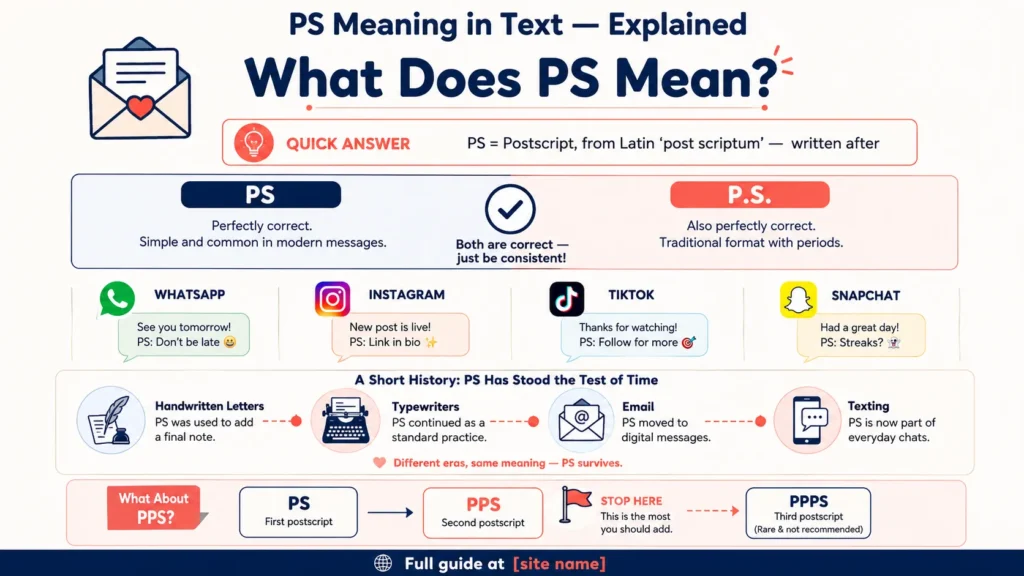
breakdown in one glance.
Is PS Still Popular in 2026?
Yes. Its original job (fixing a finished letter) is obsolete, but its second job — making an add-on line feel more spontaneous and personal than something folded into the main message — still works exactly as well as it always did. It remains common in casual texting, social captions, and email marketing specifically because of that effect.
How Is PS Used? (By Context)
| Context | Typical Function | Example |
| Texting | Reminder or punchline | “Running late. PS bring the charger” |
| Email (personal) | Warm afterthought | “Thanks again! PS, call me later.” |
| Email (professional/marketing) | Restated CTA — readers who skim often jump straight to the PS line | “Offer ends Friday. PS, don’t miss it.” |
| Social captions | Tonal twist or bonus detail | “Best hike ever. PS my legs disagree.” |
| Letters | Original, most formal use | Genuine afterthought below the signature |
Examples of PS in Text
- “Dinner was great. PS I’m paying next time.”
- “See you at 7. PS, bring your charger.”
- “Loved the photos! PS, send me the raw ones.”
- “Thanks for today. PS I had a really good time.”
PS Meaning on Social Media
| Platform | Tone | Common Use |
| Casual, personal | Follow-up thoughts in ongoing chats | |
| Playful, curated | A caption’s punchline or bonus detail | |
| TikTok | Fast, humorous | Text-overlay jokes, behind-the-scenes notes |
| Snapchat | Quick, informal | One-off funny or affectionate add-ons |
The meaning doesn’t shift by platform — only the tone does, matching how each platform is generally used.
Relationship Meaning: What Does PS Mean From a Specific Person?
There’s no different “definition” of PS depending on who sends it — it doesn’t carry gendered or person-specific meaning on its own. What actually determines the tone:
- What follows “PS” — a logistical note reads nothing like an emotional one.
- Emoji or none — changes the read completely.
- Existing relationship context — the same line from a friend, a new match, or a coworker means three different things.
- Where it sits — a PS at the end of a long, thoughtful message tends to carry more weight than one on a quick logistical text.
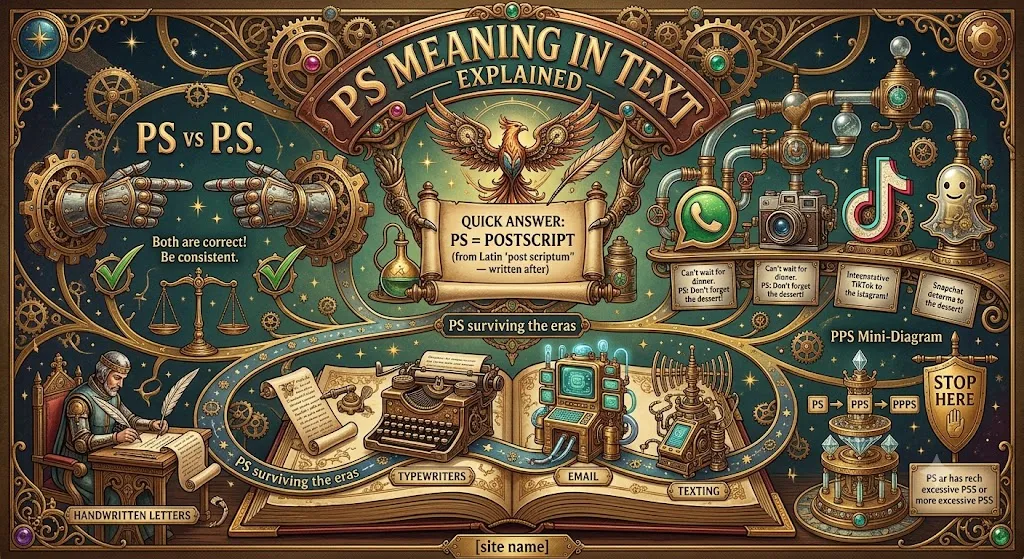
breakdown in one glance.
Love Meaning: “PS I Love You”
“PS I love you” works by breaking the postscript convention on purpose — putting the biggest possible statement into what’s normally the “minor afterthought” slot. That mismatch (huge declaration, casual delivery) is exactly what makes it read as sincere rather than staged.
“Had a really good time tonight. PS I love you.”
PPS and Beyond — How Many Postscripts Can You Use?
PPS (“post-postscript”) is a second afterthought after the first PS. Technically you can stack further (PPPS), but past two it stops looking spontaneous and starts looking disorganized. Three things to add after a “finished” message usually means the message needed a rewrite instead.
How to Use PS Correctly (Practical Guide)
- One sentence, not a paragraph. If it needs more, it belongs in the main body.
- Never bury essential information in it. A PS is not the place for anything someone must act on.
- Use it for contrast, not repetition. The strongest PS lines shift tone from the main message.
- In marketing copy, treat it as a second CTA — skimmers often read the subject line and the PS before anything else.
- Skip it in formal writing (cover letters, legal documents) unless genuinely necessary.
Related Terms and Similar Meanings
| Term | Full Meaning | Formality | Best For |
| PS | Postscript | Casual → Formal | Afterthoughts, emphasis, personal notes |
| BTW | By The Way | Casual | Quick conversational asides |
| FYI | For Your Information | Formal | Neutral information sharing |
| NB | Nota Bene | Formal/Academic | Flagging something important in a document |
| Edit: | — | Casual (forums/social) | Correcting/updating a post after publishing |
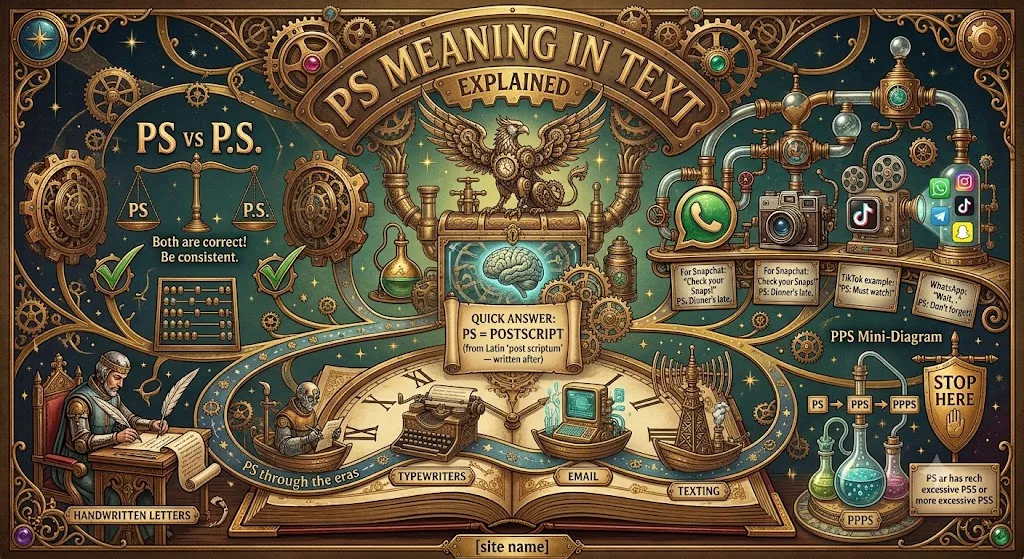
breakdown in one glance.
Common Misunderstandings
- “PS always means something unimportant.” Often the opposite — it’s frequently where the real point or feeling lives.
- “PS is outdated.” Its original practical use is gone, but its stylistic effect is not — hence continued use in 2026.
- “PS and P.S. mean different things.” They don’t; punctuation is a style choice, not a meaning change.
- “You can only use PS once.” A second is PPS — just don’t stack past that.
People Also Ask
“Postscript” — a short note added after the main message, used for reminders, jokes, or personal touches without rewriting the text.F
Both. It’s used in casual texts and formal emails alike; the tone comes from what follows it, not the abbreviation.
No difference in meaning. “P.S.” is the traditional, formal style; “PS” is the modern, casual default in texting and em
It frames “I love you” as a casual afterthought, which often makes it read as more sincere than stating it in the main message.
Yes — a second is PPS. Past that, it’s cleaner to just rewrite the message.
Yes — its practical reason for existing is gone, but its emotional/stylistic effect (making an add-on feel more spontaneous) still works.
Conclusion
PS means “postscript” — a short note added after a message is technically finished. The term hasn’t changed in centuries; what’s changed is why people use it. It once fixed a letter that couldn’t be edited. Now it’s a deliberate tool: the spot where a joke, compliment, reminder, or the real point of the message often lives. Once you know that, “PS” stops being a mystery and starts being a tool you can use on purpose — in a text, an email, or a caption.