Your Dog Escaped Again? These 7 GPS Fences Will End That Forever
Best GPS dog fence is no longer a luxury — it’s your dog’s lifeline.
If your dog has ever slipped past a gate or bolted across the yard, you already know that sickening panic. In this guide, discover the 7 expert-tested GPS dog fences that finally give every worried dog owner real peace of mind — starting today. Dog ownership in Europe is evolving quickly. Across the United Kingdom, Germany, the Netherlands, France, Sweden, Spain, Italy, and many other countries, more families are living in a wide mix of environments: compact city apartments, suburban homes with modest gardens, and open rural properties with far more space than a traditional fence can conveniently cover. At the same time, many owners are becoming more aware of leash expectations, animal welfare standards, local containment rules, and the practical challenge of keeping a dog safe without limiting its freedom.
That is exactly why the best GPS Dog fence solutions have become such a major topic in 2026.
A GPS dog fence is a modern containment and training system that uses satellite positioning and virtual boundaries to help guide a dog’s movement around a defined area. Instead of relying on buried wire or a fixed transmitter, you create a digital perimeter through an app. The dog wears a collar that receives signals, monitors location, and provides warnings such as a beep, vibration, or, in some systems, an optional static correction.
How GPS Dog Fences Give European Dog Owners More Freedom & Control
But there is an important truth that many marketing pages gloss over: a GPS dog fence is not a wall, not a gate, and not a physical barrier. It is a behavior support system. It can help teach boundaries, reinforce habits, and add an extra layer of awareness, but it cannot replace good training, supervision, or responsible ownership.
This matters because a virtual fence works best when the dog understands the rules, the owner understands the limits of the technology, and the training process is handled with patience and consistency. Without that foundation, even an expensive system can disappoint.
In this guide, you will learn how GPS dog fences actually work, what types exist, which systems make the most sense for European homes, where these products tend to fail in real-world conditions, and how to choose one based on your dog’s personality, property layout, and training commitment. The goal is not just to help you buy a device. The goal is to help you make a smart containment decision.
What Is a GPS Dog Fence?
A GPS dog fence is a smart containment solution that creates a virtual boundary around a property by using satellite positioning, map-based software, and a wearable collar. You define the safe zone in an app or control platform, then the collar uses location data to monitor where the dog is relative to that perimeter.
When the dog approaches the border, the collar responds with a warning sequence. In many systems, that sequence begins with a tone or audible beep, then vibration, and in certain models, a correction impulse if the dog continues forward. The purpose is to interrupt movement, build boundary awareness, and reinforce safe behavior over time.
Think of it as a digital training assistant rather than a magical containment field.
The strongest use cases are usually large properties, irregular land shapes, and homes where traditional fencing is impractical, expensive, or visually undesirable. It can also be helpful in places where a physical fence is impossible due to rental restrictions, landscape limitations, or local regulations.
Still, the system works only when several factors line up:
- The collar receives stable location data,
- The boundary is configured correctly,
- The dog has been introduced to the system gradually,
- and the owner applies consistent training.
That is why the question is never just “Does it work?” The better question is: “Does it work for this dog, in this environment, with this training plan?”
How GPS Dog Fences Actually Work
The technology behind a GPS dog fence is simpler than it sounds, even though the user experience feels advanced.
At a basic level, the collar receives satellite positioning data, compares the dog’s current location with the boundary you created, and then sends a response when the dog gets too close to the edge. Some systems also use software refinement, map smoothing, signal filtering, and app-based adjustments to reduce obvious errors.
Here is the process in plain language:
- You define a virtual boundary on a map.
- The collar tracks the dog’s position.
- The system checks whether the dog is moving toward or beyond the safe zone.
- If needed, the collar triggers a warning.
- The dog learns to stop, turn back, or remain inside the area.
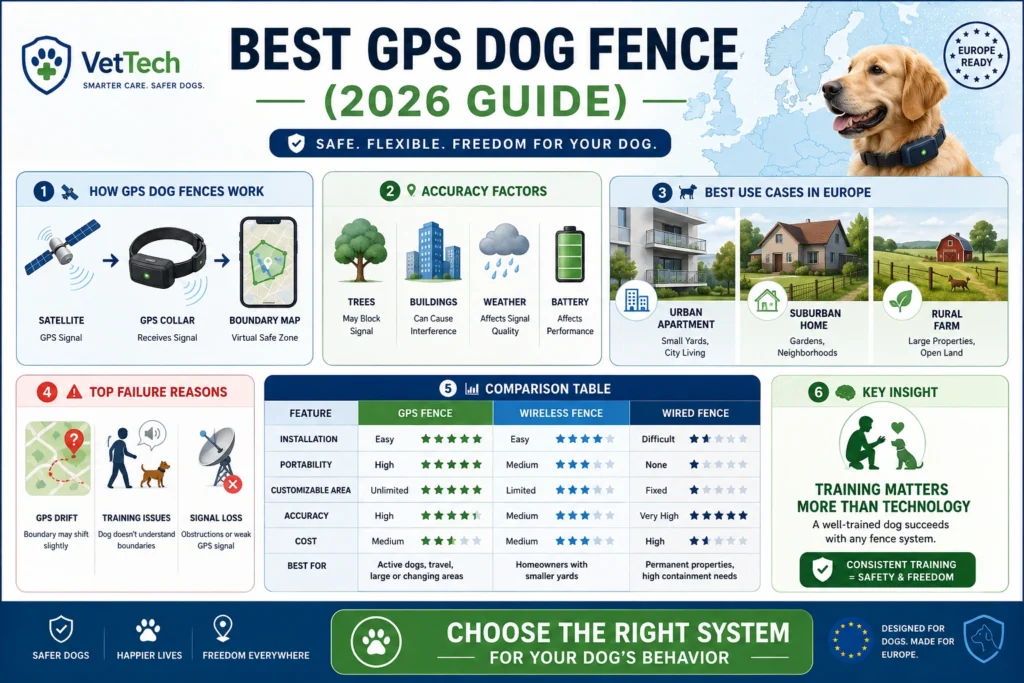
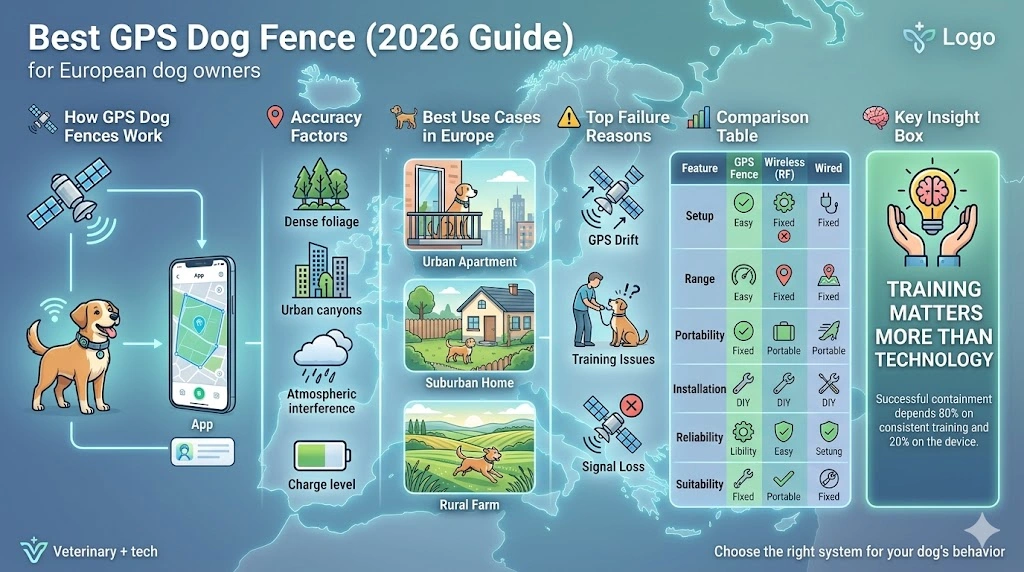
That sounds straightforward, but real-world use is more complicated because satellite positioning is never perfect. Small drifts can happen. Trees can interrupt signal quality. Buildings can distort location readings. The weather can interfere slightly. Battery level can affect performance. Even the refresh speed of the collar matters.
Accuracy Levels to Understand
Not all GPS fences perform the same way. A premium system may feel impressively precise, while a lower-cost or older model may show more drift.
A practical way to think about accuracy is this:
- Premium systems may stay within a tight range under good conditions,
- mid-range systems may be acceptable for larger boundaries but less refined at the edge,
- Weak signal environments can create drift or delayed responses.
That is why technical specifications matter, but the environment matters just as much.
What Affects Performance?
1. Trees and dense vegetation
Forests, hedges, and thick tree cover can weaken the satellite signal and reduce boundary precision.
2. Urban density
Tall buildings, narrow streets, and reflective surfaces can create an urban canyon effect, where location data becomes less stable.
3. Weather and atmospheric conditions
Heavy storms, deep cloud cover, and harsh weather do not usually destroy performance, but they can make the system less reliable at the margin.
4. Battery level
As the collar battery drops, signal updates may become less dependable. That can affect warning timing and tracking consistency.
5. Refresh rate
A fast, responsive system is more likely to react before a dog reaches the boundary. A slow one can feel late.
This is why a GPS fence should be judged as a living system, not just a product box. The same device may feel excellent in an open field and only average in a forested garden or dense neighborhood.
Discover how GPS dog fences really work, what affects accuracy, and why training matters more than technology. Compare GPS, wireless, and wired systems before you choose the right one for your dog.
Types of GPS Dog Fence Systems in 2026
There are several containment models available today, and each one fits a different ownership style.
1. GPS Smart Collar Systems
These are the most flexible and technologically advanced systems. They rely on satellite location tracking and app-based boundary creation, which makes them ideal for custom shapes, larger parcels of land, and property owners who want movement freedom without digging wire.
Strengths:
- flexible boundary design,
- no buried cable,
- mobile app control,
- real-time tracking,
- convenient for irregular or large land.
Weaknesses:
- usually more expensive,
- requires structured training,
- can struggle in dense forests or signal-blocked areas,
- depends heavily on battery management and signal quality.
These are often the best fit for rural homes, farms, and owners who value portability and digital control.
2. Wireless Radio Fence Systems
Wireless radio fences typically use a transmitter placed in one location to create a fixed circular containment area. They are easier to understand and faster to set up than buried wire systems, but they are less adaptable than full GPS collar systems.
Strengths:
- simple installation,
- beginner-friendly,
- lower cost than premium GPS systems,
- decent choice for compact properties.
Weaknesses:
- usually circular boundaries only,
- limited precision compared to high-end options,
- less suitable for large or unusually shaped land.
This type is often best for small yards, simple property layouts, and owners who want convenience over customization.
3. In-Ground Wired Dog Fences
Traditional wired fences remain one of the most stable and exact containment methods. A buried cable marks the perimeter, and the collar reacts when the dog approaches the boundary.
Strengths:
- highly consistent boundary definition,
- excellent reliability,
- less affected by some GPS-related drift,
- Good for homeowners who want a fixed and dependable system.
Weaknesses:
- Installation takes more work,
- less portable,
- not ideal for rented properties,
- less modern and less flexible than virtual systems.
This style remains attractive for permanent residences where accuracy and predictability matter more than convenience.
GPS Dog Fence vs Other Systems
To choose the right containment approach, it helps to compare the main options directly.
| Feature | GPS Fence | Wireless Fence | Wired Fence |
| Setup | Easy | Very Easy | Hard |
| Accuracy | Medium–High | Medium | Very High |
| Mobility | High | Limited | None |
| Cost | High | Low to Medium | Medium |
| Training Needed | Yes | Yes | Yes |
| Best Use | Large land and flexible spaces | Small yards | Permanent properties |
This comparison shows an important pattern: there is no single best option for every household. The right choice depends on where you live, how your dog behaves, and how much effort you can realistically put into training.
A GPS fence is especially attractive when freedom, portability, and app-based control matter more than fixed-wire precision. A wired system is stronger if you want dependable perimeter control on a permanent property. A wireless system can make sense when speed and simplicity are the top priority.
Best GPS Dog Fence Strategy:
A lot of buyers start by asking, “Which brand is best?” That is understandable, but it is not always the smartest way to choose.
A better approach is to match the system to the use case.
Best for Large Properties and Farms
If you manage a farm, rural estate, or a large open property, a GPS smart collar system may be the most logical choice. It gives you broad coverage, digital flexibility, and the ability to create boundaries that match the real shape of your land instead of forcing your dog into a simple circle.
This is especially useful for owners in countryside areas where traditional fencing would be expensive or visually intrusive.
Why it fits:
- broader boundary coverage,
- custom virtual shapes,
- good mobility,
- strong fit for open land.
Watch out for:
- training discipline,
- wildlife distractions,
- uneven satellite quality in trees or hills.
Best for Cities and Suburbs
Urban and suburban owners often need a different approach. The property may be smaller, boundaries may be more predictable, and the surrounding environment may include other people, pets, vehicles, and distractions.
In this case, a simpler fence format may be enough, especially if the main need is organized containment rather than wide-ranging freedom.
Why it fits:
- easier to supervise,
- smaller and cleaner layouts,
- simpler training path,
- better control in compact spaces.
Best for Budget-Conscious Users
Budget buyers usually want a practical solution that does not overcomplicate their routine.
A lower-cost system can work for a small garden or a controlled outdoor area, but buyers should understand the trade-offs:
- fewer advanced features,
- reduced flexibility,
- possibly slower response,
- less confidence in difficult environments.
The cheapest option is not always the most economical if it creates confusion, poor training results, or repeated replacement costs.
Why GPS Dog Fences Fail in Real Life
This is one of the most important parts of the guide, because many product pages only describe the upside.
The truth is that GPS dog fences fail for predictable reasons. Once you understand those weak points, you can avoid many of them.
1. GPS Drift
GPS drift means the location reading shifts slightly even when the dog is not truly moving that far. A small error can create a false correction or make the boundary feel inconsistent.
The result may be:
- confusion,
- hesitation,
- delayed response,
- or unexpected warnings.
For a dog, inconsistency is not just inconvenient. It can be emotionally frustrating.
2. Signal Blockage
Trees, walls, slopes, and Buildings can interrupt the collar’s view of the satellites. When that happens, the system may become less accurate.
This is especially relevant in:
- wooded land,
- steep terrain,
- dense suburbs,
- and urban environments with lots of vertical structures.
3. Delayed Correction
Even a good system can be too slow if the response arrives after the dog has already crossed the boundary.
If the correction comes late, the dog may learn the wrong lesson. Instead of associating the warning with the edge, it may associate it with random movement, confusion, or anxiety.
4. Poor Training
This is the biggest reason systems underperform.
Technology does not train dogs by itself. Dogs learn through repetition, timing, association, and consistency. A fence can support the lesson, but the lesson still has to be taught.
Without proper training, dogs may experience:
- confusion,
- stress,
- avoidance,
- Repeated boundary testing,
- or even stronger escape behavior.
The device is only one part of the equation. The other part is teaching the dog what the signals mean.
Dog Behavior Science:
A dog is not a machine. It does not automatically understand that a beep or vibration means “turn around and stay safe.” That meaning must be built through structured learning.
Dogs respond best to:
- repetition,
- predictable routines,
- reward-based reinforcement,
- clear cue timing,
- calm handling,
- and patient progression.
Some dogs adapt quickly. Others need more time. Breed tendencies, rescue history, age, sensitivity, confidence level, and environmental distractions can all shape the learning curve.
Dogs That May Need Extra Care
Certain dogs are more likely to need a careful introduction to GPS containment:
- high-prey-drive dogs,
- energetic terriers,
- anxious or nervous dogs,
- rescue dogs with uncertain histories,
- dogs that already have a strong escape habit,
- and dogs that are easily overwhelmed by stimulation.
This does not mean they cannot use the system. It means the training path should be slower, clearer, and more humane.
A useful rule is this: the fence should teach direction, not fear. When the dog understands the pattern, the system becomes much more effective.
Discover how GPS dog fences really work, what affects accuracy, and why training matters more than technology. Compare GPS, wireless, and wired systems before you choose the right one for your dog.
Real-Life Scenarios in Europe
Europe is not one uniform environment. Conditions change dramatically from one country or region to another, and that directly affects GPS fence performance.
Urban Dogs
City dogs live around traffic, people, bicycles, balconies, shared courtyards, and small outdoor spaces. In these settings, the priority is often controlled access and safe awareness rather than huge roaming freedom.
For some urban owners, a GPS may be useful primarily as a tracking and boundary support tool. For others, a simpler wireless fence or a different containment method may be enough.
Rural Dogs
Rural dogs often have more room to move, but they also face different risks. Wildlife, open land, neighboring properties, and weaker landmark control can make containment more complicated.
In these environments, a GPS-based system can be especially appealing because it gives the owner more flexibility without needing to install a long physical boundary.
Cold and Snowy Regions
In colder climates, seasonal conditions may alter how the collar performs or how comfortable it is for the dog to wear for long periods.
A high-quality system with strong battery management and stable tracking is generally safer for owners dealing with winter weather, snow, or large seasonal shifts in outdoor use.
Safety and Legal Considerations in Europe
This topic is especially important because pet welfare expectations in Europe can be strict, and local rules may vary.
There is no single continent-wide rule that applies equally everywhere. Different countries and regions may have different expectations around training devices, correction levels, and humane handling.
That means responsible use matters.
Safe Usage Principles
- start with training, not correction,
- introduce the collar slowly,
- avoid over-correcting a nervous dog,
- monitor the dog’s comfort and behavior,
- do not rely on the device as the only layer of safety,
- and use supervision during the learning stage.
A GPS fence should never become a shortcut for responsible ownership. It should be a structured support tool that works alongside humane training and attentive care.
Pros and Cons of GPS Dog Fences
Pros
- No physical fence is required.
- The system can be portable.
- It may work well on large areas.
- It can be controlled through an app.
- It gives you a modern, flexible containment option.
Cons
- Training is mandatory.
- Accuracy is not perfect in every environment.
- High-quality models can be expensive.
- Some dogs are not good candidates for this approach.
- The system may be less reliable in dense or obstructed locations.
This balance is why a GPS fence should be seen as a smart tool, not a universal solution.
Expert Tips for Better Results
If you want a GPS dog fence to succeed, training and implementation matter just as much as the technology.
Start in a Calm Environment
Begin in a quiet area with minimal distractions. That helps the dog focus on the new cues instead of competing stimulation.
Use Positive Reinforcement
Pair guidance with rewards. When the dog responds correctly, reinforce the behavior with praise, treats, or calm encouragement.
Test the Boundary Before Full Use
Do not assume the first setup is perfect. Walk the area, check the boundary shape, and make sure the system behaves the way you expect.
Progress Slowly
A gradual introduction is usually better than a sudden, full-pressure rollout. Dogs learn more reliably when changes are measured.
Watch Battery and Collar Fit
A loose collar can create inconsistent feedback. A weak battery can reduce reliability. Both matter.
Observe the Dog’s Emotional Response
The best training plan is not only about compliance. It is about confidence. If the dog seems anxious, confused, or overly reactive, adjust the method.
Common Mistakes Dog Owners Make
Many disappointing outcomes are caused by avoidable mistakes.
Using the System Without Training
A virtual boundary cannot replace learning. If the dog has never been taught what the warning means, the experience may be random and unhelpful.
Expecting Instant Results
Most dogs need repetition. Boundary awareness usually develops over time, not in one session.
Ignoring Environmental Limits
A system that works beautifully in open land may behave differently in a forest, beside tall buildings, or near uneven terrain.
Choosing the Wrong Product Type
A rural property may benefit from a different solution than a city garden. Picking the wrong category often causes frustration.
Over-Correcting Sensitive Dogs
Some dogs become more uncertain when they are corrected too aggressively. That can reduce trust and make the learning process harder.
How to Choose the Best GPS Dog Fence in 2026
When you evaluate options, think beyond the product name and look at the bigger picture.
1. Property Size
Large properties usually benefit more from flexible GPS-based containment. Small yards may not need that level of complexity.
2. Landscape Type
Open land, wooded areas, sloped terrain, and dense city environments each create different technical challenges.
3. Dog Personality
A calm, obedient dog may adapt more quickly than a highly reactive, anxious, or impulsive dog.
4. Training Commitment
Your consistency matters. If you are unlikely to follow a structured training plan, even a premium system may underperform.
5. Budget Versus Value
A lower price can be attractive, but value is about reliability, comfort, durability, and long-term fit.
6. Safety Philosophy
Choose a system that aligns with your approach to humane training and responsible pet care.
The best GPS dog fence is not the one with the loudest marketing. It is the one that fits the dog, the land, and the owner’s follow-through.
Advanced Buying Perspective:
When Experienced owners compare systems, they tend to focus on a few practical dimensions:
- boundary flexibility,
- battery life,
- collar comfort,
- correction options,
- app usability,
- signal consistency,
- setup simplicity,
- and whether the product supports humane training.
These are far more important than flashy features that sound impressive but do not matter in daily life.
A useful mindset is this: do not buy for the demo; buy for the routine.
If a system looks amazing in a promotional video but becomes frustrating after a week of real-world use, it is not the right choice.
Training Framework:
While every dog is different, a structured introduction often looks like this:
Phase 1: Familiarization
Let the dog get used to the collar, the routine, and the environment before boundary testing becomes serious.
Phase 2: Boundary Awareness
Teach the dog where the edge is, how the warning sounds, and what behavior is expected.
Phase 3: Controlled Repetition
Repeat the same lesson consistently in short sessions until the dog begins to understand the pattern.
Phase 4: Supervised Independence
Only after the dog shows a reliable understanding should you begin reducing direct supervision.
Phase 5: Ongoing Review
Continue checking battery, fit, responsiveness, and behavior over time.
This gradual model is usually safer and more effective than rushing into full containment on day one.
Who Should Avoid a GPS Dog Fence?
This system is not ideal for every dog or every household.
You may need a different approach if your dog is:
- extremely fearful,
- highly reactive,
- prone to panic,
- medically sensitive to collar wear,
- or difficult to train without causing stress.
It may also be a poor choice if your property has heavy signal interference and you need absolute precision in every corner.
In those cases, a different containment method, additional supervision, or a professionally planned fencing strategy may be better.
People Also Ask
Yes, but some countries regulate correction levels.
Yes, but only with proper training.
High-end smart collar systems with real-time tracking.
They often struggle due to signal blockage.
Yes, when used responsibly.
Usually 2–4 weeks.
Highly anxious or aggressive dogs without training.
Yes, but mostly for tracking.
Conclusion:
There is no universal best GPS dog fence for every dog, every home, and every European environment.
The best choice depends on a combination of factors:
- your dog’s behavior,
- your property size,
- the environment around your home,
- your willingness to train consistently,
- and your preference for humane, practical containment.
That is the real expert answer.
Technology can create a virtual boundary, but training creates understanding. The collar can provide a signal, but the dog learns through repetition. The owner can choose the system, but consistency determines whether it works.
So instead of asking which product is the most expensive or the most advertised, ask which one fits your dog’s temperament, your land, and your daily routine.
In the end, the best GPS dog fence is not simply the most advanced one. It is the one that matches your dog’s personality, respects the limits of the technology, and supports safe, calm, and reliable behavior over time.