What Colors Do Dogs See Best? — The Truth Most Owners Get Wrong
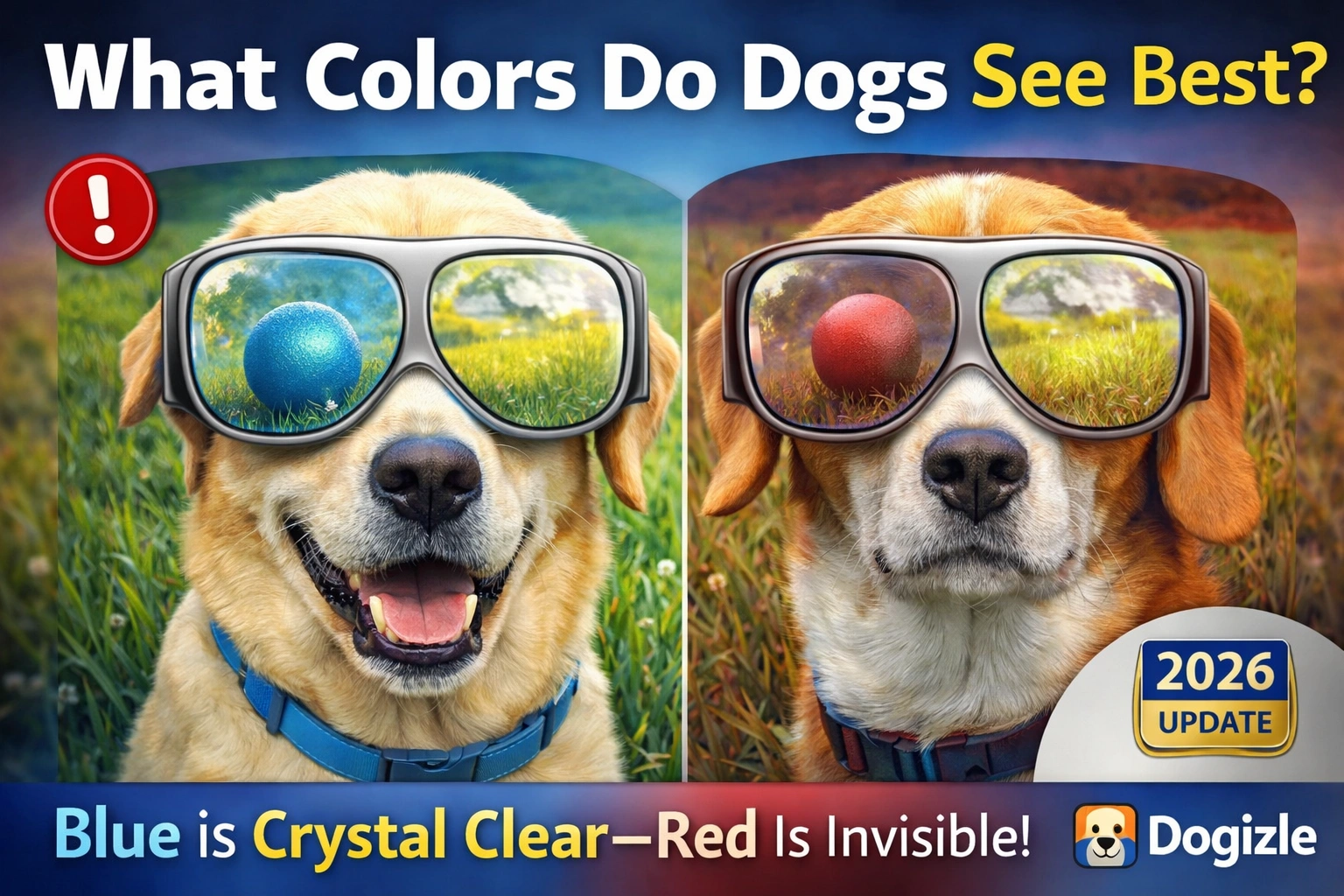
Blue and yellow are the colors dogs see best. If you have ever wondered why your dog misses a red ball in the grass, the answer is in canine vision. In this guide, you will learn the science, the smartest toy choices, and the simple tricks that make play, training, and safety much easier for every dog owner today. When people ask, “What colors do dogs see best?” they usually expect a simple answer.
Blue and yellow.
Why Your Dog Can’t Find the Toy — The Real Vision Problem
Dog color vision is not just a fun biology fact. It has practical value in everyday life, and it can influence how well your dog plays, learns, searches, and stays safe. A color that looks bright and exciting to you may be nearly useless to your dog if it disappears into the background. On the other hand, a simple toy in the right color can become much easier for your dog to locate, chase, and enjoy.
That matters for a lot of real-world situations:
How well can you support an older dog or a dog with weaker vision? Many articles stop at the basic science and leave it there. They say dogs are “color blind” or repeat that dogs see blue and yellow, but they do not explain the why, the how, or the what now. They do not connect dog vision to owner decisions.
How Dog Vision Works (Dichromatic Explained Simply)
You will learn the biology behind dog color perception, why blue and yellow stand out so clearly, which colors are harder for dogs to detect, and how to apply that knowledge in a practical, behavior-based way. You will also see how color works with contrast, smell, sound, movement, and environment, because a dog never experiences the world through color alone.
By the end, you will understand not only what dogs see, but also how to use that information to make better choices for play, training, and safety.
Why Dogs See Colors Differently from Humans
Humans and dogs both see the world through eyes, but their visual systems are not the same. The difference starts at the level of the retina, where specialized cells detect light and help the brain interpret the environment.
Human color vision is built for a wide spectrum. Dog color vision is built for a narrower, more functional one. Dogs do not need human-style color richness to survive, navigate, and communicate. Their vision is optimized in a different direction: motion detection, night performance, and contrast awareness.
That is why asking what colors can dogs see leads to a more nuanced answer than most people expect.
Dogs Have Dichromatic Vision
Humans are typically trichromatic, which means we have three major types of cone cells in the eye. Those cone cells let us distinguish a broad range of colors with a high degree of precision. That is why humans can tell apart red, green, orange, pink, purple, and many subtle shades in between.
Dogs, by contrast, are dichromatic. They have two main types of cone cells instead of three. That difference limits the range of colors they can distinguish. It does not mean dogs see a blank world. It means they see a more compressed color spectrum.
In simple terms, dogs are best at perceiving:
Blue shades
Yellow shades
And they have much more difficulty with:
Reds
Greens
Many oranges
Color differences that rely on the red-green portion of the spectrum
This is why a dog toy that looks vivid and bold to a person may appear muted, less distinct, or harder to separate from the background to a dog. A red ball in a grassy field can become visually noisy or indistinct, while a blue ball can stand out sharply.
The important takeaway is this:
Dogs do not lack color entirely.
They just process fewer color categories than humans do.
So when people ask what colors do dogs see best, the shortest accurate answer is blue and yellow. But the more complete answer is that dogs see a compressed, blue-yellow-biased world with lower sensitivity to red-green differences.
Rod Cells Give Dogs an Advantage in Low Light
Color is only one part of vision. Another major part is how well an animal can detect light, movement, and shape in dim conditions.
Dogs have a high concentration of rod cells, which are the retinal cells that help detect movement and work well in low-light environments. Rod cells do not create color information. Instead, they support brightness perception, edge detection, and motion sensitivity. This is a major reason dogs can function so well at dawn, dusk, or in shadowy spaces.
This gives dogs a practical survival advantage. Even if the color of an object becomes less useful in darker settings, dogs can still detect the motion of that object and track it efficiently. In other words, when the light drops, color becomes less important and movement becomes more important.
That is why a dog may still find a tossed toy near sunset even if the color is not ideal. The motion, shape, and contrast can carry the visual signal more strongly than the color itself.
This matters for owners because it explains a behavior many people notice:
A dog may fail to spot a stationary object quickly but immediately notice the same object when it moves.
That is not carelessness. It is a visual design.
The Black-and-White Myth Is False
A common myth says dogs only see the world in black and white.
That is false.
Dogs do not see a grayscale-only image. They are seeing a limited color range, with some hues more accessible than others. The old black-and-white idea is outdated and oversimplified. It gives people the wrong mental model and leads them to make poor assumptions about dog toys, training tools, and play visibility.
A better way to think about dog vision is this:
Dogs see color, but not the same color range humans do.
Their world is less saturated in the red-green spectrum.
Blue and yellow are much more available to them.
Contrast and motion often matter more than color itself.
So the accurate answer is not “dogs see no color.” It is “dogs see a different color map.”
What Colors Do Dogs See Best?
The direct scientific answer is simple:
Dogs see blue and yellow best.
Those are the colors that their cone cells can distinguish most effectively. But there is a deeper layer here. It is not just that blue and yellow exist in the dog’s visual world. They also create stronger sensory clarity than colors such as red, green, and orange.
Why?
Because these colors sit inside the range where canine vision is most responsive. They are easier for dogs to separate from one another and easier to distinguish from many backgrounds. In practical terms, that means they are more useful for toys, training markers, and outdoor visibility.
When you ask what colors do dogs see best, you are really asking which colors create the strongest behavioral signal. The answer is blue first, yellow second, and contrast always.
Why These Colors Stand Out
Blue and yellow stand out because they align more closely with the way the canine eye receives and processes light. They are not magical colors. They are simply more accessible to the dog’s visual system.
Here is what makes them effective:
They fit the dog’s cone sensitivity
They separate more clearly from muted backgrounds
They are easier to notice during play and training
They work better than red or green in many outdoor environments
For owners, this means a blue or yellow toy often has a higher chance of being seen quickly. That can improve fetch, retrieval games, target training, and general engagement.
Practical Color Visibility Table
| Color | How Dogs See It | Best Use |
| Blue | Very clear and bright | Best for toys, training, fetch |
| Yellow | Clear and easy to detect | Balls, mats, targets |
| White / Gray | Seen through contrast | Indoor use, clean backgrounds |
| Red | Often dull or brownish | Limited use, especially outdoors |
| Green | Blends into many backgrounds | Poor for grass or parks |
| Orange | Inconsistent depending on context | Only useful with a strong contrast |
The most important lesson is not simply “use blue.” It is this:
Blue is best overall. Yellow is second. Contrast is the deciding factor.
A toy that is the “right” color but disappears into the surroundings will still be hard for your dog to find. A toy that is not ideal in color can still work if it creates a strong visual boundary against the background.
What Colors Do Dogs Struggle to See?
Dogs have the greatest difficulty with colors that fall outside their strongest visual range, especially colors that depend heavily on red-green discrimination. That includes red, green, and many orange tones.
This does not mean these colors are completely invisible. It means they are less reliable and less distinct. To a dog, these colors may appear muted, brownish, grayish, or simply less saturated than they appear to us.
Why These Colors Fail
Red, green, and some orange shades are weak from a canine perspective because they do not create a strong signal in the dog’s visual system. They also tend to blend into natural environments, especially outdoor spaces with grass, trees, dirt, and shadows.
A color may look bright to a human because human eyes are tuned to it. But a dog’s eye is tuned differently. That mismatch is the source of the problem.
Real-World Example
Imagine a red ball sitting in green grass.
To a human, the ball may look obvious.
To a dog, that same ball may lose its visual separation and become much harder to identify quickly.
Now imagine a blue ball in that same grass.
The blue ball is much more likely to pop out visually because it creates a stronger contrast against the background and lives in a color zone dogs detect better.
This is the central rule for practical dog vision:
Visibility = Color + Background + Contrast
Not color alone.
Not brightness alone.
Not brand packaging alone.
All three visual factors work together.
Background Matters More Than Color
A color that is weak in one setting can become useful in another setting if the background helps it stand out.
For example:
A red toy on a white floor may still be visible
A red toy in thick grass may vanish from a dog’s point of view
A yellow toy on dark pavement may stand out very well
A blue toy in shallow water may be easier to track than an orange one
So the environment matters as much as the object itself. The same toy can move from highly visible to nearly invisible depending on context.
That is why good dog owners think in terms of visual context, not just toy color.
What the World Looks Like to Dogs
Dogs do not live in a dull world. They live in a world that is organized differently from ours.
Their vision is less detailed in color, but highly useful in other ways. They are not trying to appreciate a rainbow the way humans do. They are trying to notice movement, track action, identify safe paths, and respond to sensory cues quickly.
Their Vision Is:
Less colorful than human vision
A bit less sharp in fine detail
Highly sensitive to motion
Stronger in low light
Very dependent on contrast and environmental cues
If you imagine the world through a dog’s eyes, blue and yellow would appear more prominent, while reds and greens would be muted or harder to separate. The result is not a poor visual system. It is a specialized one.
Simple Visualization
A useful mental model is this:
Blues and yellows appear more vivid
Greens become less distinct
Reds may look brownish or grayish
Motion becomes easier to notice than stillness
Dim environments reduce the importance of color even more
That is close to the experience many researchers describe when discussing dog color vision. The brain is not using color as its strongest signal. It is using contrast, movement, smell, and sound to build a complete understanding of the environment.
That explains why dogs can still navigate beautifully even though their color palette is more limited than ours.
Best Color Toys for Dogs
When choosing a toy, the goal is not to pick the prettiest item on the shelf. The goal is to pick the toy your dog can actually see and engage with easily.
That is why color should be part of your toy selection strategy.
The safest rule is this:
Choose blue first. Choose yellow second. Add contrast and texture whenever possible.
Best Toy Colors by Environment
Grass or Parks
In green outdoor areas, blue is usually the most effective. Yellow can also work well, especially if the background is darker or the lighting is strong.
Best choices:
Blue
Yellow
Weak choices:
Red
Green
This is because grass and foliage tend to absorb or hide the lower-contrast colors that dogs already struggle to see.
Indoor Floors
Indoor visibility depends on the floor surface. A bright blue toy can stand out on a light floor or a neutral carpet. Yellow can also work well. White may help in some settings, but it can disappear on pale surfaces.
Best choices:
Blue
Yellow
White, if the background allows contrast
Water or Beach
Water and sand introduce reflection, glare, and motion complexity. In these settings, color matters, but sound and movement matter even more.
Best choices:
Blue toys with bright contrast
Floating toys
Toys with squeaks or sounds
Low-Light Conditions
When the light falls, visual detail weakens. In that case, a dog depends more on motion, sound, and strong contrast.
Best choices:
Bright blue or yellow
Sound-based toys
High-contrast shapes
Toys with movement cues
Smart Rule for Buying Dog Toys
Before you buy a toy, ask:
Will this toy stand out where my dog actually plays?
That one question can save you from buying objects that look exciting to you but are practically invisible to your dog.
A very effective buying mindset is to evaluate three factors:
Color visibility
Contrast against the background
Extra sensory support, such as sound or scent
If a toy wins in all three, it is a strong choice. If it only wins in one, it may be disappointing in real use.
What Colors Attract Dogs the Most?
This is where many articles get misleading. They act as if the color itself is the main attraction.
It is not.
Dogs are not driven primarily by color. They are driven by a mix of sensory and emotional signals.
Color Alone Does NOT Attract Dogs
A toy may be blue and highly visible, but if it has no scent, no motion, and no reward history, your dog may ignore it. Another toy may look visually ordinary but carry a powerful smell, familiar texture, or emotional association and become far more interesting.
That is because dogs care about:
Movement
Smell
Sound
Reward association
Texture
Familiarity
Owner interaction
Color helps with detection. It does not guarantee attraction.
Why Your Dog Ignores “Perfect” Toys
Owners often make this mistake:
They buy an attractive, new, expensive toy in the “best” color, then wonder why the dog still prefers an old sock, a dirty rope, or a forgotten plush object.
The reason is simple. To the dog, the toy is not just an object. It is a sensory bundle.
The old item may smell like home, comfort, or familiar play. It may have a texture your dog enjoys. It may be linked to a memory of fun, attention, or reward. The new item might be visually perfect but emotionally meaningless.
So the real attraction equation is bigger than color.
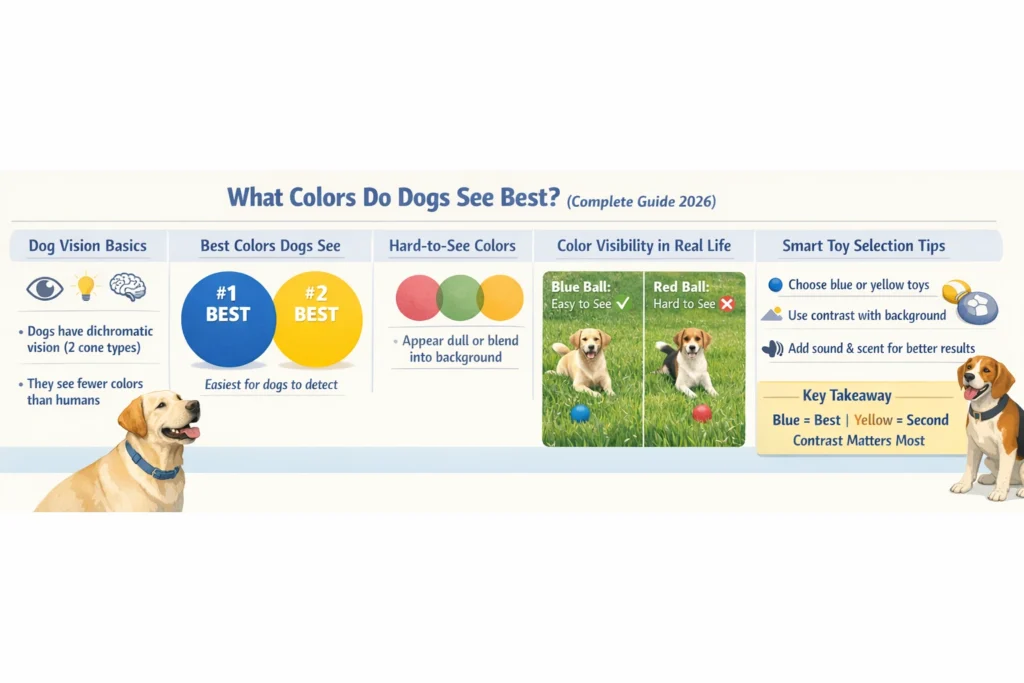
Blue and yellow stand out the most, while red and green can disappear, especially in grass. Use this quick guide to choose toys your dog can actually see.
The Real Attraction Formula
The best dog toys combine:
Good color visibility
Strong sound cues
Appealing texture
Interesting scent
Positive history
Movement or bounce behavior
This is a more complete, behavior-based way to think about dog engagement. It recognizes that dogs are multisensory problem-solvers, not color-first shoppers.
If you want a toy to succeed, it should be easy to see and rewarding to interact with.
Dog Vision vs Human Vision
Dog vision and human vision are built around different priorities.
Humans are highly color-focused. Dogs are more motion-focused. Humans enjoy fine detail and rich color differences. Dogs prioritize what matters most in the environment: movement, shape, and light changes.
| Feature | Humans | Dogs |
| Color Range | Wide spectrum | Limited, blue-yellow dominant |
| Vision Type | Trichromatic | Dichromatic |
| Night Vision | Moderate | Stronger |
| Motion Detection | Good | Excellent |
| Sharpness | High | Lower in fine detail |
This comparison shows why it is misleading to judge a dog’s visual system by human standards. Dogs do not need the same color detail we do. They have a different functional design.
The Tradeoff
Dogs trade some color richness for other survival advantages:
Better low-light detection
Stronger motion sensitivity
Useful contrast awareness
A visual system that supports outdoor movement and response
That tradeoff makes sense when you consider what dogs are built to do: move, track, search, react, and stay alert.
So when you ask what colors do dogs see best, you are really asking how their visual system prioritizes information. The answer is blue and yellow, but the bigger story is that dogs do not depend on color as much as humans do.
Real-Life Examples Every Dog Owner Should Know
To make this practical, let’s turn the science into real-life situations.
Fetch in the Park
A blue ball in the park is usually much easier for a dog to locate than a red one.
Why?
Because blue stands out better against grass and natural outdoor backgrounds. A red ball may visually sink into the environment, especially if the dog is moving fast or the lighting is uneven.
This affects play quality. If your dog can see the toy more easily, the game becomes more exciting, smoother, and less frustrating.
Apartment Living
Inside a home, visibility changes based on flooring, furniture, and lighting. A bright mat, a yellow target, or a blue training marker may be easier for your dog to detect than a toy that blends with the carpet or wooden floor.
In apartment settings, the right color can support:
Training clarity
Target placement
Meal routines
Play organization
Winter or Low-Light Regions
When daylight is weak or winter evenings arrive early, vision becomes more dependent on movement and contrast.
In those conditions, it helps to use:
Bright blue or Yellow toys
Sound-based cues
Movement-heavy games
Simple, high-contrast objects
This is especially useful for dogs that play outdoors in low-visibility conditions.
Wet or Muddy Environments
Mud, wet grass, puddles, and reflective surfaces make visual tracking harder. A toy that is already weak in contrast can disappear fast.
In these settings, the best strategy is not to depend on color alone. Use:
Blue or yellow toys
Floating objects
Squeaky toys
Toys that move easily and create sound
That gives your dog more than one way to locate the object.
Breed, Age, and Health Differences
Not all dogs experience vision in the same way. The general principles of color perception are similar across dogs, but age, breed structure, and eye health can change how clearly an individual dog sees.
Breed Differences
Breed differences may not change the basic fact that dogs are dichromats, but they can influence how a dog gathers visual information in practice.
Factors include:
Head shape
Eye placement
Facial structure
Field of view
Individual visual comfort
Some dogs may be better at tracking moving objects. Others may rely more heavily on smell or body positioning. The overall sensory strategy can differ.
Senior Dogs
As dogs age, their vision may become less sharp. Older dogs may show signs of reduced clarity, slower detection, or greater dependence on familiar cues.
Senior dogs may:
It takes longer to find toys
Bump into objects more often
Rely more on smell and sound
Become more cautious in new spaces
For these dogs, visibility and consistency become even more important.
Helpful supports include:
Scented toys
Sound cues
Stable layouts
High-contrast objects
Avoiding cluttered environments
Dogs with Vision Problems
Some Dogs have eye conditions or age-related changes that affect their ability to see clearly. In those cases, color alone is not the main issue. Safety and comfort matter more.
Signs may include:
Bumping into objects
Hesitation in unfamiliar areas
Cloudy eyes
Eye rubbing
Reduced confidence during movement
If you notice those signs, it is wise to involve a vet. The goal is not just to pick a better-colored toy. The goal is to protect eye health and support the dog’s overall quality of life.
Pros and Cons of Blue and Yellow Toys
Blue and yellow are the most practical colors for dog toys, but they are not perfect in every situation.
Pros
Easy to see in many environments
Useful for outdoor play
Helpful for training and retrieval
Good for contrast-based visibility
Often more reliable than red or green
Cons
Not every background makes them ideal
Color alone does not guarantee interest
Scent and sound may still matter more
A dog with vision issues may still need extra support
The best way to think about blue and yellow is this:
They are the strongest starting point, not the only answer.
A smart owner does not rely on a single trick. A smart owner builds a multi-sensory play system.
Common Mistakes Dog Owners Make
Many Toy-selection problems stem from simple misconceptions.
Buying red toys for grass
Red can lose visibility in natural outdoor settings, especially against green vegetation.
Thinking dogs see black and white
This is an old myth and not accurate.
Ignoring background contrast
A color that looks great in the store can disappear at home or outside.
Using color only
Dogs need more than a visible object. Sound, scent, motion, and reward history all matter.
Missing early vision problems
If a dog starts acting unsure, colliding with objects, or hesitating more often, the issue may be health-related rather than preference-related.
Avoiding these mistakes makes life easier for both the dog and the owner.
Safety and Health Considerations
Color choice is useful, but health always comes first.
If your dog suddenly changes how it moves or responds to objects, do not assume the problem is just toy color. There may be an underlying vision issue.
Watch for:
Sudden vision loss
Eye redness
Cloudiness
Frequent rubbing
Clumsiness in familiar areas
Startling easily when approached
These signs can indicate a need for veterinary attention.
Important Tip
A better toy color helps with visibility.
A healthy eye system helps with life.
Both matter, but health is more important.
If something seems off, it is worth getting checked rather than trying to solve everything with a brighter toy.
Expert Tips for Choosing the Best Color for Your Dog
Here is a practical framework you can use immediately.
Choose blue first for outdoor play
Use yellow as a strong backup
Prioritize contrast over brightness alone
Add sound features when visibility may drop
Use scent and texture to increase engagement
Watch how your dog actually behaves in real settings
This is the core owner strategy:
Do not choose for your eyes. Choose for your dog’s visual world.
That single shift in perspective can improve play, training, and daily routines.
Another useful rule is this:
If the toy disappears when you place it in the real environment, it is not the right toy.
A product does not need to be expensive to be effective. It just needs to be visually and behaviorally accessible to your dog.
FAQs
Dogs see blue and yellow best. That is the most accurate simple answer because those colors fall inside the stronger part of the canine visual spectrum.
Yes, but not as clearly as blue or yellow. Red and green often look muted, dull, or less distinct to dogs.
Not fully. Dogs are not colorless. They have limited color vision, not zero color vision.
Blue is usually the best choice for grass because it stands out better against green outdoor backgrounds.
Dogs respond more to: Movement
Smell
Sound
Reward history. Color can help, but it is not the only attraction factor.
Mostly yes, but vision can vary because of:
Breed structure
Age
Health conditions
Individual differences
For blind or senior dogs, use: Scent-based toys
Sound cues
Consistent environments
Gentle routines
Safe spaces with fewer obstacles
Conclusion
So, What Colors do dogs see best?
The answer is clear:
Blue is best.
Yellow is second.
Red and green are much weaker.
But the best dog owners do not stop there. They understand that real visibility is shaped by more than color alone. Contrast matters. Environment matters. Motion matters. Sound and scent matter. Your dog’s age and eye health matter too.
The smartest approach is to think in practical terms:
Choose colors your dog can actually detect
Match the toy to the environment
Use sound and scent when needed
Watch your dog’s behavior, not just the package label