6 Best Dental Chews for Dogs in 2026 — Vet-Approved Picks That Actually Clean Teeth Fast
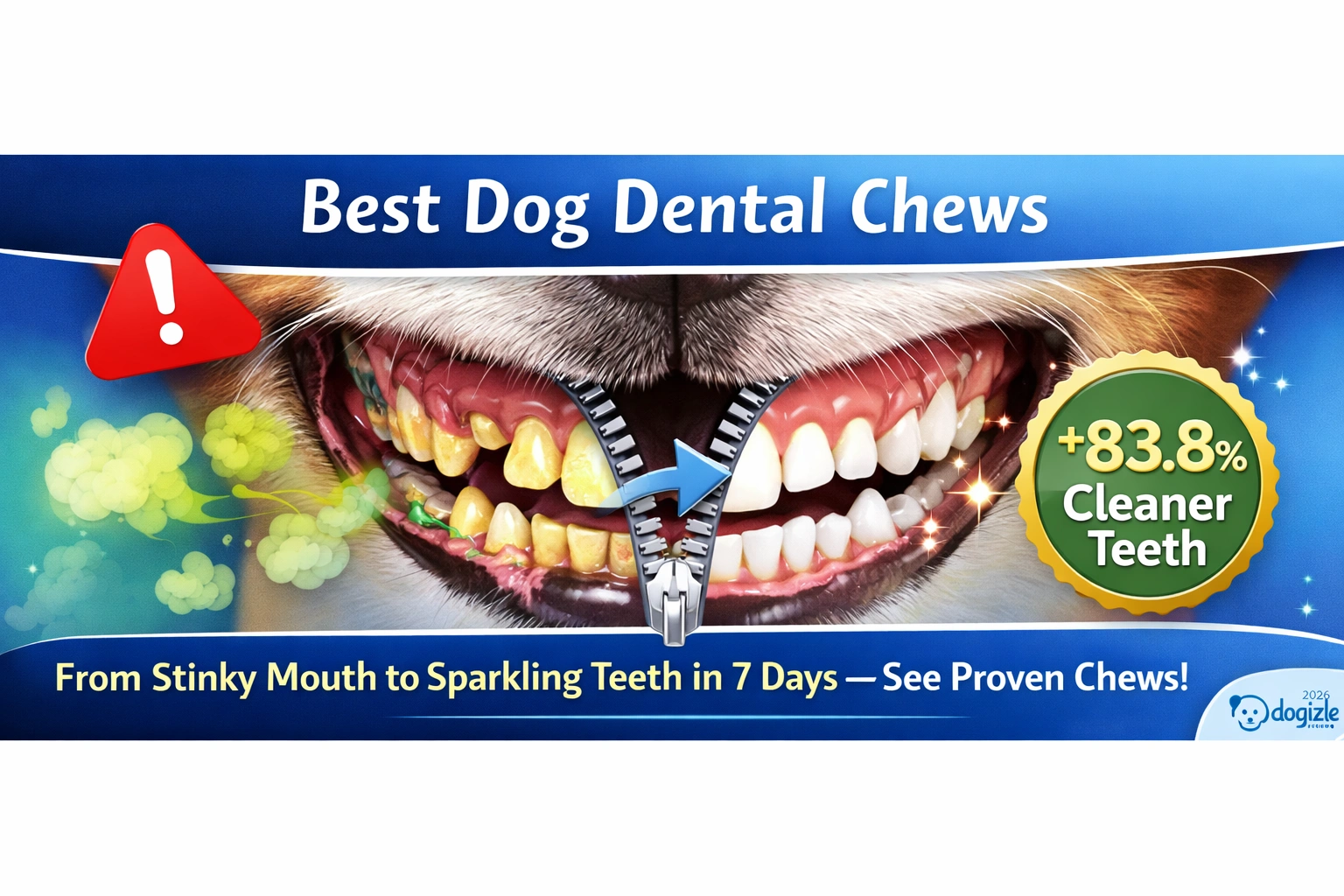
Best dog dental chews can reduce plaque, control tartar, and improve bad breath when used correctly. If your dog has stinky breath, yellow teeth, or early gum issues, this guide reveals which VOHC-approved chews actually work—plus how to choose the right one before dental problems become painful and expensive. Bad breath is not just an odor problem. In dogs, it is often one of the earliest warning signs of dental disease, along with red gums, drooling, discolored teeth, and changes in how a dog eats. Dental disease can stay hidden for a long time, which is one reason routine oral care matters so much. AAHA notes that many pets hide pain well, and that untreated periodontal infection can spread beyond the mouth and affect major organs.
Most dog owners assume a little smell is normal. It is not always normal, and that assumption can delay care until plaque becomes tartar, gums become inflamed, and the mouth becomes painful. Once that process starts, the problem is no longer cosmetic. It becomes a comfort, health, and quality-of-life issue.
Why Dental Chews Are Essential for Your Dog’s Oral Health in 2026
The best defense is still daily brushing. Veterinary guidance is clear that brushing is the most effective home method for reducing plaque accumulation, and AAHA specifically says it should be done daily to matter. AVMA likewise states that daily brushing is best, while brushing several times a week can still help when daily brushing is not realistic.
That is where the best dog dental chews come in. They are not a replacement for brushing, but they can be a practical support tool for owners who need something easier to maintain consistently. When a chew is scientifically designed, properly sized, and used regularly, it can help reduce plaque and tartar buildup while also supporting fresher breath. AAHA and VOHC both emphasize that the chew must be evidence-based, not just marketed as “dental.”
This guide is built to help readers make the right choice quickly and confidently. It focuses on VOHC-accepted dog dental chews, the role of chewing mechanics, the importance of dog size and chewing style, and the practical differences between popular options. It is designed for owners who want a cleaner, healthier mouth for their dog without guesswork.
What Most Articles Miss (And Why This Guide Wins)
A lot of competing pages are just product dumps. They list brands, repeat the same marketing claims, and stop there. That leaves readers with no system for deciding what actually fits their dog’s mouth, chewing behavior, calorie needs, or dental risk level. Veterinary guidance is more useful when it tells owners exactly what to look for, because specific recommendations are more likely to be followed.
The second gap is personalization. A chew that works well for a large, enthusiastic chewer may be a poor choice for a tiny dog, a senior dog, or a fast eater who swallows treats too quickly. AAHA explicitly recommends matching home care products to the patient and even reminds owners to choose the correct size range for chew products. VOHC also notes that chew and treat products should be fed in the right size for the dog.
The third gap is logic. Many pages say a dental chew “helps teeth,” but they never explain why. The real mechanism is mechanical: the chew rubs against tooth surfaces as the dog works it, helping remove plaque before it hardens into tartar. Some shapes and textures increase contact time and surface cleaning, which is why shape, density, and chew duration matter as much as the brand name on the bag.
That is the edge this guide gives you. It is not only a list of products. It is a decision framework. Readers can use it to match a chew to the dog in front of them instead of buying something that looks popular but does little in practice. That is the difference between a random treat and a more deliberate oral-care routine.
Do Dog Dental Chews Really Work? (Honest Answer)
Yes, dog dental chews can work, but only in the right context. They are best understood as a supplemental oral-hygiene tool rather than a complete replacement for toothbrushing or veterinary dental treatment. AAHA says chewing can help remove some plaque, and that scientifically designed, tested dental chews can help keep plaque and tartar buildup to a minimum.
The mechanism is simple but important. As dogs chew, the texture of the product scrapes against the tooth surface. The longer the dog chews safely and actively, the more opportunity the product has to produce mechanical cleaning. This is why longer chew time is often discussed as a benefit. A chew that disappears in seconds is not doing much work.
Shape also matters. Certain designs are made to increase tooth contact and reach different parts of the mouth. That does not mean the chew works like a toothbrush, but it does mean the geometry can improve cleaning compared with a plain soft treat. For this reason, some products are developed specifically for oral health rather than general snacking.
Still, dental chews are not magic. They do not replace brushing, they do not cure periodontal disease, and they do not replace professional cleaning when tartar or infection is already present. AAHA is clear that even daily brushing does not remove the need for anesthetized exams, radiographs, and treatment when disease is already present.
So the honest answer is this: dental chews can be helpful, but only when they are evidence-based, sized correctly, and used consistently as part of a broader oral-care plan. That is also why VOHC acceptance is such a useful filter.
Why VOHC Matters
VOHC stands for the Veterinary Oral Health Council, and its accepted-product list is the most useful shortcut for separating marketing from measurable oral-care support. The current VOHC dog products page says the listed items have earned the Seal of Acceptance, and the list includes products in categories such as edible chew treats, rawhide chews, dental diets, water additives, toothpastes, brushes, and wipes.
That matters because not every chew labeled “dental” has been tested the same way. A product can sound healthy, natural, or premium and still have little evidence behind it. VOHC acceptance means the product has met the council’s standard for helping control plaque and/or tartar. AAHA specifically recommends choosing dental treats and chews with the VOHC seal.
The practical takeaway is simple. If you are choosing between a brand with accepted product status and one without it, the accepted product is usually the safer evidence-based starting point. That does not guarantee it is the perfect fit for every dog, but it gives you a much stronger foundation than choosing by packaging alone.
For readers in Europe, this is especially useful because the VOHC list includes some product variants specifically labeled for European sizes, such as Purina DentaLife Daily Oral Care Dog Treats, European Sizes, and Purina DentaLife ActivFresh Daily Oral Care, European size. That makes the framework relevant outside North America as well.
How to Choose the Best Dog Dental Chews
Step 1: Start with VOHC Approval
Your first filter should be evidence, not flavor, price, or packaging. If a chew appears on the VOHC accepted-products list, it has a stronger case for helping reduce plaque or tartar than a random treat sold as “oral care.” AAHA recommends using VOHC-accepted products when selecting chews or treats for dental support.
Step 2: Match the Chew to Your Dog’s Size
Size is not a minor detail. VOHC explicitly reminds owners that chew and treat products should be fed in the right size for the dog, and AAHA emphasizes selecting products with the correct weight range. A treat that is too small may be swallowed too fast to clean much, while one that is too large may be awkward or unsafe.
Small dogs often need smaller formats and closer supervision because they are more likely to face dental issues and because a mismatched size can become a choking or swallowing issue. Larger dogs usually need a larger, more durable format so the chew lasts long enough to provide meaningful mechanical action.
Step 3: Match the Chew to Chewing Style
Chewing style matters just as much as body size. Fast eaters need products that force slower chewing. Gentle chewers may do well with softer formats. Aggressive chewers often need denser, more durable products that are less likely to disappear in a few bites. AAHA and VOHC do not frame this as entertainment; they frame it as product fit and oral effectiveness.
If your dog tends to gulp treats, a chew that disappears quickly will not do much for oral hygiene. If your dog is powerful enough to crush brittle products, the wrong choice can also create a safety problem. The goal is not maximum hardness. The goal is meaningful chewing time with appropriate texture and safe supervision.
Step 4: Check Calories
Dental chews are still treats. That means calories matter. Overuse can contribute to weight gain, especially in smaller dogs, indoor dogs, and pets that already need weight control. A dental routine should support oral health without quietly creating a body-condition problem.
Step 5: Keep the Ingredient List Practical
Ingredient panic is common, but it can distract from the bigger question: Does the chew actually work? Does it fit the dog? And is it safe to use regularly? For many healthy dogs, the most important factors are VOHC acceptance, chew time, and correct sizing. For sensitive dogs, a simpler formula may be easier to tolerate.
Best Dog Dental Chews in 2026 (Research-Based Picks)
The current VOHC accepted-products table for dogs includes a wide range of familiar names and variants. Among the commonly recognized edible chew options are Greenies, OraVet, Purina DentaLife, Hill’s Science Diet Canine Oral Care Chews, Pedigree Dentastix Advanced, WHIMZEES Brushzees, WHIMZEES Toothbrush Dental Dog Treats, and several Veggiedent products from Virbac. The list also includes newer additions such as Blue Buffalo Dental Chews and others across chew, treat, diet, and topical categories.
1. Greenies — Best All-Rounder
Greenies is one of the most recognizable names on the VOHC list, and the accepted-product table includes multiple versions, including standard Canine Greenies in five sizes, Weight Management versions, Hip and Joint Care Chews, Grain-Free Dental Chews, Aging Care Dental Chews, and Puppy Dental Chews. That variety makes it flexible across life stages and household routines.
Why does it work so well in practice? Because it is easy to fit into a daily routine. When a product has many sizes and life-stage options, it becomes easier to match with the dog rather than forcing the dog to adapt to the product. For readers who want a familiar, mainstream starting point, Greenies is a sensible place to begin.
2. WHIMZEES — Best Shape-Based Cleaning
WHIMZEES appears on the VOHC list with both Brushzees and Toothbrush Dental Dog Treats, each accepted in all sizes. That makes it a strong example of a product family built around shape and chewing mechanics. The design goal is not just taste; it is extended chewing and surface contact.
This is a smart pick for dogs that enjoy an active chew session. Owners who want a more “texture-driven” approach often like WHIMZEES because the chewing experience itself is the point. For dogs that do not inhale treats instantly, this can be a practical daily oral-care option.
3. OraVet — Best Vet-Style Routine
OraVet Dental Hygiene Chews for Dogs are on the VOHC accepted list and are often positioned as part of a more deliberate dental-care routine. That makes them appealing for households that already think in terms of prevention, not just fresh breath.
If a dog already has dental concerns, owners often want something that feels closer to a structured oral-health plan. OraVet fits that mindset well, especially when paired with exams, brushing, and a professional dental schedule. AAHA also reminds owners that home care does not remove the need for veterinary dental evaluation when disease is present.
4. Virbac C.E.T. Veggiedent — Best Long Chew Option
Virbac’s C.E.T. Veggiedent line includes FR3SH, Zen, and Flex, all accepted by VOHC for dogs in all sizes. That broad acceptance across multiple variants makes it a notable option for owners who want flexibility without leaving the evidence-based lane.
This family is a useful fit for dogs that need more chew time. Longer engagement tends to mean more mechanical cleaning, which is why this style can be attractive for dogs that otherwise finish treats too quickly. It is a strong option for readers who care about function over flash.
5. Purina DentaLife — Best Daily Routine Option
Purina DentaLife Daily Oral Care Dog Treats appear on the VOHC list in both North American sizes and European sizes, and VOHC also lists Purina DentaLife ActivFresh Daily Oral Care, European size, plus Purina Pro Plan Dental Care and later DentaLife Plus variants. That breadth makes it one of the more accessible evidence-based daily-care options.
For readers who want something easy to find and easy to repeat every day, this is a strong choice. Consistency matters more than occasional perfection in oral care, and daily use is where a chew-based habit has the best chance to help.
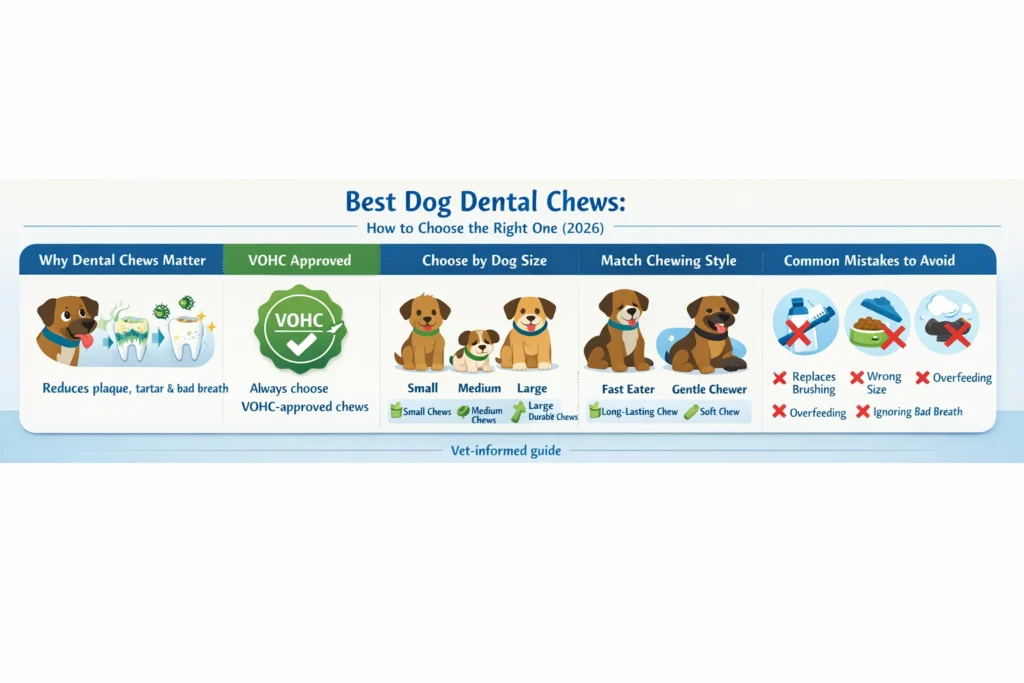
This simple guide shows how to choose the right chew based on size, chewing style, and vet-approved standards—so your dog gets real dental benefits, not just a treat.
6. Pedigree Dentastix — Best Budget-Friendly Choice
Pedigree Dentastix appears on the VOHC list in several forms, including Dentastix Advanced, Dentastix Original Large Dog Treats, Dentastix Daily in the UK, Dentastix Fresh, Chewy Chunx, and Light versions. That makes it one of the more visible budget-conscious options that still carries acceptance.
For owners balancing price and oral-care goals, that matters. The key is still to use the correct size and follow the feeding guidance. A cheaper product is only helpful if it is used properly and regularly.
Best Dog Dental Chews by Dog Type
Best Dental Chews for Small Dogs
Small dogs often need more careful product selection because fit matters so much in a smaller mouth. They are also among the pets AAHA notes may need professional dental cleanings more frequently. For small dogs, look for appropriately sized VOHC-accepted products rather than scaling up to a bigger chew just because it seems more substantial.
Good choices are compact, size-matched chews that encourage deliberate chewing without being unwieldy. The goal is clean contact, not a wrestling match. The wrong size can mean minimal cleaning and a higher chance of gulping.
Best Dental Chews for Large Dogs
Large dogs usually need larger formats and tougher textures. The chew must last long enough to create meaningful mechanical cleaning, especially if the dog is a strong, enthusiastic chewer. VOHC’s accepted list includes many products with multiple size options, which makes it easier to tailor the product to the dog’s build.
For large dogs, the best choice is often the one that survives long enough to matter without turning into a hard, unsafe object. That balance is crucial. AAHA and AVMA both stress avoiding inappropriate chew choices and emphasizing safe home oral care.
Dental Chews for Aggressive Chewers
Aggressive chewers need durability, but not at the expense of safety. A brittle or overly hard product may split, disappear too quickly, or become a hazard. The better option is a dense chew that is designed to hold up long enough to provide sustained abrasion and contact.
This is the category where owners often make the biggest mistake: they confuse hardness with effectiveness. Harder is not automatically better. Better means safer, longer-lasting, and better matched to the dog’s chewing pattern.
Best Dental Chews for Sensitive Stomachs
Sensitive dogs do better with consistency than with constant product hopping. If your dog has a delicate stomach, it is usually smarter to choose one appropriate VOHC-accepted chew and introduce it gradually than to keep switching. A stable routine reduces digestive surprises and makes it easier to evaluate what is working.
Puppies and Seniors
Puppies and older dogs often need softer handling and more thoughtful sizing. VOHC includes puppy-specific Greenies, and the accepted list also includes aging-care versions. That is useful because life stage changes chewing ability, dental risk, and feeding tolerance.
In both age groups, supervision matters. Puppies can be overenthusiastic, and seniors may have more fragile teeth or mouths that are already affected by dental wear. The safest approach is to stay within product guidance and talk to a vet if the mouth looks painful or the chewing pattern changes.
Greenies vs Whimzees vs OraVet (Quick Comparison)
Greenies, WHIMZEES, and OraVet are all on the VOHC accepted list, which makes them credible starting points rather than random choices. Greenies offers the widest range of sizes and life-stage variants. WHIMZEES stands out for shape-driven chewing. OraVet is often chosen by owners who want a more veterinary-style oral-hygiene routine.
If the goal is a simple everyday default, Greenies is often the easiest all-rounder because it is available in multiple formats for different dogs. If the goal is a chew that emphasizes texture and active chewing, WHIMZEES is compelling. If the goal is a more structured dental routine, OraVet is a strong fit.
The quick verdict is not that one brand is universally “better.” The better product is the one your dog will chew safely, consistently, and in the correct size. That is how oral-care routines actually succeed in the real world.
Common Mistakes Dog Owners Make
Mistake 1: Replacing Brushing
The biggest mistake is treating a dental chew like a substitute for brushing. Veterinary guidance is clear that brushing remains the most effective home method for plaque control. Chews can support the routine, but they are still secondary.
Mistake 2: Choosing the Wrong Size
If the chew is too small, the dog may swallow it too fast. If it is too large or poorly matched, the chewing experience may be awkward or unsafe. VOHC specifically reminds owners to use the right size for the dog, and AAHA echoes the need to select products based on the dog’s needs.
Mistake 3: Overfeeding Chews
Even an approved chew is still a treat, which means calories add up. Giving too many can lead to unnecessary weight gain, especially in smaller or less active dogs. Oral care should not create a body-condition problem.
Mistake 4: Ignoring Symptoms
Bad breath is not the only clue. Red gums, drooling, eating on one side, blood on chew toys, and trouble chewing all deserve attention. AAHA notes that many pets hide dental pain, so obvious signs often mean the issue has already progressed.
Safety Tips for Dog Dental Chews
Always supervise chew time, especially when introducing a new product or using a product with a dog that is enthusiastic, fast, or rough with treats. Good oral care should never come at the expense of safety.
Choose the size correctly. Make sure the product matches the dog’s weight range and chewing strength. If the chew starts breaking in a risky way or the dog tries to swallow large pieces, stop using it.
If your dog has persistent bad breath, bleeding gums, facial swelling, or difficulty eating, the answer is not just a better chew. It is a veterinary exam. AAHA recommends scheduling a dental exam when those signs appear.
Do not rely on hard household items or untested chewing substitutes. AVMA and AAHA both caution owners to think carefully about inappropriate chew choices. The safest dental habit is the one that cleans while still respecting the dog’s mouth.
Expert Tips
For apartment Dogs, choose chews that are less messy and keep the dog occupied long enough to feel worthwhile. A longer chew session can help create a calm routine and may reduce the urge to snack randomly throughout the day. That makes oral care easier to maintain in a small living space.
In colder climates or more routine-driven households, a daily dental chew can become part of a stable morning or evening pattern. The more automatic the habit, the more likely it is to survive busy weeks. Consistency is the real power move in dental care.
In multi-dog homes, do not assume one size fits all. Different dogs often need different products, different chew times, and different calorie allowances. A tailored routine is safer and more effective than a one-product-fits-all shortcut.
FAQs — Best Dog Dental Chews
Usually once daily, as part of a routine that respects the product’s calorie load and feeding guidance. Daily consistency is the key idea, not occasional use. AAHA stresses that home oral care should be daily when possible.
No. Brushing is still the best home method for plaque control. Chews are helpful support tools, but they do not replace brushing or professional care.
Yes. VOHC acceptance gives you a practical, evidence-based filter, and AAHA specifically recommends products carrying the VOHC seal. That makes them a smarter choice than untested dental treats.
They may help with breath freshness by reducing plaque buildup, but persistent bad breath can also signal disease. If the odor is strong or new, it is worth a vet visit rather than assuming the chew alone will solve it.
Yes, when the chew is correctly sized and the dog is supervised. The main risks come from poor fit, fast swallowing, or products that do not match the dog’s chewing style.
Not necessarily. “Natural” is not the same as effective. A chew’s actual value comes from its tested oral-health effect, fit, and safe use. VOHC acceptance is more useful than vague wellness language.
For cleaning performance, shape, texture, and chewing time usually matter more than marketing language about ingredients. The product has to create enough contact and enough chewing duration to do real mechanical work.
Conclusion: How to Choose the Best Dog Dental Chews
The best dog Dental chew is not the most popular one. It is the one that fits your dog’s size, matches your dog’s chewing style, carries VOHC acceptance, and is used consistently. That is the practical formula behind better oral hygiene.
Daily brushing remains the gold standard, but dental chews can make the routine more realistic for many households. Used properly, they can support plaque control, tartar management, and fresher breath while giving dogs a treat they actually enjoy. That combination is why the right chew can be such a useful part of a broader prevention plan.
The simplest strategy is still the strongest one: start with VOHC, match the size, match the chewing behavior, use it daily, and keep brushing whenever possible. That is how you turn a treat into an oral-care habit that actually earns its place in the routine.