HBY Meaning in Text: The Complete Guide (Definition, Origin, Tone & How to Reply)
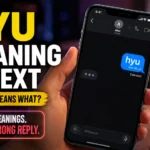
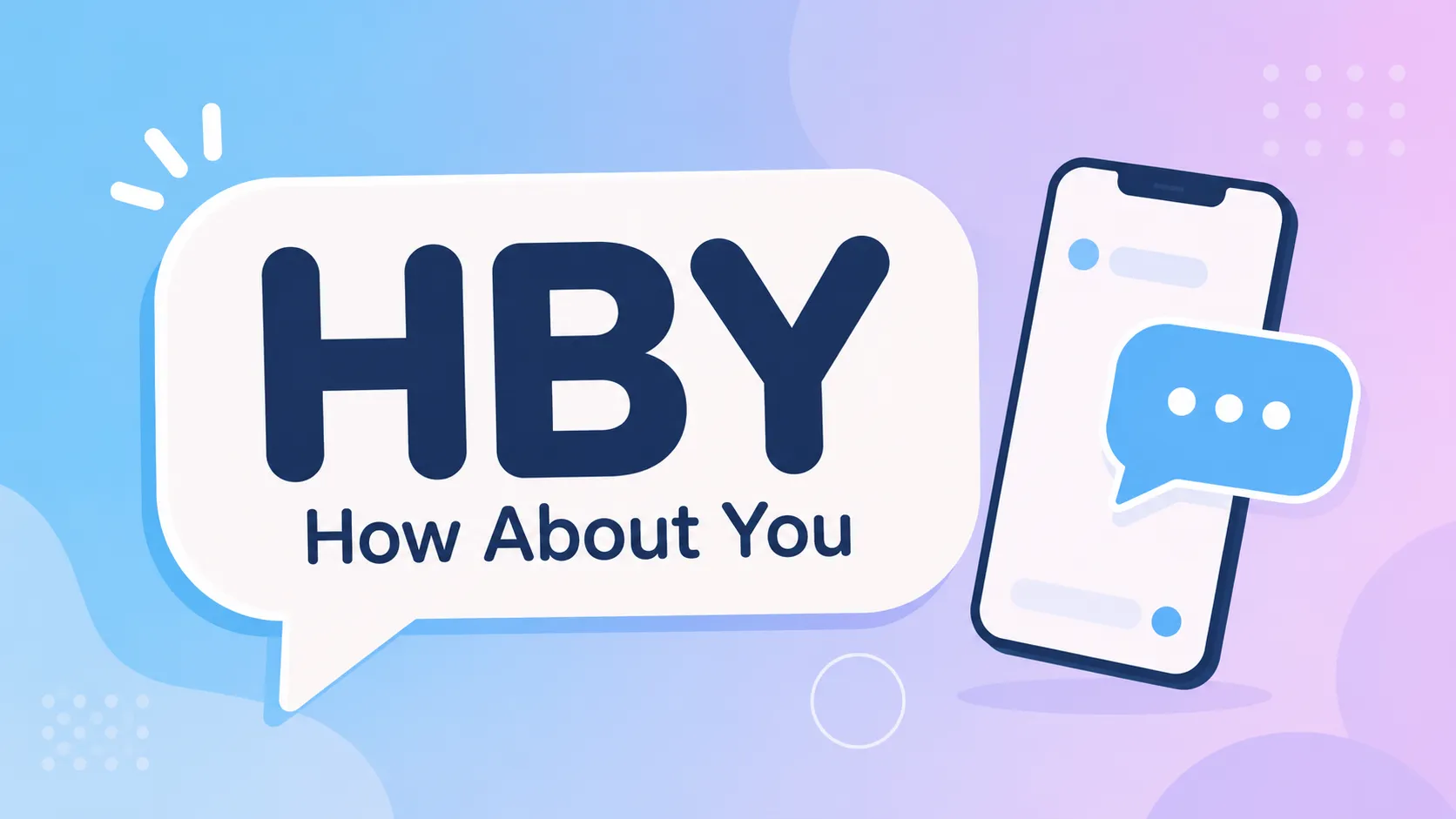
Quick answer: HBY stands for “How About You” (occasionally styled as “How ‘Bout You”). It’s a texting abbreviation used to bounce a question back to the person you’re chatting with, after you’ve just answered something yourself. Example: “I’m good, just tired. HBY?”
That one-line definition is where most guides stop. It’s also where the useful part actually begins — because the same three letters can mean “I’m being polite,” “I’m into you,” or “I’ve run out of things to say,” depending entirely on context. This guide covers all of it: the real origin, how HBY shifts meaning by platform and relationship, how to tell if it’s flirty, and exactly how to reply in any situation.
What Does HBY Mean? (The Short Version)
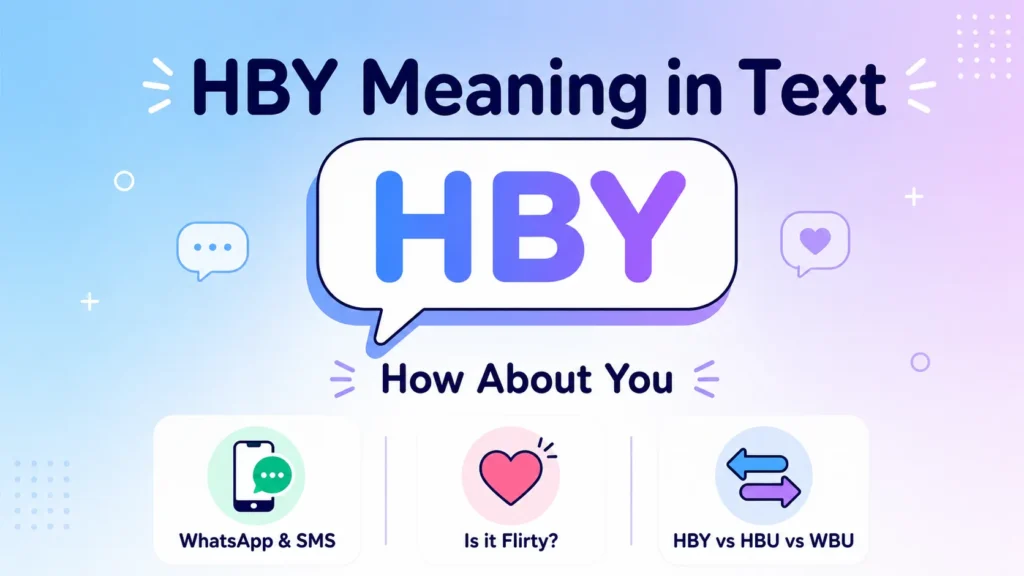
HBY = How About You.
It’s a reciprocal question — a way of saying “your turn” in a conversation. When someone shares information about themselves and then adds “HBY,” they’re inviting you to share the same thing back.
- “Just got out of work, HBY?” → asking what you’re doing right now
- “I loved that movie, HBY?” → asking your opinion
- “Doing okay today, HBY?” → asking how you’re feeling
It’s almost never a question on its own. HBY is a follow-up, tacked onto a statement to keep the exchange balanced instead of one-sided
How to Say and Write It
HBY is read as three separate letters (“H-B-Y”), not as a word. In text, you’ll see it in a few common forms, and the punctuation actually changes the tone slightly:
| Format | Typical feel |
| hby? (lowercase, question mark) | Casual, genuine — the standard everyday version |
| hby (no punctuation) | Very casual, sometimes low-effort or trailing off |
| HBY (all caps) | Can read as more emphatic or, in an argument, slightly sharp |
| hbyy / hbyyy (stretched) | Playful, often flirty or teasing |
Most competitor guides skip this entirely, but punctuation and capitalization are a real part of how people read tone into three-letter texts — a stretched “hbyy” lands very differently than a flat “hby.”
Where Did HBY Come From? (Real Origin)
HBY belongs to the same family as LOL, BRB, and TTYL — abbreviations born from 1990s–2000s instant messaging (AIM, MSN Messenger, Yahoo Chat), where typing speed and character limits mattered.
Here’s the nuance most articles get wrong or skip: HBY is a variant of HBU, not the other way around. “HBU” (How ‘Bout You) was the earlier and more common shorthand of the two, closely tracking the casual spoken phrase “how bout you.” HBY emerged as an alternate spelling — swapping the “U” sound for a “Y” — and picked up steam later as texting moved from desktop IM clients to phones and then to Instagram, Snapchat, and WhatsApp. Today the two are used interchangeably, though HBU still edges out HBY in raw frequency across most platforms.
Its staying power despite unlimited modern texting comes down to tone, not necessity — HBY signals casualness on purpose, the same way starting a sentence lowercase does.
HBY Meaning by Platform
The letters don’t change, but the social context around them does:
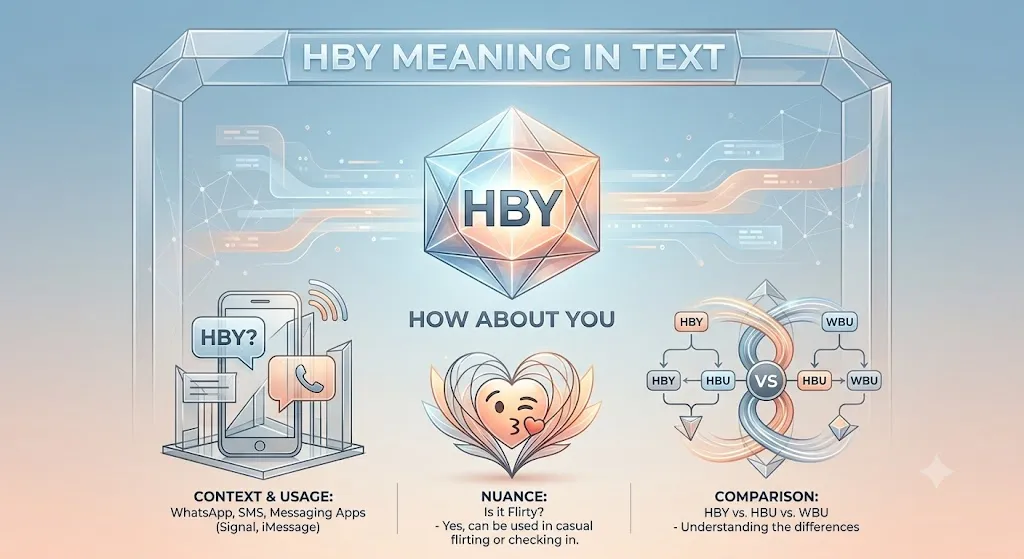
WhatsApp & SMS/iMessage: The most neutral, all-purpose use — friends and family checking in on each other’s day. Lowest chance of any hidden subtext.
Instagram (DMs & comments): Common after sharing a post, story, or update. “HBY?” in a comment is a light, public way to invite someone into a mini-conversation.
Snapchat: Often shows up in streak replies or after a Snap — quick, low-commitment, meant to keep a streak or chat alive without much effort.
TikTok (comments): Used between users bonding over a video, usually as a throwaway conversational hook rather than a deep question.
Dating apps (Tinder, Bumble, Hinge): Carries more weight here than anywhere else — see the flirty-vs-friendly breakdown below, since dating-app context changes the read almost completely.
Slack / workplace chat: Occasionally used between close coworkers in informal channels, but it’s one of the few contexts where you should default to the full phrase — “How about you?” — to keep things professional.
Is HBY Flirty? How to Tell the Difference
This is the question most people are actually typing “hby meaning” to answer, and it’s the part every competing article skips. HBY itself is tone-neutral — the flirtiness comes from everything around it, not the abbreviation itself.
| Signal | Platonic / Polite | Flirty / Interested |
| Timing | Sent any time, no urgency | Sent quickly after your last message |
| Follow-through | Question, then conversation drops or moves on | Question is followed by more questions, deeper topics |
| Emoji/punctuation | Plain “hby” or “hby?” | Stretched (“hbyy”), paired with 😏🥹👀 or ellipses |
| Content it follows | Neutral updates (“just ate,” “at work”) | Personal or vulnerable shares (“thinking about you,” “kind of bored without you”) |
| Pattern over time | One-off, inconsistent contact | Regular check-ins that always circle back to you |
The short version: HBY on its own is not a flirty word. It becomes flirty through frequency, timing, and what surrounds it — the same way “what are you up to?” can be completely innocent or a clear opener depending on who’s sending it and when.
HBY vs. HBU vs. WBU vs. Other Variants
Since these get used almost interchangeably, here’s how they actually differ:
| Term | Full Form | Tone Notes |
| HBY | How About You | Slightly softer, more conversational feel |
| HBU | How ‘Bout You | The more common/original variant; near-identical meaning |
| WBU | What About You | Slightly more direct or blunt than HBY |
| HRU | How Are You | A standalone greeting, not a reciprocal follow-up like HBY |
| ANY | And You | Shortest option; common in fast back-and-forth texting |
| SUP | What’s Up | An opener, not a reciprocal question — different function entirely |
Functionally, HBY, HBU, and WBU are near-synonyms and can be swapped without changing meaning. HRU and SUP are different tools: they start a conversation rather than return one.
HBY Meaning From a Girl vs. From a Guy
The meaning doesn’t change based on who’s sending it — “How About You” is gender-neutral. What can differ is delivery:
- From a girl: Often woven into a warmer, more conversational message — HBY tends to follow a personal share rather than stand alone.
- From a guy: Often more clipped — a quick “hby” tacked onto a short update, less elaboration either side of it.
That’s a stylistic tendency, not a rule. The tone table above (timing, emoji, follow-through) is a far more reliable read than the sender’s gender.
How to Use HBY Correctly
A few practical rules for using it naturally instead of sounding like you’re forcing slang:
- Always follow a statement. HBY works as a reply-hook, not a conversation opener. “HBY?” with no context reads as lazy or confusing.
- Keep it casual-only. Reserve it for friends, casual dating chats, and close coworkers — never emails, cover letters, or messages to someone you report to.
- Don’t overuse it. Sending “hby” after every single message gets repetitive fast; mix it with actual follow-up questions.
- Match the energy of the conversation. A stretched “hbyyy 👀” in a serious conversation will feel out of place; a flat “hby” in a flirty exchange can feel cold.
15 Real Conversation Examples (By Scenario)
With a friend
“Just finished a 12-hour shift, I’m dead 💀 hby?” “Binged the whole season last night lol, hby?”
With a crush / early dating
“Can’t stop thinking about that place we went, hbyy 🥹” “Kind of bored tonight… hby, you free?”
On a dating app (first few messages)
“I’m more of a coffee-shop-on-a-Sunday person, hby?” “Just got back from the gym, hby, big plans this weekend?”
With family
“Made it home safe, everything’s good here. HBY, how was your drive?”
With a coworker (informal Slack/WhatsApp group)
“Wrapping up early today, hby — heading out soon too?”
Low-effort / bored texting
“nm just laying in bed, hby”
After sharing news
“Just got the job offer!! Hby, hear back from yours yet?”
Casual social media comment
“Loved this reel 😂 hby, seen the sequel yet?”
Notice the pattern: every single example follows a statement. None of them open cold — that’s the single biggest usage mistake to avoid.
How to Reply to HBY (By Tone)
| Situation | Sample Reply |
| Casual, with a friend | “Pretty good, just relaxing. You?” |
| Flirty / interested back | “Better now that you texted 😊 what are you up to?” |
| Polite but not that interested | “I’m okay, thanks for asking!” |
| Professional / workplace | “Doing well, thank you — how about yourself?” |
| Low-effort match (bored energy) | “Same tbh, nothing going on here” |
The strongest replies do two things: answer the actual question, then add something new (a follow-up question, a detail) so the conversation doesn’t stall.
When to Avoid Using HBY
Skip it in:
- Job applications, cover letters, or emails to a manager/client — use the full phrase, “How about you?”
- First formal introductions — HBY signals pre-existing casualness that may not fit yet
- Customer service or support chats — even informal brands generally keep this level of shorthand out of official replies
If in doubt, the full phrase costs you three extra words and removes all ambiguity.
Does HBY Mean Anything Outside of Texting?
Rarely, and only as an acronym coincidence rather than a widely recognized alternate meaning — unlike well-documented multi-meaning acronyms, HBY doesn’t have a verified, sourced technical definition in fields like physics or medicine (a claim you’ll see repeated on some slang sites without any actual citation). The one legitimate exception: HBY is also used as a location/identifier code in some technical databases and directories outside of texting, but this has no bearing on its near-universal meaning in chat, which is “How About You.”
Common Misconceptions
- “HBY means Happy Birthday.” No — that’s HB or HBD. HBY has nothing to do with birthdays.
- “HBY is only for young people/Gen Z.” It’s most common among Millennials and Gen Z, but it’s understood broadly across most texting-literate age groups at this point.
- “HBY always means someone is romantically interested.” As covered above, it’s the surrounding context — not the abbreviation — that signals interest.
HBY Cheat Sheet (Quick Reference)
| Question | Answer |
| What does HBY stand for? | How About You |
| Is HBY the same as HBU? | Yes, near-identical meaning; HBU is the more original/common variant |
| Is HBY flirty? | Not inherently — depends on timing, emoji, and what it follows |
| Can I use it professionally? | Not recommended — spell it out instead |
| Where is it most common? | WhatsApp, Instagram, Snapchat, dating apps |
People Also Ask
HBY means “How About You” — a way of turning a statement back into a question for the other person, keeping a conversation two-sided instead of one-sided.
Yes. Both mean “How About You” (or “How ‘Bout You”). HBU is the earlier and slightly more common version; they’re used interchangeably today, and switching between them mid-conversation doesn’t change the meaning at all.
By itself, it’s neutral — the word carries no inherent flirtation. It becomes flirty based on context: quick reply timing, playful spelling like “hbyy,” emoji, and whether it follows a personal or vulnerable share rather than a plain update.
Answer the question honestly, then add a small follow-up of your own — a detail or a question — so the exchange keeps moving instead of stalling into a dead end.
It’s best avoided in emails or messages to a manager or client. Spell it out as “How about you?” instead — it costs three extra words and removes any risk of reading as too casual.
Conclusion
HBY means “How About You” — full stop, in almost every context you’ll encounter it. What actually matters, and what most guides miss, is reading the context around it: timing, punctuation, platform, and what it follows tell you whether someone’s being polite, bored, or genuinely interested. Use the tone table and reply examples above, and you’ll never have to guess again.