
IHHT Meaning: The Complete Guide to Intermittent Hypoxic-Hyperoxic Training
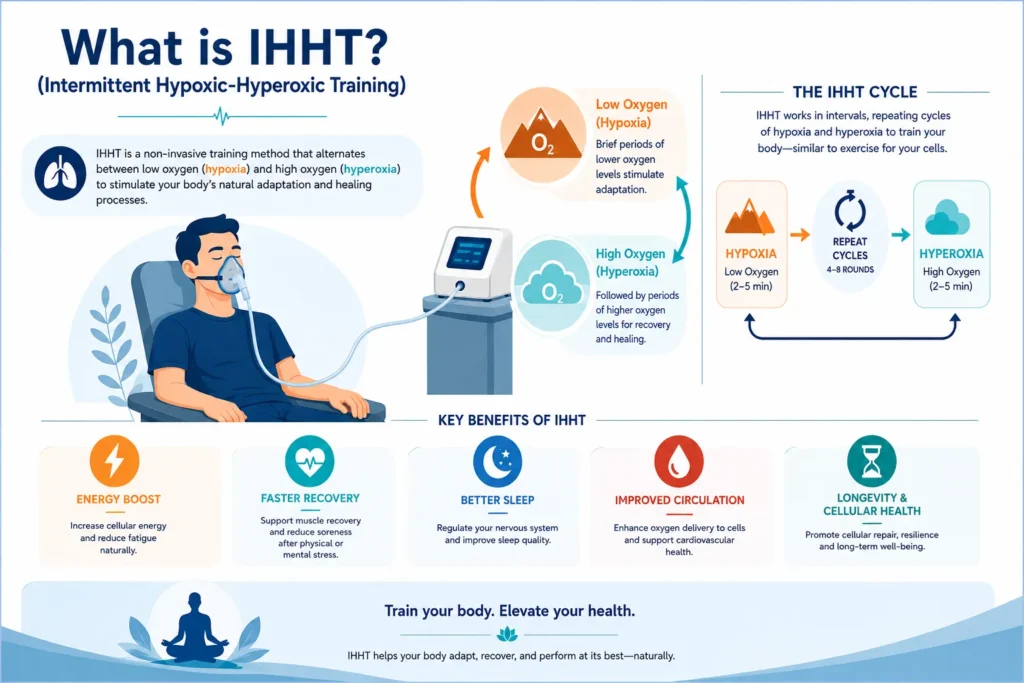
IHHT stands for Intermittent Hypoxic-Hyperoxic Training (sometimes called Intermittent Hypoxic-Hyperoxic Therapy or Treatment). It’s a supervised breathing method where you alternate between inhaling low-oxygen air (hypoxia) and oxygen-enriched air (hyperoxia) through a mask, in short cycles, to stimulate your mitochondria — the energy-producing structures inside your cells.
In plain terms: IHHT simulates the oxygen swings your body would experience at high altitude, then reverses them with an oxygen boost, to train your cells to become more efficient, resilient, and energy-producing — without you having to climb a mountain or exercise.
Below, you’ll find everything wrapped into one place: the full form, how the science actually works, exact oxygen percentages used in real protocols, benefits by category, who should avoid it, and how it compares to plain hypoxic (IHT) or altitude training.
Why People Search “IHHT Meaning”
Most searchers land on this term one of three ways: they saw “IHHT” on a wellness clinic’s price list, a chiropractor or biohacking influencer mentioned it, or a doctor recommended it and they want to know what they’re signing up for before booking. Because it sounds clinical but isn’t widely taught, the term creates a trust gap — this guide is built to close that gap with a real definition first, then the supporting depth.
Origin and History of IHHT
IHHT didn’t start as a wellness trend — it grew out of Soviet and Eastern European high-altitude physiology research from the 1990s, originally used to prepare pilots, cosmonauts, and endurance athletes for low-oxygen environments without physically relocating to altitude. That early method — alternating hypoxic air with normal room air — became known as IHT (Intermittent Hypoxic Training).
Researchers later found that replacing the “normal air” recovery phase with oxygen-enriched air sped up recovery between hypoxic bouts and produced more consistent results. That refinement became IHHT, and over the last decade it has moved from sports-science labs into longevity clinics, chiropractic practices, and home-use devices.
IHHT Full Form and Quick Definition
| Full form | Intermittent Hypoxic-Hyperoxic Training / Therapy |
| Also written as | IHHT treatment, interval hypoxic-hyperoxic training |
| What it does | Alternates low-oxygen (hypoxic) and high-oxygen (hyperoxic) air in cycles |
| How it’s delivered | Breathing mask connected to a device that mixes oxygen concentrations |
| Typical hypoxic range | 9–18% O₂ (sea-level air is 20.95%) |
| Typical hyperoxic range | 30–40% O₂ |
| Session length | 30–50 minutes, including several cycles |
| Course length | Usually 15–20 sessions for measurable change |
| Primary target | Mitochondrial function and cellular oxygen efficiency |
IHHT is not a workout. You sit or lie down, relaxed, while a machine controls what you breathe. That’s the detail most articles about “IHHT meaning” skip — people searching this term are often surprised to learn there’s no physical exertion involved at all.
Where the Term Comes From: IHT vs. IHHT
To understand IHHT, it helps to know its predecessor.
IHT (Intermittent Hypoxic Training) came first. It alternates hypoxic air with plain room air (normoxic), roughly simulating altitude training at 2,000+ meters. It’s the original “train low, live low” method used by endurance coaches decades before wellness clinics adopted it.
IHHT is the evolution: instead of returning to normal air between hypoxic phases, you get oxygen-enriched air. That added hyperoxic phase is believed to speed up cellular recovery between hypoxic stress bouts, which is why most modern clinics have shifted from IHT to IHHT.
IHT vs. IHHT at a Glance
| Feature | IHT | IHHT |
| Recovery phase | Normal room air (~21% O₂) | Enriched air (30–40% O₂) |
| Recovery speed between cycles | Slower | Faster |
| Cellular stimulus | Hypoxic stress only | Hypoxic stress + hyperoxic “flush” |
| Common use case | Classic altitude-simulation training | Modern wellness/clinical protocols |
| Equipment | Hypoxic generator | Hypoxic + hyperoxic generator |
How IHHT Works: The Mitochondrial Science
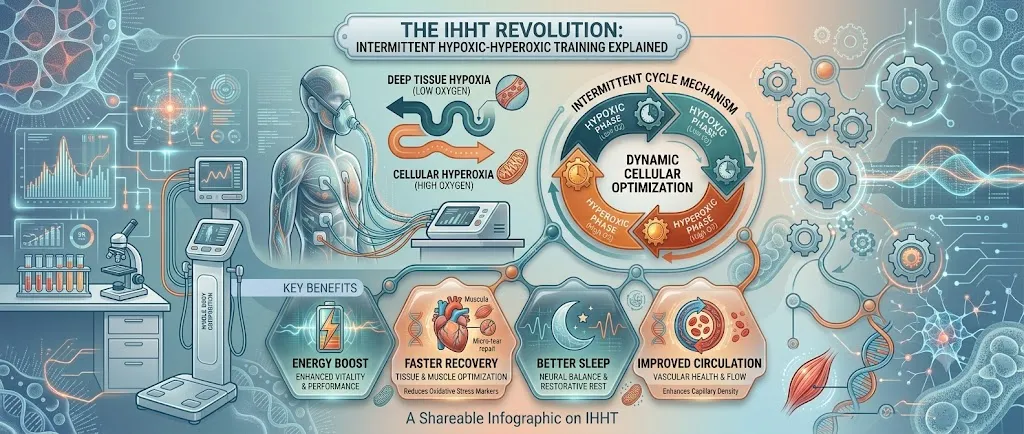
Every cell in your body relies on mitochondria to convert oxygen and nutrients into usable energy (ATP). Chronic stress, poor sleep, illness, and aging can damage mitochondrial DNA. Damaged mitochondria don’t just underperform — they replicate more damaged copies of themselves, gradually reducing your cellular energy output.
IHHT is built around a concept called mitochondrial hormesis: a controlled, brief stressor (oxygen deprivation) that’s mild enough to trigger adaptation rather than harm.
Here’s the cycle, step by step:
- Hypoxic phase (roughly 3–7 minutes): You breathe air with 9–18% oxygen. Your body senses the drop and activates hypoxia-inducible factor (HIF), a protein that helps cells adapt to low oxygen.
- Hyperoxic phase (roughly 2–5 minutes): You breathe air enriched to 30–40% oxygen. This oxygen surge is thought to accelerate the removal of damaged mitochondria (a process called mitophagy) and support the growth of new, healthier ones (mitochondrial biogenesis).
- Repeat for several cycles, with the device and a pulse oximeter continuously tracking your blood oxygen saturation (SpO₂) to keep the swings within a safe, individualized range.
Over a course of sessions, the theory — and a growing set of small clinical studies — suggests this repeated stress-and-recover pattern can improve how efficiently your cells use oxygen, even outside of the sessions themselves.
What Does an IHHT Session Actually Feel Like?
This is one of the most commonly searched follow-up questions, and most competing pages barely touch it.
- You sit or recline in a chair, fully clothed, no movement required.
- A soft mask covers your nose and mouth.
- A clinician or automated device sets your personal oxygen range based on a pre-session health screening.
- Your heart rate and SpO₂ are monitored throughout.
- Most people describe the hypoxic phase as similar to being slightly out of breath at altitude — noticeable, but not distressing — followed by a wave of alertness or relaxation during the hyperoxic phase.
- Sessions run 30–50 minutes, and a typical course is 15–20 sessions, done 2–3 times per week.
IHHT Benefits (Organized by Category)
Research on IHHT is still emerging and most studies are small, but the reported and studied benefits generally fall into four buckets:
1. Energy and Cellular Health
- Supports mitochondrial regeneration (mitophagy + biogenesis)
- May reduce fatigue linked to chronic stress or burnout
- Reported improvements in subjective energy and well-being
2. Athletic Performance
- Naturally stimulates erythropoietin (EPO), which can increase red blood cell production
- Small pilot studies report measurable gains in wattage/output and VO2max after 4-week programs
- Used as an alternative to altitude training camps for endurance athletes
- May support recovery in athletes showing signs of overtraining syndrome (via improved heart rate variability)
3. Metabolic and Cardiovascular Markers
- Associated with improvements in blood pressure regulation and vascular function in some studies
- Some evidence for improved LDL cholesterol and body composition markers
- Explored as a complementary approach in metabolic syndrome and select cardiovascular conditions
4. Cognitive and Mental Well-Being
- Reported improvements in sleep quality, stress resilience, and cognitive performance, particularly in older adults
- Used in some clinical settings as an adjunct for burnout, chronic fatigue, and stress-related conditions
Important caveat: IHHT is not a verified cure or standalone treatment for any disease. Most of the above are associations from small studies or clinical observation, not large-scale randomized trials. Treat it as a complementary, evidence-informed therapy — not a replacement for medical care.
IHHT Contraindications: Who Should NOT Do It
This is the section most competing “meaning” articles either skip entirely or bury. Because IHHT deliberately manipulates blood oxygen levels, it is not appropriate for everyone. You should avoid or get medical clearance first if you have:
- Severe or unstable cardiovascular disease (unstable angina, recent heart attack, uncontrolled hypertension)
- Advanced COPD, pulmonary fibrosis, or other severe lung disease (note: some clinicians treat moderate cases under close supervision)
- Pregnancy
- Uncontrolled epilepsy or serious neurological disorders
- Severe anemia, sickle cell disease, or thalassemia
- Polycythemia vera or other blood disorders affecting oxygen transport
- Active acute infection, fever, or hypertensive crisis
- Certain heart valve conditions
A qualified provider should always take a full medical history and, ideally, run a baseline SpO₂/heart rate check before your first session.
IHHT vs. Related Terms (Don’t Get Them Confused)
| Term | What It Means | How It Differs From IHHT |
| IHT | Intermittent Hypoxic Training | No hyperoxic recovery phase — alternates with normal air instead |
| EWOT | Exercise With Oxygen Therapy | Combines exercise with breathing only enriched oxygen (no hypoxic phase) |
| Altitude training (natural) | Living/training at real high altitude | Uses actual reduced air pressure, not a mask-controlled gas mixture; harder to control precisely |
| Hyperbaric Oxygen Therapy (HBOT) | Breathing 100% oxygen in a pressurized chamber | Only increases oxygen and pressure — no hypoxic phase at all |
| Wim Hof Method | Breath-holding + cold exposure | Self-directed breathing technique, not device-controlled gas mixtures |
People Also Ask
IHHT stands for Intermittent Hypoxic-Hyperoxic Training (also called Intermittent Hypoxic-Hyperoxic Therapy or Treatment).
For most healthy adults, yes — when administered by a trained provider with continuous SpO₂ monitoring. It’s not recommended for people with certain cardiovascular, pulmonary, neurological, or blood conditions, or during pregnancy. Always get medical clearance if you have an underlying health condition.
Altitude training relies on reduced air pressure at high elevation, which lowers the partial pressure of oxygen you breathe even though the oxygen percentage in the air stays roughly the same (20.95%). IHHT instead directly changes the oxygen percentage in the air you breathe through a mask at normal air pressure, and adds a hyperoxic recovery phase that natural altitude can’t replicate
Most protocols recommend at least 15–20 sessions, done 2–3 times per week, before resting SpO₂ and subjective energy improvements become measurable. Benefits typically need ongoing sessions (roughly weekly) to be maintained.
Hypoxic phases typically use 9–18% oxygen, and hyperoxic phases typically use 30–40% oxygen, compared to the 20.95% oxygen found in normal room air.
No — it’s non-invasive and pain-free. You may feel mildly short of breath during hypoxic phases, similar to being at altitude, but properly administered IHHT should never feel like suffocation. You’re always breathing a sufficient volume of air; only the oxygen concentration changes.
Conclusion
IHHT Meaning, in one sentence: it’s a mask-based therapy that alternates low-oxygen and high-oxygen air in controlled cycles to stress-test and regenerate your mitochondria, with applications ranging from athletic performance to fatigue recovery and metabolic support.
It’s not a miracle cure, and it’s not for everyone — but for the right candidate, under proper supervision, it’s one of the more researched ways to simulate altitude-style adaptation without leaving sea level.
This article is for informational purposes and isn’t medical advice. Talk to a qualified healthcare provider before starting IHHT, especially if you have a cardiovascular, pulmonary, neurological, or blood-related condition, or if you’re pregnant.