TW Meaning in Text: The Complete Guide to Every Definition, Use, and Response (2026)
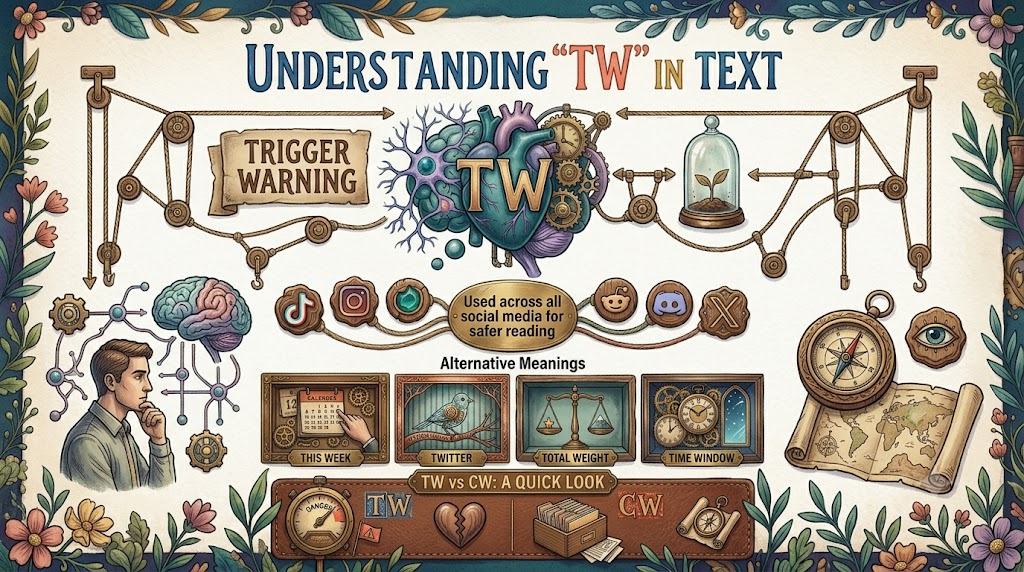
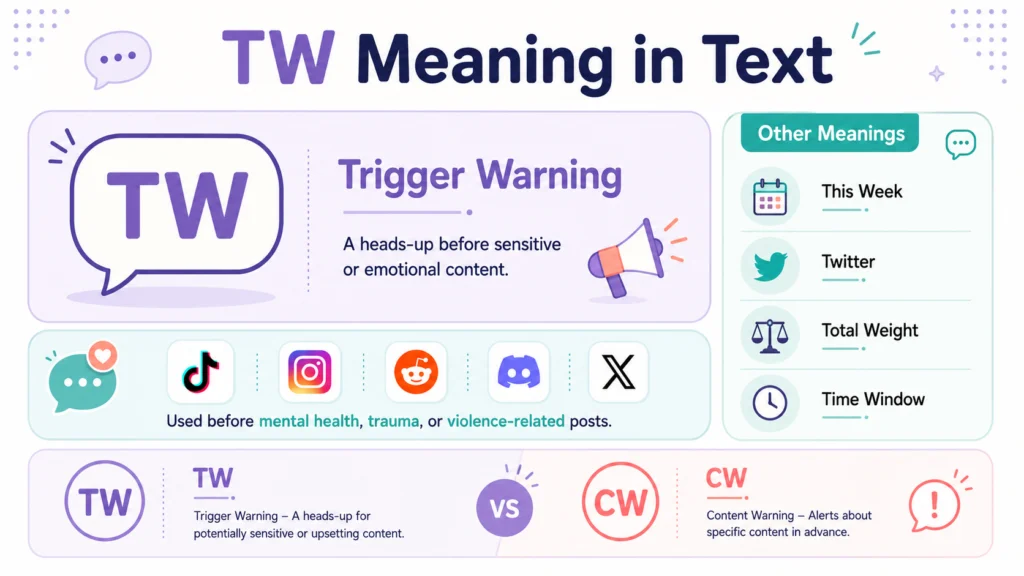
TW most commonly stands for “Trigger Warning” — a short heads-up placed before content (a text, post, or video) that might be emotionally distressing to some readers, such as material about trauma, violence, or mental health. Outside of social media, TW can also mean “This Week” (common in work chats), Twitter, Total Weight, Terawatt, Time Window, or Trans Woman, depending entirely on where you see it.
If you only came here for the one-line answer, that’s it. Everything below covers where it came from, how to use it correctly, what it means on every major platform, and — something almost nothing else online will tell you — what the actual psychological research says about whether trigger warnings work at all.
Quick Meaning Summary
| Most common meaning | Trigger Warning |
| Category | Text/social media abbreviation |
| Tone | Sincere, respectful — not playful slang |
| Where it originated | Feminist/trauma-survivor forums, late 1990s–early 2000s |
| Where it’s most used today | TikTok, Instagram, Reddit, Discord, fanfiction (AO3) |
| Closest relative | CW (Content Warning) |
| Other meanings | This Week, Twitter, Total Weight, Terawatt, Time Window, Trans Woman, Teamwork, Technical Writer |
What Does TW Mean in Text?
In the vast majority of texts, DMs, captions, and posts, TW = Trigger Warning. It’s placed before a piece of content to let the reader decide, in advance, whether they want to engage with what follows.
A typical example:
TW: death — my grandmother passed away last week, and I need to talk about it.
The person reading gets a split second to brace themselves — or to scroll past — before the emotional content lands. That’s the entire function of the abbreviation: informed consent for your attention.
It’s worth being precise about tone here, because it trips a lot of people up. TW isn’t playful shorthand like “brb” or “lol.” It’s not trying to be clever or fast — it’s doing a small piece of social labor, which is why it reads as sincere even when the topic itself is casual (“TW: bad puns ahead”).
Where “TW” Actually Came From
Most articles on this topic vaguely say “it started on Tumblr.” That’s only half the story, and it undersells why the abbreviation exists at all.
From there, the practice spread:
- 2000s — mental health and PTSD-focused forums adopt “trigger warning” as standard etiquette.
- Early 2010s — Tumblr and LiveJournal communities shorten it to “TW” and normalize placing it at the top of posts.
- Mid 2010s — the term crosses over into Reddit (where many trauma and mental-health subreddits make it a posting rule), then Twitter.
- Late 2010s–2020s — TikTok, Instagram, and YouTube creators fold TW into captions and video openers; some university syllabi begin using full “trigger warning” labels for course material, sparking an ongoing academic debate (more on that below).
How to Use TW Correctly
There isn’t an official rulebook, but there is a clear informal etiquette that’s built up over 25 years of actual use:
- Put it first. TW only works if it appears before the sensitive content. A trigger warning at the bottom of a post defeats the purpose.
- Be specific. “TW” alone is weak. “TW: suicide” or “TW: eating disorder mention” is what actually lets someone make an informed choice.
- Don’t overuse it. Slapping TW on everything (a rainy day, a bad haircut) dilutes it for the times it matters. Reserve it for content that’s genuinely likely to be distressing to a meaningful chunk of your audience.
- Mean it. TW added sincerely, because you actually care how your words land, reads very differently from TW tacked on as decoration or, worse, used sarcastically to mock people for being “too sensitive.”
TW Meaning on Social Media (TikTok, Instagram, Snapchat, Facebook, Reddit, Discord, X)
The core meaning (“Trigger Warning”) holds across almost every platform, but how it’s used shifts:
| Platform | Typical Use |
| TikTok | Placed in the caption or as on-screen text at the very start of a video, often before content about mental health, body image, or personal trauma. |
| Usually the first line of a caption, sometimes followed by a colon and the topic (“TW: grief”). | |
| Snapchat | Used more casually in captions or chat before sharing something personal or upsetting with friends. |
| Common in group posts, especially in support groups, before sharing personal struggles or graphic news content. | |
| X (Twitter) | Can mean Trigger Warning or, rarely, be shorthand for “Twitter” itself — context makes it obvious. |
| Often required by subreddit rules in mental-health and trauma-support communities, usually formatted as “TW: [topic]” in the post title.Discord/group | |
| Discord/group chats | More casual — a quick “tw, gonna vent about work” before someone opens up to friends. |
| WhatsApp / texting | Personal and conversational, typically between people who already know each other well. |
| Work Slack / email | Almost never means Trigger Warning — see the meanings table below. |
| YouTube | Verbal or on-screen warning near the start of a video, sometimes with a timestamp for when the sensitive content begins. |
TW in Fanfiction and Fandom
This is a use case almost no other guide covers, but it’s one of the biggest sources of real search traffic for this term.
On Archive of Our Own (AO3), Wattpad, and similar fanfiction platforms, TW is part of standard tagging etiquette. Writers use it to flag content in a work’s tags or author’s notes — things like character death, self-harm, non-con, or graphic violence — so readers can filter what they engage with. AO3 actually has a formal tagging system with “Archive Warnings” built in (things like “Graphic Depictions Of Violence” or “Major Character Death”), and TW is the informal shorthand fandom communities use in notes and comments on top of that system, e.g.:
Author’s Note: TW for canon-typical violence and a panic attack scene in chapter 3.
Every Other Meaning of TW
Context is everything. Here’s the full disambiguation table:
| Meaning | Where You’ll See It | How to Tell |
| Trigger Warning | Social media, texting, fandom, mental-health spaces | Appears before emotionally heavy content |
| This Week | Work Slack, project management, scheduling emails | “Let’s finalize this TW” — no sensitive topic in sight |
| Older posts, casual references to the platform | “Saw it on TW” | |
| Total Weight | Jewelry/diamond listings | Used with carat weight (“2.5 TW diamonds”) |
| Terawatt | Physics, energy, engineering contexts | Paired with numbers and units |
| Time Window | Delivery, logistics, scheduling | “TW: 2–4 pm” |
| Trans Woman | LGBTQ+ community spaces | Used as a personal identifier, not before “content” |
| Teamwork | Workplace, sports, group-project chats | “Great TW today, everyone” |
| Technical Writer | Job postings, professional bios | Appears as a job title abbreviation |
Rule of thumb: if TW appears directly before a topic and a colon (“TW: [subject]”), it’s almost certainly Trigger Warning. If it shows up in a scheduling or professional context with no emotional subject attached, it’s something else entirely.
TW vs. CW vs. NSFW: What’s the Difference?
These three get confused constantly, so here’s a clean breakdown:
| Abbreviation | Full Meaning | Scope |
| TW | Trigger Warning | Narrower — specifically flags content tied to trauma or strong emotional/psychological reactions (self-harm, abuse, PTSD triggers). |
| CW | Content Warning | Broader — covers anything sensitive, including spoilers, flashing lights, or disturbing imagery, not just trauma-related content. |
| NSFW | Not Safe For Work | Different axis entirely — flags content inappropriate for a professional setting (explicit, violent, or graphic material), not necessarily emotionally triggering. |
In practice, people use TW and CW almost interchangeably in casual conversation, but if you want to be precise: CW is the umbrella term, TW is the specific trauma-focused version underneath it.
Ready-to-Use TW Templates
Copy and adapt these for common situations:
- Mental health: “TW: depression — I’ve been struggling lately and want to talk about it.”
- Grief/loss: “TW: death — sharing something hard about losing my [family member].”
- Self-harm/suicide: “TW: self-harm mention — please skip this one if you’re not in a good place today.”
- Violence: “TW: graphic violence — the next part gets intense.”
- Eating disorders: “TW: disordered eating — discussing my recovery journey.”
- Abuse: “TW: abuse — sharing my story to raise awareness.”
- Medical: “TW: medical procedure — includes some graphic detail.”
- Relationships: “TW: toxic relationship — venting about my ex.”
How to Respond When Someone Sends a TW
There’s no single “correct” reply — it depends on whether you’re ready to engage:
- “Thanks for the heads-up.” — Simple acknowledgment.
- “I’m good to hear it, go ahead.” — Signals you’re ready.
- “Can we talk about this later? Not in the right headspace right now.” — A respectful decline.
- “What’s it about, roughly?” — Asking for a bit more context before deciding.
- “Appreciate the TW — I’ll sit this one out.” — Opting out without making it awkward.
The point of TW is that it gives the other person a real choice — so any of the above is a fine response, as long as it respects that choice rather than pressuring them either way.
Do Trigger Warnings Actually Work? What the Research Says
Here’s something almost nothing else ranking for this term will tell you: whether trigger warnings actually do what people assume they do has been studied — and the results are more complicated than the “empathy and awareness” framing you’ll see everywhere else.
A 2024 meta-analysis published in Clinical Psychological Science by researchers Victoria Bridgland, Payton Jones, and Benjamin Bellet pooled the available experimental studies on trigger and content warnings. The findings:
- Warnings had no measurable effect on how distressing people found negative material afterward, and no effect on comprehension or learning outcomes.
- Warnings reliably increased anticipatory anxiety — people felt more anxious in the moments before encountering the flagged content, even though that anxiety didn’t translate into any protective benefit once they got there.
- People were just as likely to view flagged content as unflagged content, even when given the option to skip it — the warning didn’t function as an effective avoidance tool in practice.
None of this means trigger warnings are pointless — plenty of people report finding them courteous, and the social function (signaling that you’re being considerate of your audience) is real regardless of the clinical effect. But it does mean the common claim that TWs “protect” people from psychological harm isn’t well supported by the current evidence, which is exactly why platforms, universities, and psychologists are still actively debating whether — and how —
Common Mistakes and Misconceptions
- Assuming TW always means Trigger Warning. In a work chat about deadlines, it almost certainly means “This Week.”
- Using TW without specifics. “TW” alone tells the reader almost nothing useful — always follow it with the actual topic.
- Putting TW after the content instead of before it. This defeats the entire purpose.
- Confusing TW with CW. They overlap but aren’t identical — see the table above.
- Assuming a TW guarantees emotional safety. As the research above shows, a warning is a courtesy, not a guarantee.
People Also Ask
In most personal texting, TW means “Trigger Warning” — a heads-up before sensitive or emotionally difficult content.
Not exactly. TW (Trigger Warning) specifically flags trauma-related content, while CW (Content Warning) is a broader umbrella that also covers things like spoilers or flashing lights.
No. In professional or scheduling contexts, TW usually means “This Week.” Context — is there a sensitive topic attached? — is the giveaway.
No — it’s generally read as a considerate, respectful gesture, not a rude one, as long as it’s used sincerely rather than mockingly.
They originated in feminist and trauma-survivor online communities in the late 1990s and early 2000s, long before “TW” became the common shorthand on Tumblr and Reddit in the 2010s.
According to a 2024 meta-analysis in Clinical Psychological Science, no — warnings didn’t reduce post-exposure distress or change comprehen
Conclusion
At the end of the day, TW boils down to one simple idea: giving someone a moment’s notice before they encounter something that might hit them hard. In most texts, DMs, and social posts, it means Trigger Warning — a small, sincere signal that says “I care how this lands for you.” But context is everything: in a work chat it’s probably just This Week, and in a handful of other spaces it could mean anything from Total Weight to Trans Woman.
What matters most isn’t memorizing every possible definition — it’s reading the room. Is there a sensitive topic attached? Is it a scheduling conversation? That one question will get you the right answer almost every time.